
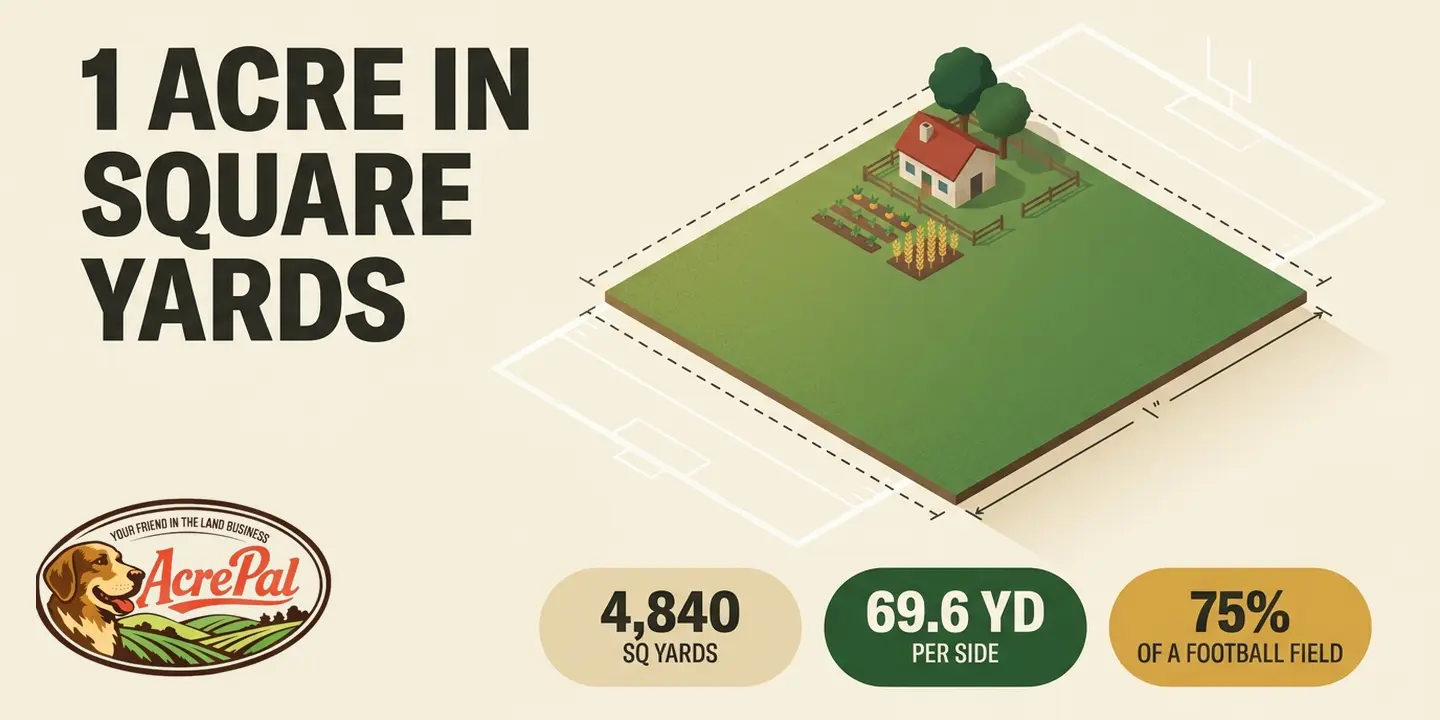
There are exactly 4,840 square yards in one acre. That makes 1 acre in square yards one of the cleaner conversions in land math, with no rounding and no asterisk. The method runs both ways, acres times 4,840 gives you square yards, and square yards divided by 4,840 gives you acres back. A 2-acre lot is 9,680 square yards, and 4,840 square yards split down the middle is exactly half an acre.
Most calculators hand you that number and stop. We would rather show you what 4,840 square yards looks like when you stand on it, and what an acre that size actually costs in 2026.
The 4,840 Formula and Where the Number Comes From
The forward conversion is one multiplication. Take your acreage and multiply by 4,840 to get square yards. A 3-acre parcel works out to 3 times 4,840, which is 14,520 square yards. Whatever your acreage, the factor never changes.
The strange part is why the factor is 4,840 instead of something round. Two derivations explain it, and both land on the same number.
From area units, one acre is 43,560 square feet, and one square yard is 9 square feet (a 3-foot by 3-foot square). Divide 43,560 by 9 and you get exactly 4,840.
From the old chain-and-furlong system, one acre is 1 chain (22 yards) by 1 furlong (220 yards). Multiply 22 by 220 and you get 4,840.

That second derivation is the historical one. The furlong was the length of a furrow an ox team could plow before resting, and the chain, standardized by Edmund Gunter in the 1620s, fixed the width. In the older rod measure, that same plot is 4 rods wide by 40 rods long, since a rod is 5.5 yards. The whole unit was calibrated around what one team could plow in a day, roughly 700 years ago. The US later redefined the acre as exactly 22 yards by 220 yards, which is why 4,840 is a precise integer rather than a rounded estimate.
Square Yards Back to Acres
Going the other direction is just as simple. Divide your square yardage by 4,840 and you have acres. If you are staring at a survey figure, a sod order, or a listing quoted in square yards, that one division settles it.
A couple of worked examples make it concrete. A plot of 12,100 square yards divided by 4,840 comes to 2.5 acres. A 9,680-square-yard parcel divided by 4,840 is exactly 2 acres. The math holds at any scale, since the factor is fixed.
For a single square yard, the acre figure is tiny. One square yard equals 1/4,840 of an acre, which is about 0.000206611 acres, a sliver you would barely notice on the ground. You need all 4,840 of them stacked together to make a full acre.
When you only need a rough sense of size, round the factor to 5,000. Treating one acre as about 5,000 square yards overestimates by roughly 3.3 percent, close enough to eyeball a parcel before you reach for a calculator.
What 4,840 Square Yards Actually Looks Like
Shaped as a tidy square, one acre runs about 69.6 yards on each side (the square root of 4,840 is 69.57 yards, or 208.7 feet). Real parcels are almost never perfect squares, so treat that as a baseline, not a promise. A long, skinny acre feels nothing like a compact square one, and shape ends up mattering as much as area when you actually walk the land.
The football field is the anchor most people reach for, so it pays to get it right. A full American field including both end zones measures 120 yards by 53.33 yards, which is 6,400 square yards, or about 1.32 acres. Run the division, 4,840 over 6,400, and one acre comes to about 75.6 percent of that full field. Measured against just the playing surface between the goal lines, an acre is roughly 90.8 percent.

That surprises people. An acre is smaller than the instinct suggests, three-quarters of a field rather than some sprawling frontier. A buyer eyeing 2.5 acres is looking at about 2.5 football fields, which is suddenly easy to picture.
A few more anchors help if football is not your thing.
About 7 tennis courts side by side
About 9 NBA basketball courts
Roughly one-fifth of a standard 5-acre Chicago city block
Parking lots get mentioned a lot, but the figure is slippery, somewhere between about 130 and 270 spaces depending on whether you count the drive aisles. The cleaner takeaway is that an acre holds plenty of room for a home and a yard.
Why Materials Sell by the Square Yard but Land Sells by the Acre
The reason you are probably converting at all is that a material was quoted to you per square yard. Sod and turf are sold that way, carpet is sold that way, and landscaping, grading, and fencing bids all run through square-yard math first. Carpet clings to the unit for a quirky reason, since it was traditionally made in 12-foot-wide rolls, and 12 feet is exactly 4 yards.
The conversion is the first line of any bid. Here is the price feel in 2026 numbers.
Sod materials run about $2.70 to $7.20 per square yard, or roughly $9 to $18 per square yard installed
Carpet runs about $25 to $75 per square yard fully installed, with premium wool above that
A square acre needs about 836 linear feet of perimeter fencing
Scale those up and the totals get real fast. Sodding an entire acre means 4,840 square yards of grass, so even at the low end the materials alone climb into five figures, and the high end nears $35,000 before labor. A quarter-acre lawn is a more typical job at 1,210 square yards, which is still a serious order once you price it out.
Land never works this way. A 5-acre parcel is 24,200 square yards, an unwieldy number to quote or negotiate, and rural ground pencils out to under a dollar per square yard. So land gets priced and deeded by the acre while materials stay in square yards. Same unit, two completely different scales.
Partial Acre and Multi Acre Conversions
You rarely need exactly one acre. Most buyers and DIYers are sizing a fraction or a multiple, whether that is a quarter-acre lawn quote or a 10-acre parcel on a listing. Here are the figures you can copy straight across, and the method is reproducible, since every one is just the acreage times 4,840.
Partial acres.
1/10 acre equals 484 square yards
1/8 acre equals 605 square yards
1/4 acre equals 1,210 square yards, the common residential-lot benchmark
1/2 acre equals 2,420 square yards
Multiple acres.
5 acres equals 24,200 square yards
40 acres equals 193,600 square yards

The quarter-acre line is worth a second look, since 10,000 square feet sits just under a quarter acre and trips up plenty of lot shoppers. A listing that calls a 10,000-square-foot lot a quarter acre is rounding up, since a true quarter acre is 1,210 square yards, or 10,890 square feet.
One Acre in Square Feet, Meters, and Hectares
Four units, one block. Everything below describes the same single acre.
4,840 square yards
43,560 square feet
About 4,047 square meters (precisely about 4,046.86)
About 0.405 hectares
The one relationship that ties it all together is that 1 square yard equals 9 square feet. That is the exact reason 43,560 divided by 9 lands on 4,840, the same callback from the formula section. So the square-yard figure and the square-foot figure are not two facts to memorize, they are one fact viewed at two scales. The square-feet figure runs the identical math at larger scale, so a 5-acre parcel is simply five times 43,560.
The square-meter and hectare figures matter mostly for metric readers or international listings, but they trace back to the same chain-and-furlong definition.
What One Acre Can and Cannot Hold
An acre does far more than people expect in some ways and far less in others. The honest picture is two lists, not one.
What one acre holds comfortably.
A single-family home with a real yard, since the average new US home lot is under a quarter acre, meaning four average lots fit inside one acre
A serious year-round food garden, because a documented 1/8-acre plot of 605 square yards has fed a family of six all year, and a quarter acre can grow a year of vegetables for four
A flock of 25 laying hens, which need only about 39 square yards of functional coop-and-run space
Fruit trees, beehives, a shed, and a full homestead layout, one documented version fitting 16 raised beds, a goat pen, a coop, 9 fruit trees, and 3 hives

Productivity can run higher than the size implies. One off-grid Vermont farm grosses about $250,000 in food a year on just over an acre of growing space. The constraint is rarely raw room, it is system design.
What an acre cannot do.
Support full-scale livestock or grazing at herd scale
Buffer you from every neighbor with true privacy
Deliver reliable year-round off-grid self-sufficiency
The honest caution is that most people assume they need more land than they do. As one homesteader puts it, you probably need a lot less land than you think.
What One Acre Costs and Why It Is Priced Per Acre
This is the part most buyers actually came for. Nationally, raw rural land runs roughly $3,800 to $4,200 per acre in 2026, but averages hide an enormous spread.
USDA farmland averaged about $4,500 per acre, pastureland about $2,000, and cropland about $6,020
The cheapest Western states fall under $200 per acre
The Northeast can top $15,000 per acre, and waterfront parcels go far higher
Location and parcel size swing the figure hard. Michigan alone ranges from about $9,333 per acre up to $247,000 for prime Lake Michigan frontage, and the same county can drop from roughly $247,000 for small lots to $92,610 for 2-to-5-acre parcels. Price per acre falls as parcels get bigger, which is why small parcels carry a per-acre premium.
The reason land is quoted per acre and never per square yard comes down to scale. At about $4,000 an acre, rural ground is roughly $0.83 per square yard, a tiny and unintuitive figure, and a 5-acre parcel would read as 24,200 square yards. The acre keeps the transaction and the deed in manageable numbers.
AcrePal sells owner-financed rural land by the acre across its active counties, which is one practical route to cheap rural land if buying outright is not in the cards. Whatever route you take, the math underneath it all stays the same, 4,840 square yards to the acre.
Frequently Asked Questions
How many square yards are in 1 acre?
There are exactly 4,840 square yards in one acre. The number is defined, not rounded, coming from 1 chain (22 yards) multiplied by 1 furlong (220 yards). To convert any acreage, multiply by 4,840. A half acre is 2,420 square yards, a quarter acre is 1,210, and 2 acres is 9,680. The factor is the same no matter the state or county.
How many acres is 1 square yard?
One square yard equals 1/4,840 of an acre, which works out to about 0.000206611 acres. That is a very small slice, so you need 4,840 square yards laid together to make a single acre. To convert any square-yard figure to acres, divide it by 4,840. For example, 9,680 square yards divided by 4,840 is 2 acres.
Is an acre exactly 4,840 square yards or 4,840.0073?
It is exactly 4,840 square yards under the international and modern definition. The 4,840.0073 figure only shows up when you mix the US Survey foot with the international foot, two definitions that differ by a hair. That difference never matters in practice, so 4,840 is the number to use.
How many square yards is half an acre?
Half an acre is 2,420 square yards, which is simply 4,840 divided by 2. A quarter acre is half of that again, at 1,210 square yards, and a tenth of an acre is 484. For any fraction of an acre, multiply the fraction by 4,840 to get the square yards. The quarter acre is the figure most residential lots are measured against.
What is the difference between a square yard and a square foot?
One square yard equals 9 square feet, because one yard is 3 feet and 3 squared is 9. To go from square feet to square yards, divide by 9, and to reverse it, multiply by 9. That relationship is why one acre is both 43,560 square feet and 4,840 square yards.
Can a full football field fit on 1 acre?
No. A full American field including both end zones is 6,400 square yards, or about 1.32 acres, so one acre covers only about 75.6 percent of it. Even the playing field alone between the goal lines is 5,333 square yards, still larger than a single acre. An acre is smaller than most people picture, closer to three-quarters of a field than a full one.
Why is land sold per acre instead of per square yard?
Acres compress large areas into manageable numbers. Even a modest 5-acre parcel is 24,200 square yards, an awkward figure to quote or deed. Per-square-yard prices for rural land are also tiny, around $0.83 per square yard, which is unintuitive for buyers. The acre keeps negotiations and paperwork clean.