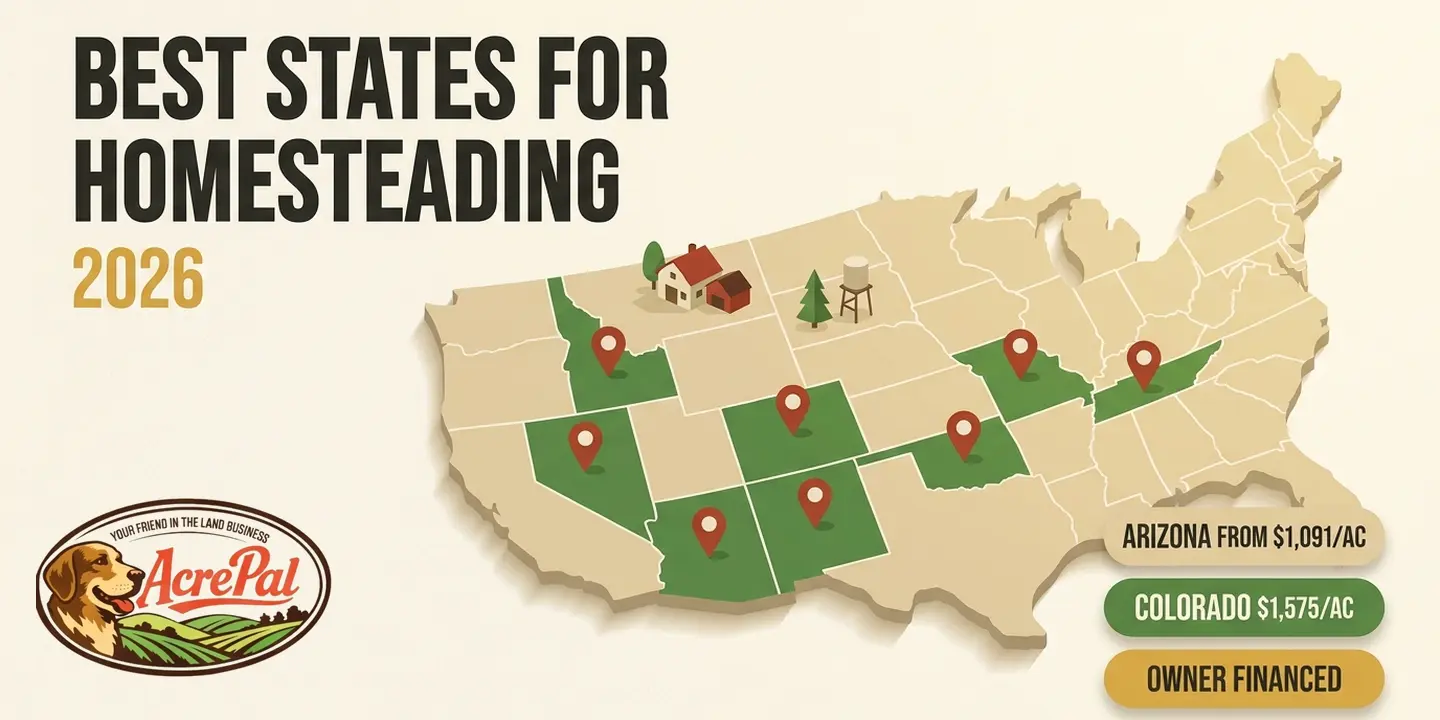
Every homesteading list picks a side. You either get the deep-rainfall eastern states with no real prices attached, or a cheap-Western-land roundup that never tells you whether you can grow a single tomato on the dirt. This ranking of the best states for homesteading covers both camps honestly, scored on the five things that actually decide a homestead, real productive-acre price, water, growing season, off-grid legality, and carrying cost. These are the markets we work in every day, so the Western prices below are what buyers really pay, not blended USDA farm averages that fold in cropland and barns. You get real 2026 per-acre numbers, the honest catch on every state, and how owner financing gets you onto raw land for a few hundred dollars down. Eight states, ranked as a straight all-around-viability gradient, not an East-versus-West popularity contest. The water-rich picks lead because they are the safest bet, and the ultra-cheap arid West sits lower because water and growing season honestly put it there for anyone trying to grow food.
1. What Actually Matters When You Pick a Homestead State
A low price per acre means nothing until you subtract what it costs to make land livable, since a $3,000 desert parcel can need $30,000 in well, septic, power, and access before you can sleep on it. Weigh every candidate against these five filters.
Water is the whole game. The humid East hits water at 50 to 150 feet so a well runs $3,000 to $9,750, while the arid West needs 200 to 400 feet and $10,000 to $26,000, and prior-appropriation states cap rainwater, with Colorado allowing only 110 gallons against Texas with no limit at all.
Judge the real productive-acre price, not the USDA farm average, which blends in cropland, fences, and buildings you will never buy.
County beats state. Zoning, RV rules, and composting-toilet permits are set locally and override the state's reputation.
Off-grid living is legal in all 50 states, so the real question is whether your county lets you live in an RV or a tiny home while you build.
Carrying cost and tax close the math. No-income-tax states like Tennessee, Texas, Nevada, and Florida free up 3 to 9 percent of your income for land payments, and ag or greenbelt programs tax land on farm-use value, though a rollback tax claws back years of savings if you drop that use.
The movement's sweet spot is 10 to 20 acres, enough for a house, a garden, animals, and a buffer. Prioritize water and a long growing season and you lean East. Prioritize entry cost and off-grid freedom and you lean West.
2. Tennessee, the Strongest All-Around Pick
If you want reliable rainfall, a long growing season, and no state income tax without babysitting a well, start with Tennessee. It is the lowest-learning-curve homestead state in the country, which is exactly why it keeps topping migration lists.
Farmland averages $5,895 per acre, mid-range and honestly priced, and property taxes on a small rural parcel typically run $400 to $900 a year. Lower elevations get roughly 270 frost-free days, close to nine growing months, with rainfall steady enough that you never have to build irrigation just to keep a garden alive. Tennessee also runs the Greenbelt program, which taxes agricultural and forest land on its farm-use value instead of market value, a real cut to your carrying cost. The one string attached is the rollback tax. Drop the ag use or sell for development and the county claws back three years of the difference, five years on open-space land.
The honest cons are real and worth naming.
Land prices are climbing through 2026 on steady migration pressure.
It is far more humid than the arid West, so mold, insects, and summer stickiness come standard.
The Greenbelt rollback bites if you ever stop farming the land.
It is simply not as cheap as raw Western desert or Appalachian hill land.
Tennessee is the lowest-regret homestead state in America, and you pay a fair premium for that peace of mind.
3. Missouri, Cheap Land With Real Water
Cheap land that actually comes with water is rare, and water is the one thing the arid West cannot sell you at any price. Missouri gives you both, a low entry cost and a genuine growing climate in the same parcel.
Raw Ozarks land commonly ranges from roughly $1,500 to $4,000 per acre depending on access and water, well below Tennessee, and property taxes sit below the national average. Treat that as a market band, not a quoted median, since prices swing hard with road frontage and creek access. The Ozarks come with springs, creeks, and reliable rain, so wells are shallow and cheap compared with anything out West, and the central-US location gives you four real seasons and a workable growing window. Missouri also carries the number two legal off-grid score in the country, behind only Alabama, which is a real differentiator for anyone planning an RV build or a composting-toilet setup. Independent 2026 value lists keep flagging the Missouri Ozarks, and farmland writer Alexandra Fasulo warns that private equity and solar developers are buying this exact tier of land now.
The honest cons are straightforward.
Tornadoes and severe weather are a genuine seasonal risk.
It is less scenic than the West or Appalachia, with no mountains or coastline.
You trade dramatic views for practicality.
Best for the buyer who wants water security and a low price in one package. Skip it if you want big scenery or a mild winter.
4. Oklahoma, Affordable Acreage and Farm Culture
For livestock and row-crop buyers who want cheap acreage inside a real farm culture, Oklahoma earns its spot. This is ranching country with the community and infrastructure to match.
Eastern Oklahoma raw land commonly runs in the low thousands per acre with reasonable rainfall, while the western half is cheaper but slides toward semi-arid, so location inside the state matters more than any statewide average. Read it as a market band and shop the wetter eastern counties on purpose. The pull here is cultural as much as financial. Consider the Army veteran posting as @originaljakeb in June 2026, who saved every dollar from his service, bought 7 acres, and is now closing on 80 acres near his in-laws to grow a grass-fed cattle herd with his father-in-law. He plans to live in a camper while they build a modest house. That is the honest, messy shape of a real homestead scale-up, and Oklahoma is built for it.
The cons are worth respecting.
It sits in tornado alley with real severe-weather exposure.
The western half is increasingly arid.
Oklahoma does levy a state income tax, though a moderate one.
It is not as off-grid-legal-friendly as Tennessee or Missouri.
If your plan is livestock and community over views, buy in Oklahoma, and stay in the wetter eastern counties where the rain actually supports pasture.
5. Idaho, No Building Codes and Room to Build
Idaho rewards the build-it-yourself homesteader who wants four real seasons and almost no red tape. The surprising part is that many sparsely populated Idaho counties have no building codes at all, so you answer to yourself on the framing crew.
Remote rural raw land runs $1,500 to $5,000 per acre once you get well away from Boise and the resort towns. Rainfall beats the arid Southwest, the four true seasons make good livestock country, and a flat, low income tax keeps carrying costs down. Snowy northern winters do shorten the growing season, so plan your crops around a compressed window. What it really costs to build from scratch is not a mystery either. Jeannette Belliveau sold her Baltimore home at 68 and built two arched 20-by-24 cabins on 16 code-free Idaho acres using YouTube tutorials and local help, each cabin about $125,000, after proving the method on an $11,000 prototype workshop first. No prior construction experience, and it worked.
The cons keep it honest.
Prices near Boise, Sun Valley, and Coeur d'Alene have skyrocketed, so you must go genuinely remote.
Snowy winters cut the growing season short.
Wildfire risk is rising across the region.
Prior-appropriation water rights still apply, so surface water is not automatically yours.
Idaho rewards the buyer willing to go remote and swing a hammer, and it punishes anyone who wants Boise-adjacent convenience on a homestead budget.
6. Colorado, Cheap High-Desert Acreage for Off-Grid Buyers
What if the cheapest mountain-valley land in the West is also the hardest to grow food on? Colorado's San Luis Valley hands you off-grid freedom at a rock-bottom price, as long as you stay honest with yourself about water and the season.
Costilla County raw land carries a $1,575 per-acre median (average listing around $3,659), owner-financed 5-acre off-grid lots run $159 to $295 a month with no credit check, and the property tax rate is an ultra-low 0.31 percent. You also get a thriving off-grid community, lax zoning, extreme privacy at three people per square mile, and excellent solar under near-constant clear skies.
Then the catches, and this is where the valley earns or loses your trust.
The growing season is only 85 to 100 frost-free days, so long-season crops are out and food supplementation is required.
Precipitation runs under 8 inches a year.
Colorado's 110-gallon rainwater cap (two 55-gallon barrels) is the most restrictive rule in the continental US, a product of prior-appropriation water law.
You need 35-plus acres to legally drill a well in parts of the valley, so many 5-acre lots rely on hauled water to a 2,000-gallon cistern.
Altitude runs 7,664 to 10,300 feet, which is hard on gardens, livestock, and brand-new residents.
Wind, UV, and temperature extremes are constant.
Real valley builds run a full stack of cistern, propane, solar, and septic to make a parcel livable, so budget for infrastructure, not just land. Best for shelter-and-freedom off-grid buyers who will haul water and supplement food. Skip it if your goal is feeding your family from the garden.
7. Arizona, the Cheapest Raw Land in the Southwest
Nowhere in the Southwest gets you in cheaper than Arizona, and strong solar and warm winters come with it. The surprising part is just how cheap the cheap counties get. Apache County averages $1,091 per acre, one of the most affordable raw-land counties in the continental US.
Real June 2026 entry listings back that up, with 1 acre at $3,295 and 2.5 acres at $5,960, both owner-financed with no credit check. Mohave County offers better infrastructure but costs more, with undeveloped parcels at $3,000 to $10,000 per acre and an $11,151 overall average, so name the cheap corridors honestly instead of trusting a countywide number. Statewide you get 300-plus sunny days, most counties permit composting toilets, solar, and water tanks, and warm winters cut your heating bill to near nothing. Big parcels also stretch your dollar further, since buying more acreage at once usually drops the per-acre price, the usual reward for going bigger.
The desert catch is real.
Summer heat tops 110 degrees in the lower elevations.
Water scarcity is even more severe than Colorado across southern Arizona.
Wells run deep and expensive through hard caliche and rock.
Apache County is extremely remote with little infrastructure.
Prior-appropriation law limits your surface-water rights.
Buy in Apache County for the absolute cheapest entry, or Mohave near Kingman if you want more infrastructure and can pay the premium. Either way, verify well depth and legal access before you sign anything.
8. New Mexico, Rock-Bottom Prices and 300 Sunny Days
New Mexico has the absolute lowest per-acre price on this list and some of the best solar in the country, if you do your due diligence. This is where the listing price and the real cost sit furthest apart, so the state punishes anyone who buys on a daydream.
The prices are almost hard to believe. Catron County desert grass ranches run $300 to $800 per acre, among the cheapest in the US, Socorro County posts a $2,059 median (average $4,837), and typical 1 to 5 acre raw parcels land at $2,000 to $8,000. Add 300-plus sunny days statewide, high-desert air that stays clean and dry, no zoning in many rural counties, and an established off-grid community, and the appeal is obvious. The problem shows up in the details. When AskPawPaw ran a 2026 land challenge on a $2,500 parcel advertised as no restrictions, RV allowed, and tiny homes welcome, the real test was a three-part gut check. Is it legally usable, is it physically buildable, and what does it truly cost to make livable.
The honest cons follow from that.
Cheap land is almost always raw, with no power, water, or road on the parcel.
Prior-appropriation water scarcity is the norm.
You are very remote from services.
The word unrestricted in a listing does not guarantee the land is legally buildable.
New Mexico has the cheapest land on this list and the widest gap between the listing and the reality, so buy with a checklist, not a fantasy.
9. Nevada, No Income Tax and Wide-Open Elko County
For maximum privacy and zero state income tax on cheap high-desert acreage, Nevada is hard to beat. If your goal is space and solitude with a low tax bill, Elko County delivers it fast.
Elko County raw land carries a $1,187 per-acre median (average cost around $1,541), with 106 off-grid listings on the market by mid-2026. Total inventory runs to 453 listings on LandWatch, so selection stays deep even this far out from services. Nevada charges no state income tax, the Elko property tax rate is a low 0.51 percent, and most counties permit RVs, solar, and water tanks without special permits. Owner financing is widely available, so the entry stays cheap in both price and paperwork. This is genuine wide-open country where you can see for miles and rarely see a neighbor.
The tradeoffs are steep.
Remoteness is extreme, with services miles away.
The Great Basin climate means cold winters and hot, dry summers.
The growing season is short at elevation.
Nevada is the driest state in the country, so prior-appropriation water scarcity is severe.
Community infrastructure is even thinner than Costilla County Colorado.
Best for the solitude-seeking, tax-conscious buyer who values space and privacy over convenience. Skip it if you need neighbors, nearby services, or a real growing season.
10. The Low-Entry Path Nobody Ranks, Owner Financing and Land Contracts
You do not need a bank or a big down payment to start. Banks will not finance raw land under $50,000, so on cheap parcels the seller carries the note directly and hands you the keys for a few hundred dollars.
Real 2026 monthly numbers make it concrete.
Arizona 5-acre parcel at $299 down and $89 a month.
New Mexico 10-acre tract at $500 down and $149 a month.
Texas 2-acre parcel at $0 to $200 down and $99 to $150 a month.
Typical terms run about 5 percent down ($500 to $5,000), 8 to 15 percent interest, 15 to 30 year terms, and no credit check. One point trips buyers up. USDA Single Family Housing Direct loans sit at 5.125 percent as of June 2026 with a $119,850 income limit, but they cannot buy raw land alone because they require a home on the property, which is exactly why owner financing exists for raw-land buyers.
Two cautions before you sign.
Owner-finance rates of 8 to 15 percent run well above a bank mortgage, so you pay for the easy approval.
Most deals are a contract for deed, where the seller holds legal title until payoff, and a default can cost you the land and every payment you made.
This is where we fit in. AcrePal sells owner-financed rural parcels in several of these exact markets, including Apache and Mohave in Arizona, Costilla in Colorado, Elko in Nevada, Modoc in California, and Putnam in Florida, one straightforward route into the cheapest markets for land. Whatever you buy and from whoever, convert a monthly pitch back into the total price, the interest rate, and the deed type before you sign.
Frequently Asked Questions About Homesteading States
What is the best state for homesteading on a budget?
For the lowest raw-land entry, Apache County Arizona or Catron County New Mexico run under about $1,100 per acre. For the best all-around budget value that pairs cheap land with real water, look at the Missouri Ozarks or eastern Oklahoma. Tennessee wins if you want no income tax plus a long growing season. Arid-West land is cheapest, but water infrastructure eats some of that savings.
Is it legal to live off-grid in the US?
Yes, off-grid living is legal in all 50 states, and no state mandates a utility hookup. The catch is local. County zoning controls septic rules, building permits, and whether you can live full-time in an RV. The most permissive states are Alabama, which holds the top legal score, followed by Missouri and Tennessee. Always check the specific county zoning over the state's reputation.
Is Colorado good for homesteading?
Yes for cheap off-grid shelter in Costilla County, with a $1,575 per-acre median, a 0.31 percent tax rate, lax zoning, and an existing community. The tradeoffs are severe though. You get only 85 to 100 frost-free days, under 8 inches of rain a year, altitude up to 10,300 feet, and Colorado's 110-gallon rainwater cap. It suits shelter-focused off-grid buyers far more than food-production homesteaders.
Can you get a USDA loan for raw land to start a homestead?
No. USDA guaranteed and direct loans both require a home on the land and cannot buy raw vacant acreage on its own. The USDA Single Family Housing Direct rate is 5.125 percent as of June 2026, with a household income limit of $119,850. For raw land with no house yet, owner financing is the accessible path, since sellers carry the note directly with no credit check.
What is the difference between a homestead exemption and homesteading?
They are completely different things. A homestead exemption is a legal tax-and-creditor protection on your primary residence, available to most homeowners in most states. Homesteading is a self-sufficiency lifestyle built on food production, livestock, and off-grid systems. A state can offer a generous homestead exemption and still be hostile to off-grid living, so one never implies the other.
Which states have the cheapest raw land for homesteading?
By 2026 county data, the cheapest are Catron County New Mexico ($300 to $800 per acre), Apache County Arizona ($1,091 per acre), Elko County Nevada ($1,187 per acre), and Costilla County Colorado ($1,575 per acre). In the East, rural West Virginia and parts of Oklahoma come in under about $2,000 per acre. Always weigh the sticker price against water and infrastructure cost before you buy.