
We pulled the raw HTML of seven pages that rank for this topic and counted. Zero annual rainfall figures, zero gallons per year figures, zero runoff coefficients, no climate normals anywhere. Every one of them explains how to build a machine that turns rainfall into gallons, and not one says how much rainfall you have.
That gap matters, because a catchment water system is not a yes or no decision about a technology. It is an arithmetic decision about a location, and the answer flips county to county.
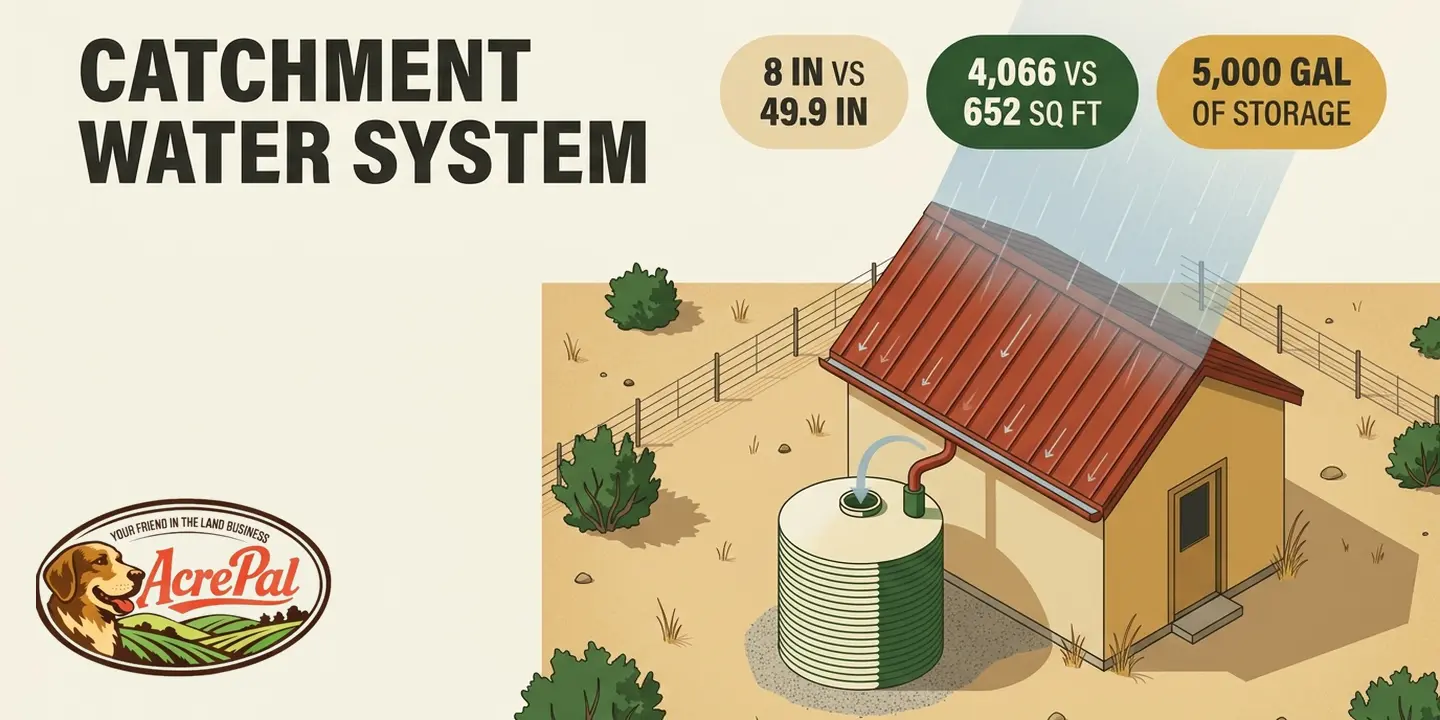
To cover 50 gallons a day year round you need 4,066 square feet of roof in Mohave County, Arizona, and 652 square feet in Putnam County, Florida. Same household, same equipment, same equation, same coefficient, roughly six to one. In Putnam that is a small cabin. In Mohave it is a commercial building.
What follows is six counties, a named NOAA station in each, the 1991-2020 normals, and every number shown with the arithmetic that produced it. By the end you can run your own parcel rather than carry around a general opinion about rainwater harvesting.
What a Catchment Water System Is, and Where the Word Catchment Gets Confusing
A catchment water system is six parts in a line. A roof to intercept the rain, gutters and downspouts to move it, a first flush diverter to throw away the dirtiest water of each storm, storage to hold it, a pump and pressure control to deliver it, and treatment sized to whether anyone is drinking it.
The roof sets your ceiling and you cannot buy your way past it. Everything downstream of it is a choice about how much of that ceiling you keep.
The most useful operating detail on page one comes from Kona Real Estate Professor, the only page written by somebody who has actually lived on catchment. It describes tanks running "up to 60,000 gallons", a pressure system cycling "between 40 & 60 psi", a 12 volt pump off solar batteries where there is no grid power, and shade cloth over the cover to keep bugs out. A pump needs a power source, so on a raw parcel you are solving two problems at once.
Plenty of people searching for a water catchment area do not mean a roof, they mean a watershed. USGS defines that as "an area of land that drains all the streams and rainfall to a common outlet such as the outflow of a reservoir, mouth of a bay, or any point along a stream channel", and says outright that "The word 'watershed' is sometimes used interchangeably with drainage basin or catchment."
The two senses are closer than they look. USGS runs this same equation at watershed scale and publishes 17,378,560 gallons falling on one square mile per inch of rain, while our own conversion factor gives 17,378,743, agreeing to within a rounding difference of about 0.001 percent.
If you came for the landscape sense, you have the definition and the source. If you came because your unimproved parcel has no water at the road, the rest of this is about the roof.
The Equation That Turns Rainfall Into Gallons
University of Arizona Cooperative Extension publication AZ1344 prints the whole thing in one line.
SUPPLY (in Gallons ) = RAINFALL (inches) x 0.623 x CATCHMENT AREA ( FT2 ) x RUNOFF COEFFICIENT
The 0.623 is not a value you have to trust. One square foot is 144 square inches, so an inch of rain on it is 144 cubic inches, and a gallon is 231 cubic inches by statute. 144 divided by 231 is 0.623377, exact geometry you can rebuild on your phone. Published roundings vary without disagreeing, CTAHR using 0.625 and Today's Homeowner 0.62.
One mistake is using your roof's pitched surface instead of its footprint, and CTAHR states the fix plainly.
So it is not the area of roof surface that you need to measure, but the roof's "footprint," the area of ground under it. To get the effective square footage of your roof for catchment purposes, measure the sides of your house from eave to eave.
AZ1344 independently says to measure "the area that is covered by the roof". Rain falls vertically, so a steeper roof over the same footprint intercepts no extra water.
The other is paying for roof material you think collects more. AZ1344's runoff coefficient table lists the roof row as one band.
ROOF Metal, gravel, asphalt, shingle, fiber glass, mineral paper 0.95 0.90
Metal, asphalt shingle and fiberglass all sit in that band, so the claim that metal collects far more than shingle is not supported there. What moves the coefficient is whether the surface is a roof at all, since the same table drops to 0.05 for a flat sandy lawn. Every figure in this article uses 0.90, the low end of the band, which is an assumption rather than a measurement of your roof, and first flush diversion takes more off the top of it.
A 1,500 square foot footprint in Kingman, Mohave County, at 8.00 inches a year and 0.90 is 8.00 x 0.623 x 1,500 x 0.90, or 6,732 gallons a year, which is 18.4 gallons a day.
| Measure | Value |
|---|---|
| Averaged over the year | 18.4 gallons a day |
| Days of supply at your daily use | 135 days |
| Roof needed to cover all 365 days | 4,066 sq ft |
| First flush to divert per rain, at the agreed floor | 15 gallons |
Page one's only version of it is Today's Homeowner's line that "every 1,000 square feet of roof can collect about 620 gallons of water per inch of rain". Their 620 is consistent with our derived 623.4 at full capture, so the number is fine. It just never meets a rainfall figure.
The Same Roof in Six Counties, and Six Different Answers
Same roof, same equation, six counties, and the answers are not close. Every row uses a 1,500 square foot footprint, a runoff coefficient of 0.90, the 0.623 conversion, and the NOAA 1991-2020 normals for the named station.
| County | Station | Annual precip | Gallons a year | Gallons a day |
|---|---|---|---|---|
| Mohave AZ | Kingman | 8.00 in | 6,732 | 18.4 |
| Apache AZ | St. Johns | 9.36 in | 7,877 | 21.6 |
| Costilla CO | San Luis | 9.00 in | 7,574 | 20.8 |
| Elko NV | Elko | 9.99 in | 8,407 | 23.0 |
| Modoc CA | Alturas | 11.74 in | 9,880 | 27.1 |
| Putnam FL | Crescent City | 49.90 in | 41,994 | 115.1 |
Turn it around. What roof covers 365 days at 50 gallons a day, or 18,250 gallons a year? In Crescent City, 652 square feet does it, and in Mohave County you need 4,066 square feet.
For a grid connected benchmark, EPA WaterSense reports that "The average American family uses more than 300 gallons of water per day at home." At that rate the same roof covers 22 days a year in Mohave County and 140 days in Putnam County. Neither is a year, which corrects in both directions. The 30 and 50 gallon a day figures used here are illustrative off grid conservation scenarios, not EPA figures.
The six records are not equally strong. Only Elko carries NCEI's Standard flag, "meets WMO standards for data availability for 24 or more years", and Elko's runs 29. The other five carry the Representative flag, "meets WMO standards for data availability for 10 or more years", and San Luis in Costilla County rests on that 10 year minimum.
A county is also not one number. Apache County has two stations with 1991-2020 normals and they disagree, St. Johns at about 5,790 feet reading 9.36 inches and Springerville at about 6,998 feet reading 11.36.
That 1,208 foot difference moves annual precipitation by 21.4 percent, or 7,877 gallons against 9,560 on the same roof, a spread of 1,683 gallons a year from elevation alone. That is why rainfall is an input to the calculator above rather than a constant baked into it, and why every rainwater harvesting by state table is useless at parcel scale.
Putnam County supports a catchment only household several times over. The five arid counties support a supplement rather than a sole supply, and the annual number still flatters them.
The Annual Average Will Not Size Your Tank
Hawaii's CTAHR program has run a dedicated rainwater catchment program for decades, in the one state where catchment is a normal way to plumb a house. Its 2020 guidelines put the warning in six words. "Plan for the worst case, not for the average." The annual column you just read is the average it warns about.
Storage is a dry season problem, so run the same roof against the driest four consecutive months at each station, with a household drawing 50 gallons a day.
| Station | Driest 4 months | Inches | Collected | Used | Deficit |
|---|---|---|---|---|---|
| Kingman | Mar to Jun | 1.24 | 1,044 | 6,100 | 5,056 |
| St. Johns | Mar to Jun | 1.13 | 951 | 6,100 | 5,149 |
| San Luis | Dec to Mar | 1.64 | 1,380 | 6,050 | 4,670 |
| Elko | Jun to Sep | 1.85 | 1,557 | 6,100 | 4,543 |
| Alturas | Jun to Sep | 1.61 | 1,355 | 6,100 | 4,745 |
| Crescent City | Nov to Feb | 9.78 | 8,230 | 6,000 | 2,230 surplus |
Every arid county needs roughly 4,543 to 5,149 gallons of working storage to cross a normal dry season. Crescent City has no deficit to cover, because even across its driest four months that roof out collects the household by 2,230 gallons.
The five arid counties do not share a dry season either. Kingman and St. Johns run dry March through June ahead of the monsoon, San Luis December through March, and Elko and Alturas June through September, when household and garden demand peaks. Generic seasonal advice cannot be right for all five.
How the rain arrives matters as much as how much falls. Elko averages 0.1 days a year at or above one inch against Crescent City's 16.5, and still logs 31.5 days at or above a tenth of an inch, so the rain is not absent, it is small.
On our 1,500 square foot example an inch delivers about 842 gallons in one storm and a tenth about 84, and a 15 gallon first flush diverter eats nearly a fifth of that small event every time. No single storm fills a tank in Elko.
These are normals, and a normal year is not a worst year, so a tank sized to a normal dry season leaves nothing for a dry one. In the five arid counties, the storage number is what you take to a supplier.
Is It Legal Where You Are Buying
Across those seven pages, counted whole including navigation and footers, there are zero statute citations and zero section symbols. Every one that raises legality resolves it with a version of check your local regulations.
InterNACHI ranks page one for this term and gets it wrong, stating that "In many areas, such as the state of Colorado, it is illegal to collect rainwater, as it is considered a public resource belonging to the public water supply." Colorado has had a permitted rooftop pathway since 2009 and an unpermitted two barrel pathway since 2016, as our post on living off the grid in Colorado covers.
The National Association of Landscape Professionals handled the same uncertainty correctly, writing that "It is important to note that many states restrict water collection and several have legislated that runoff from rain belongs to the state" and pointing readers at their own state and at NCSL. The problem is naming a state without checking it, not the publisher.
NRS 533.025 sets Nevada's baseline, that "The water of all sources of water supply within the boundaries of the State whether above or beneath the surface of the ground, belongs to the public." NRS 533.027 then exempts "The de minimus collection of precipitation: (1) From the rooftop of a single-family dwelling for nonpotable domestic use", using the statute's own spelling of de minimus.
Nonpotable does all the work there. It takes its definition of domestic use from NRS 534.013, which "extends to culinary and household purposes", so Nevada put nonpotable in front of a definition that already covered cooking and drinking. The exemption reaches nonpotable use only, so take a potable plan to the State Engineer.
Two Nevada details get repeated wrong everywhere. The 40,000 gallon and 1 acre limits belong to a subparagraph about wildlife guzzlers, not to a house, so the residential rooftop exemption carries no gallon cap, no capture area cap and no pipe length cap. And the statute says precipitation rather than rainwater, which is why searching Nevada's code for rainwater comes back empty.
Set three verified provisions side by side and the conventional wisdom inverts. California, the state buyers assume is most restrictive, has the cleanest rule, one sentence of Water Code 10574 saying "Use of rainwater collected from rooftops does not require a water right permit pursuant to Section 1201." The same act preserves the California Building Standards Commission's authority, so the accurate version is no water right permit, building code still applies.
Arizona has no state cap at all, because its only rainwater statute is a homeowners association protection, HB 2778 of 2010, telling associations they "SHALL NOT PROHIBIT THE INSTALLATION OR USE OF RAINWATER HARVESTING SYSTEMS". That is a limit on associations, not permission granted against the state.
Florida gave an honest negative. We read all 185,196 words of Chapter 373, the Water Resources chapter, and cistern, rainwater and rain water appear zero times in it. That chapter does not address rooftop collection, which is not the same as Florida having no rules, since the building code, health department rules and county ordinances were not part of that check.
Ask Putnam County and the St. Johns River Water Management District, and see our post on water rights for how rainwater sits against prior appropriation.
None of this usually kills a residential rooftop system in these six counties. The potability question is where the real limits sit.
Drinking It Versus Using It, and the Treatment Train Each One Needs
The pages that cover catchment properly all treat it as a drinking water solution. Not one says who is responsible for confirming that it is one.
Hawaii's Department of Health, Safe Drinking Water Branch, writes that "Rainwater catchment systems on individual homes are not regulated by the Department of Health (DOH). Home owners that intend to use rainwater collected off their home's roof can take action to help make the water safe for domestic use." In the one state where catchment is mainstream, the agency with Safe Drinking Water in its name hands the job to the owner. Pair that with Nevada, where the exemption does not reach potable use, and nobody is coming to certify your water.
The first decision is not which filter to buy, it is which household you are. One uses the water for bathing, laundry, flushing, livestock and irrigation and buys drinking water separately. The other takes on a more expensive machine and a standing duty to test that nobody else will perform. We do not recommend brands here.
First flush sizing is the number this section can fully deliver. Across those seven competitor pages the term appears nine times, every one of them on The Land Geek's page, and none of the nine says how much to divert. Three extension services do.
| Source | Guidance | Per 1,000 sq ft |
|---|---|---|
| Texas A&M AgriLife | 1 to 2 gallons per 100 sq ft | 10 to 20 gallons |
| University of Arizona AZ1344 | at least 10 gallons per 1,000 sq ft | 10 or more |
| Hawaii CTAHR 2020 | 10 to 49 gallons per 1,000 sq ft | 10 to 49 gallons |
All three agree on a floor of 10 gallons per 1,000 square feet and split at the ceiling. CTAHR explains why, that "Generally, the dirtier the environment (urban, dusty, industrial), the more water you should divert."
Texas A&M is equally candid that "The size of the diverter chamber is a topic of debate and varies depending on surrounding trees and your area's rainfall intensity", and notes the sacrificial first flush "has been found to contain the most amount of debris from the roof surface." On the 1,500 square foot example that is 15 gallons at the floor and about 74 at the ceiling, every time it rains.
Past first flush, the stages do different jobs. Sediment removes what the diverter missed, carbon addresses taste and odor, and disinfection handles organisms, which is where anything drinkable has to end. We are not printing micron ratings or certification numbers, because we could not verify them against a primary source, and this article is not going to do the thing it just criticized.
If drinking and cooking water is coming from town anyway, skip the potable train and put the money into storage.
What the Hardware Actually Costs, and What Drives the Number
One variable decides which end of every published price range you land on, gallons of storage.
The Land Geek's page is the longest treatment of cistern hardware on this topic at 4,249 words, genuinely covering materials, above versus below ground, install sequence, maintenance intervals, filtration and troubleshooting. Its cost figures are "$1,000 to $3,000" for small above ground systems and "$5,000 to $15,000" for larger underground ones, with no source, date, region or component breakdown. A fifteen times spread with no inputs tells you nothing about your parcel. Its sizing advice has the same shape, that "Areas with low rainfall may not collect enough water to justify a cistern", with no threshold attached.
Price the requirement instead. A 2,500 gallon Bushman PM2500 poly tank lists at $2,249.95 from a rainwater supply retailer, or $0.90 per gallon of storage. The dry season arithmetic put an arid county household at 4,543 to 5,149 gallons, so two tanks is 5,000 gallons for $4,499.90 in polyethylene alone and three is 7,500 for $6,749.85.
One tank price is not a system price. It excludes freight, which the vendor will not quote online for a 360 pound tank going to a rural parcel, plus the pad, gutters and downspouts, the diverter, the pump and pressure tank, treatment, and labor.
The rest scales off what you can already estimate. Gutters and downspouts follow the perimeter of the footprint you measured, and the diverter is sized at the 10 gallons per 1,000 square foot floor, so 15 gallons here. Pump and pressure control is the Kona setup described earlier, so budget power too, and treatment cost is set by the potable decision rather than tank size.
Three variables move the total more than anything on a spec sheet, total gallons of storage, above ground versus buried, and freight on a tank that is mostly air. Price the tank delivered to the parcel, because it varies most by location and no national article can know it for you. If you are weighing this against a line to the road, our breakdown of utility hookup costs is the comparison.
When a Cistern Plus Hauled Water Beats Catchment
Every page on this topic is written to sell you on catchment, and none runs the comparison and concludes against it for a place. In an arid county the arithmetic makes that conclusion unavoidable.
Take the yield table against 18,250 gallons a year at 50 gallons a day. Mohave County's 6,732 gallons is about 37 percent of the year, since 6,732 divided by 18,250 is 0.369. Elko's 8,407 is about 46 percent and Modoc's 9,880 about 54. In every arid county something other than the roof fills the tank for half the year or more, so catchment buys down a delivery schedule rather than replacing one.
The cistern is the same cistern either way. If you have already sized 4,543 to 5,149 gallons of storage for the dry season, you own most of the hauling infrastructure, and the only question left is whether the gutters, the diverter and the connection are worth the gallons they save. That is a much smaller question than catchment versus hauling.
Putnam County inverts it. 41,994 gallons a year against 18,250 needed, plus a surplus through its driest four months, so hauling is the wrong question there.
We could not find a publishable per gallon or per load hauling rate for any of these counties, from any hauler. The one lead that looked usable was a prepay dropdown plus a processing fee, from a company in Coconino County, which is not one of these counties and says nothing about Elko or Alturas. So this section prints no hauling rate and does not estimate one. Get two local quotes instead, one for delivered water and one for a self haul tank and trailer, both priced per 1,000 gallons, the unit that compares against the roof's output.
If a well is the other option, start with our cost breakdowns for drilling a well and for well and septic together.
The Verdict for All Six Counties
Same equipment, same 50 gallon a day household, six different answers. The roof figure covers a full year, the storage figure crosses one normal dry season.
Mohave County is the widest gap in the set. Covering the year would take 4,066 square feet of roof, and getting from March to June takes about 5,056 gallons in the tank. Buy the tank first.
Apache County carries the largest dry season deficit of the six, roughly 5,149 gallons against 3,475 square feet of roof. It is also the county that proves the point about elevation, since St. Johns and Springerville sit two inches apart in the same jurisdiction. Find your own station.
Costilla County wants 3,614 square feet and about 4,670 gallons, and its dry stretch runs December through March instead of summer.
Elko County has the smallest storage requirement of the five at about 4,543 gallons, against 3,256 square feet. It is the one place where the law shapes the design as much as the rainfall does, because the exemption stops at nonpotable use.
Modoc County has the best rainfall of the five and still cannot do it alone. 2,771 square feet, about 4,745 gallons, and a dry season landing June through September, exactly when a garden wants the most.
Putnam County is the exception that makes the rest legible. 652 square feet of roof, no seasonal deficit to cover, and a 2,230 gallon surplus running through its own driest four months. Sole supply is realistic there and nowhere else on this list.
In five of the six the roof is a contributor and the tank is the purchase. In the sixth the roof is the supply.
Frequently Asked Questions About Catchment Water Systems
How many gallons will my roof actually collect?
Rainfall in inches times 0.623 times your roof footprint in square feet times the runoff coefficient. A 1,500 square foot roof in Kingman at 8.00 inches and 0.90 gives 6,732 gallons a year, or 18.4 gallons a day. Run yours in the calculator above.
Do I measure my roof by its surface area or its footprint?
Footprint, measured eave to eave in both directions. Rain falls vertically, so a steeper roof over the same footprint intercepts the same water. CTAHR's guidelines spell out the method and AZ1344 says the same.
Does a metal roof collect more rainwater than an asphalt shingle roof?
Not materially. AZ1344's runoff coefficient table puts metal, gravel, asphalt, shingle, fiberglass and mineral paper in the same 0.90 to 0.95 band. Buy a metal roof for its lifespan, not its yield.
Is it illegal to collect rainwater in Colorado?
No. Colorado has had a permitted rooftop pathway since 2009 and an unpermitted two barrel pathway since 2016. Our post on living off the grid in Colorado has it.
Is rainwater harvesting legal in Nevada?
Yes for ordinary rooftop collection, with one limit. NRS 533.027 exempts de minimus collection from a single-family dwelling rooftop for nonpotable domestic use, with no gallon cap. The 40,000 gallon and 1 acre figures belong to the wildlife guzzler clause. Potable use is outside the exemption, so ask the State Engineer.
How big a tank do I need?
Size it to the dry season, not the year. In the five arid counties a 50 gallon a day household needs roughly 4,543 to 5,149 gallons of working storage, and a normal year is not a worst year, so add margin. Putnam County runs a surplus through its driest four months.
Can I drink water from a catchment system?
No agency certifies it for you. Hawaii's Department of Health Safe Drinking Water Branch does not regulate individual home catchment systems, and Nevada's exemption does not reach potable use. Treating and testing is the owner's job, permanently, not a one time decision.
What is the difference between a catchment water system and a water catchment area?
A catchment water system is the rooftop hardware described here. A water catchment area usually means a watershed or drainage basin, and USGS notes that the word watershed "is sometimes used interchangeably with drainage basin or catchment". Same arithmetic, different scale.