
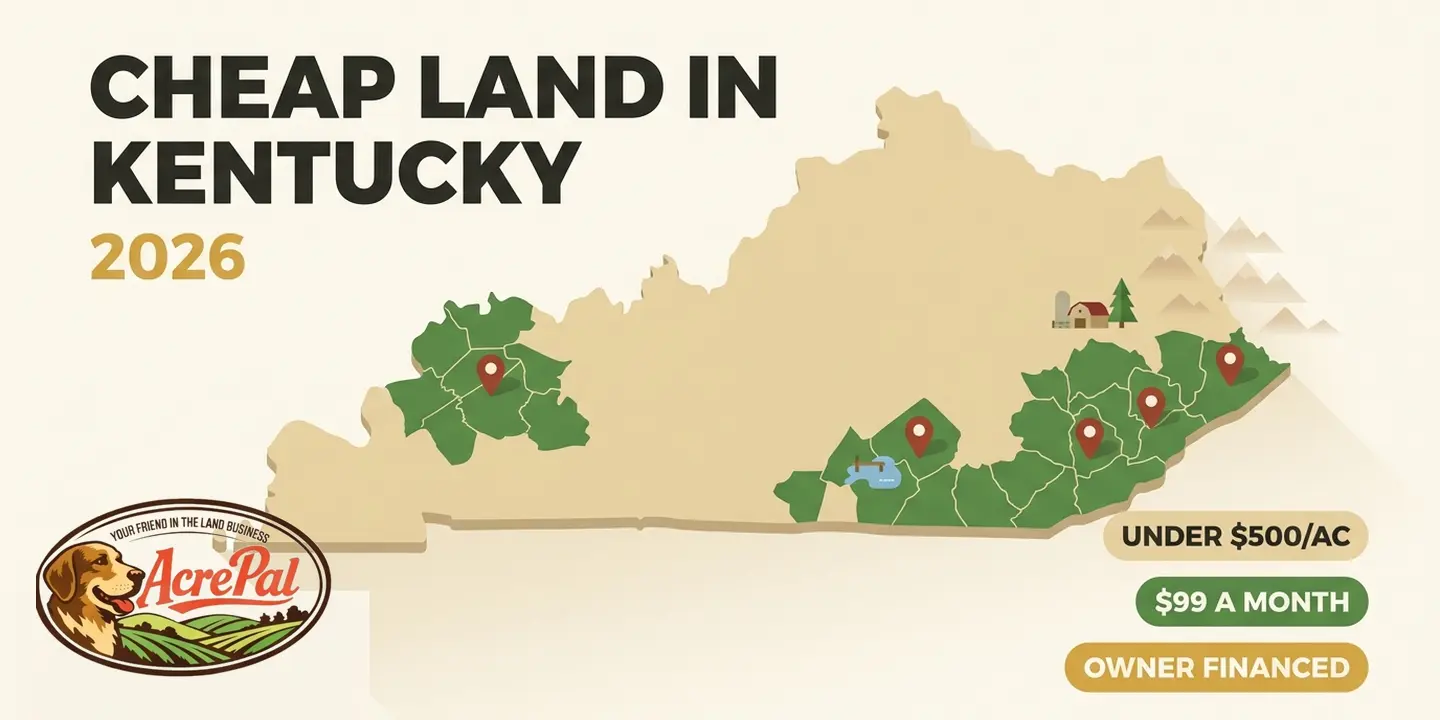
You can still buy an acre in Kentucky for under $500, and get onto a parcel for $99 a month with no bank and no credit check. That is the real floor of the market, not the $9,800 per acre state median most lists quote. The trick is knowing that the genuinely cheap land for sale in Kentucky is cheap for specific reasons, and those reasons are the difference between a bargain and a money pit.
This guide ranks the three cheapest regions in the state (cheap-tier land averages around $3,276 an acre, not the desirable counties near cities and lakes), shows exactly how owner financing works, and stays honest about the mineral rights, sinkholes, access, and develop-cost traps that keep prices low. For how Kentucky stacks up nationally, see our cheapest place to buy land breakdown. We ranked them cheapest first.
1. Eastern Kentucky Coalfields: the Cheapest Acreage in the State
Want the literal cheapest land in Kentucky? Drive into the eastern coalfields. Counties like Letcher, Knott, Leslie, Perry, Breathitt, and Harlan hold the lowest per-acre prices in the state, and it is not close.
Raw reclaimed and hollow acreage often trades under $500 an acre, with steep mountain woods running roughly $800 to $2,000. The sold medians tell the story better than any listing average. Breathitt County parcels have sold at a median of just $1,072 an acre, the lowest actual-transaction figure in the state, with Harlan at $1,127 and Leslie averaging $1,276 for undeveloped ground. Real listings back this up. A 25-acre tract in Buckhorn (Perry County) sold for $22,500, which is $900 an acre. A 10-acre parcel on Hurricane Creek Road in Hyden (Leslie County) is listed at $9,000, also $900 an acre. Even in pricier Letcher, a raw 60-acre tract near Isom lists at $80,000, about $1,333 an acre.
What you get is reclaimed strip-mine land and ridge-and-hollow wooded parcels, mostly 1 to 20 acres. The upside that makes it worth a look is the neighbor. These counties border the Daniel Boone National Forest, 708,000 acres across 21 eastern counties with roughly 600 miles of trails and strong deer, turkey, grouse, and even elk hunting on a $28.54 resident license. A parcel here can be a cheap hunting base or a spot to earn a little from a hunting lease and other land income.
Now the honest part. These prices come bundled with mineral-rights, terrain, and access tradeoffs that we cover in items 5 through 8, and you need to read those before you buy. Best for hunters and the cheapest-possible recreational ownership. Skip it if you need flat, easily buildable, farmable ground.
2. South-Central Lake Country: Cheap Recreational Land Near Lake Cumberland
What if you want cheap land you will actually enjoy, not just cheap land? Move south-central. Wayne, Clinton, Russell, McCreary, and Pulaski counties sit near one of the biggest lakes in the country, and the pricing is a step up from the coalfields for good reason.
Sold medians here run roughly $2,873 to $4,912 an acre. Wayne County sits at a $2,873 sold median, McCreary at $4,097, and Pulaski around $4,912. Small recreational lots (5 to 10 acres) commonly list from $28,000 to $40,000. A real 10-acre Wayne County listing runs $40,140, and a 5-acre Pulaski parcel near Burnside is $30,000.
The draw is Lake Cumberland, 101 miles long, with about 1,200 miles of shoreline, the 9th-largest lake in the United States. That means boating, cabins, and real rental appeal, and much of this region also borders the Daniel Boone National Forest. This is the sweet spot for a cheap parcel you can build a weekend around, far more usable than the steep eastern hollows. It is also a strong region if you ever want to earn from glamping or recreational land income.
One caveat before you fall in love. This is karst country, which means sinkholes, and we cover how to insure for it in item 6. For weekend and recreational use, this is the best cheap region in the state, as long as you insure for karst.
3. Western Kentucky: the Cheap Coal Field, Not the Pricey Purchase
A lot of lists lump all of western Kentucky together as cheap. That is wrong, and it can cost you. The cheap western land and the expensive western land are two different regions, so aim at the right one.
The cheap one is the Western Coal Field, in west-central Kentucky around Muhlenberg, Ohio, Hopkins, Butler, and Webster counties. Recreational and timber ground here runs roughly $1,900 to $2,500 an acre, flatter than the eastern mountains, which makes it easier to build on and get to. It is still a coalfield, so the same mineral-rights notes (item 5) and mine-subsidence insurance (item 7) apply, and it sits inside the mine-subsidence counties.
The expensive one is the far-western Jackson Purchase, covering Graves, Hickman, Fulton, Carlisle, and Marshall counties. Its fertile loess soils make it productive farmland at $5,000 to $7,500 an acre and up. Graves County listings average $15,965 to $33,709 an acre, which is not cheap by any definition. It also carries Mississippi and Ohio River floodplain risk (a Zone AE parcel averages about $1,386 a year in flood insurance and roughly a 26 percent chance of flooding over a 30-year loan) plus New Madrid earthquake exposure.
For cheap and flatter, look at the Western Coal Field. Skip the Purchase unless you specifically want prime farmland and will pay for it. If you are weighing states, our cheapest place to buy land guide and the way severed rights show on the deed are both worth a read first.
4. Owner Financing: Buy Kentucky Land With No Bank and No Credit Check
Short on cash and worried about your credit? Owner financing is how most low-budget buyers actually get on a Kentucky parcel. You pick a listing, sign a purchase agreement, put money down, and pay monthly. No bank, no credit check on qualifying parcels, and closings often under two weeks.
The entry point is genuinely low. The Land Service markets Kentucky parcels at $99 down and $99 a month with no interest and no credit check on qualifying land. Classic Country Land runs everything in-house with $249 to $999 down, no credit or background check, no prepayment penalty, and rates tiered by down payment from 12.99 percent down to 8.99 percent at 20 percent down. Real terms on live Kentucky listings look like this.
- An entry parcel under $5,000 total, from $99 a month.
- Wounded Oak (Rockcastle), 5.28 acres, $32,908, with $999 down and $329 a month.
- Landmodo parcel near Irvington, 2.2 acres, $27,700 cash or $7,000 down and $830 a month.
- A larger tract at $49,900 cash or $11,000 down and $987 a month.
- LandWatch lists around 134 owner-financed Kentucky parcels, some as low as $700 down and $225 a month.
Be honest with yourself about the math. Owner financing costs more than cash over the full term, and many sellers give a roughly 20 percent cash discount that is real money left on the table. If you can pay down fast, do it. For the deeper mechanics, our buy land with no money playbook walks the whole flow, and make sure you get a warranty deed at payoff.
One note on who we are, since honesty is the point of this guide. This no-bank owner-financing model is exactly how AcrePal sells rural land, but in the West (Arizona, Colorado, Nevada), not in Kentucky, so Kentucky buyers work with Kentucky owner-finance sellers. We did the same honest breakdown for other states in our cheap land in Tennessee and cheap land in Colorado guides.
5. The Mineral Rights Trap: Why Cheap Eastern Surface Land Is So Cheap
A big reason eastern Kentucky surface land is cheap is that someone else may own everything under it. Kentucky law separates the surface estate from the mineral estate, so you can own the ground while a coal or gas company owns the coal, oil, and gas beneath your feet. Longtime buyers there will tell you the minerals not coming with the land is close to normal.
This goes back a long way. Coal and timber agents like John C.C. Mayo bought eastern Kentucky mineral rights using broad-form deeds starting in the 1880s, often for a few dollars an acre, in some cases as little as 10 cents an acre. About 80 percent of the Appalachian mineral estate is absentee-owned today. Those severances happened 80 to 100 or more years ago, and a routine title look will not catch them.
The 1988 Broad Form Deed Amendment (now Section 19(2) of the Kentucky Constitution) passed by 82 percent, four to one. It means a company cannot strip-mine under an old broad-form deed without the surface owner's consent. The catch is that the mineral estate is still legally dominant, so the mineral owner can keep reasonable surface access and drilling rights even after the amendment.
The protection is straightforward but not fast. A mineral-severance title search takes 2 to 4 weeks, because it traces the chain of title back to the point of severance through deeds and wills that a standard exam misses. Never buy cheap eastern Kentucky land without hiring a Kentucky real-estate attorney to run that deep title search, and understand how a severance shows up against the deed before you sign.
6. Mine Subsidence, Sinkholes, and Floods: the Hazards to Insure Before You Buy
The cheapest ground in Kentucky sits over old coal mines, dissolving limestone, or river floodplains, and a standard policy covers none of it. Each cheap region carries its own hazard, and each one has a real, mostly cheap fix. Match the coverage to the region before you close.
- In the Eastern and Western Coal Fields, the hazard is mine subsidence. Land can sink over old underground workings, and standard policies exclude it as earth movement. Add the Kentucky Mine Subsidence Insurance endorsement, available in 37 coalfield counties, covering up to $550,000 with a 2 percent deductible. It costs only $30 to $60 a year.
- In south-central lake country, the hazard is karst sinkholes. The Pennyroyal region has more than 60,000 mapped sinkholes, one of the densest concentrations in the country. Standard homeowners insurance excludes sinkhole damage, so add a sinkhole endorsement at $80 to $300 a year (higher near Mammoth Cave), and know that a bad repair can top $100,000.
- In the Jackson Purchase and any river bottom, the hazard is flooding. A Zone AE parcel averages about $1,386 a year for flood insurance and carries roughly a 26 percent chance of flooding over a 30-year loan. Pull the FEMA flood map before you buy.
Match the endorsement to the region before closing, not after the first loss. Each one is cheap relative to the damage it prevents, and the mine-subsidence endorsement in particular is close to free.
7. Legal Access: Don't Buy a Landlocked Hollow
Plenty of cheap hollow and ridge parcels have no legal way in. On paper the price looks like a steal. In practice, you could be trespassing across a neighbor's land just to reach your own, or unable to run utilities in at all.
Landlocked Kentucky land needs a recorded access easement through a neighbor's property. A textbook example is a 68-acre wooded parcel near Totz in Harlan County listed at $69,900 (about $1,022 an acre), cheap on paper but landlocked with no deeded right-of-way. Appraisers routinely value landlocked ground at around half of comparable land with legal access, and the court cost of forcing a way in often runs more than just paying a neighbor for the easement. Kentucky does have remedies (easement by necessity, or a prescriptive easement after 15 years), but they are slow and uncertain, so you do not want to rely on them.
Confirm a recorded deeded easement before you buy. If the parcel is landlocked, negotiate and record an access easement with the neighbor as a written condition of closing, not a handshake. This stacks neatly with the mineral-rights title search from item 5, because it is the same attorney doing both. Put legal access in writing before you sign, and confirm it is recorded against the title.
8. The Real All-In Cost: Well, Septic, and Power on Raw Land
A $4,000 parcel can need $30,000 to become livable. The purchase price is only half the story on raw land, and skipping this math is how cheap land turns expensive. The 2026 develop-cost stack breaks down like this.
- A well runs about $8,484 on average for a 202-foot well, at drilling rates of $28 to $60 a foot. Eastern Appalachian water tables run 100 to 400 feet deep, versus 50 to 200 feet in the Bluegrass, so the cheapest coalfield land often carries the deepest, priciest wells. A 100-foot well runs around $9,000, while a 500-foot well can run around $29,000. Kentucky charges no well permit fee.
- A perc test runs $250 to $500, cheaper than the national midpoint, and a conventional septic install runs about $6,749, with the full range from $10,000 to $25,000 depending on soil and system. A mound or elevated system adds $3,000 to $8,000 more.
- Electric line extension underground runs $10 to $25 per foot beyond the co-op's free footage, and poles run $1,200 to $5,600 each.
There is a specific catch on reclaimed strip-mine land. It often fails to perc, and some county health departments will not issue a septic permit on it at all, so verify perc testing and permitting before you buy, not after. Price the well, septic, and power before the sticker price fools you. Our guides on the cost of digging a well in 2026, well and septic installation, and getting utilities on land break each one down further.
9. Cut the Carrying Cost: Kentucky's Low Taxes and Ag-Use Valuation
Kentucky is one of the cheaper states to just hold land. The effective property tax rate is 0.77 percent, 29th nationally, and the 2026 homestead exemption is $49,100 on a primary residence. That keeps the yearly cost of owning down while you decide what to do with the parcel, which matters when a cheap parcel might sit for years before you develop it.
The bigger lever is agricultural-use valuation. If the parcel is at least 10 contiguous acres and actively farmed, you can file Kentucky Revenue Form 62A351 with the county property valuation administrator by March 1 (with title held as of January 1) to be taxed on agricultural use value instead of market value. The savings are dramatic. An acre worth $50,000 at market can be assessed near $750 for tax purposes, which turns a real tax bill into pocket change. Even at ordinary rates, a $30,000 parcel costs only around $230 a year to hold, so Kentucky rarely punishes you for waiting.
This pairs naturally with the flatter, farmable Jackson Purchase ground from item 3, where actual farming is realistic. If you buy 10 or more acres, file for ag-use valuation your first spring, and look at other ways to make the land pay while you hold it.
FAQ
Why is land in eastern Kentucky so cheap?
Eastern Kentucky land is cheap because of steep ridge-and-hollow terrain, reclaimed strip-mine soil that perks and farms poorly, frequently severed mineral rights, mine-subsidence exposure, and landlocked-access problems. Together these push raw acreage under $500 an acre in coalfield counties like Letcher, Knott, Leslie, Perry, Breathitt, and Harlan.
Can I buy Kentucky land with no bank and no credit check?
Yes. Sellers like Landmodo, Classic Country Land, and The Land Service offer owner financing with no credit check on qualifying parcels. Down payments run from $99 to $999, monthly payments start around $49 to $99, and closings often finish in under two weeks. Some sellers charge no interest and offer a roughly 20 percent cash discount.
What is the cheapest place to buy land in Kentucky?
The eastern coalfield counties are the cheapest place to buy land in Kentucky. Letcher, Knott, Leslie, Perry, Breathitt, and Harlan hold the lowest per-acre prices in the state, with raw reclaimed and hollow acreage often under $500 an acre and sold medians around $1,000 to $1,300 in the cheapest counties.
Do I own the mineral rights when I buy cheap eastern KY land?
Often no. Kentucky splits the surface and mineral estates, and coal and gas companies bought eastern Kentucky mineral rights through broad-form deeds a century ago. Those severances are 80 to 100 or more years old and will not show up in a routine title exam, so hire a Kentucky attorney for a deep title search before you buy.
What does it cost to make cheap raw KY land livable?
Budget a well at about $8,484 (202 feet on average, deeper in the east), a perc test at $250 to $500 plus a septic system of $10,000 to $25,000, and electric line extension at $10 to $25 per foot beyond the co-op's free footage. Making a few-thousand-dollar parcel livable often costs tens of thousands.
Do I need special insurance on cheap Kentucky land?
Yes, in most cheap regions. In the 37 coalfield counties, add a Kentucky Mine Subsidence Insurance endorsement, since standard policies exclude subsidence. In south-central karst country, add a sinkhole endorsement, because standard homeowners insurance excludes sinkhole damage. Both are affordable relative to the losses they cover.