
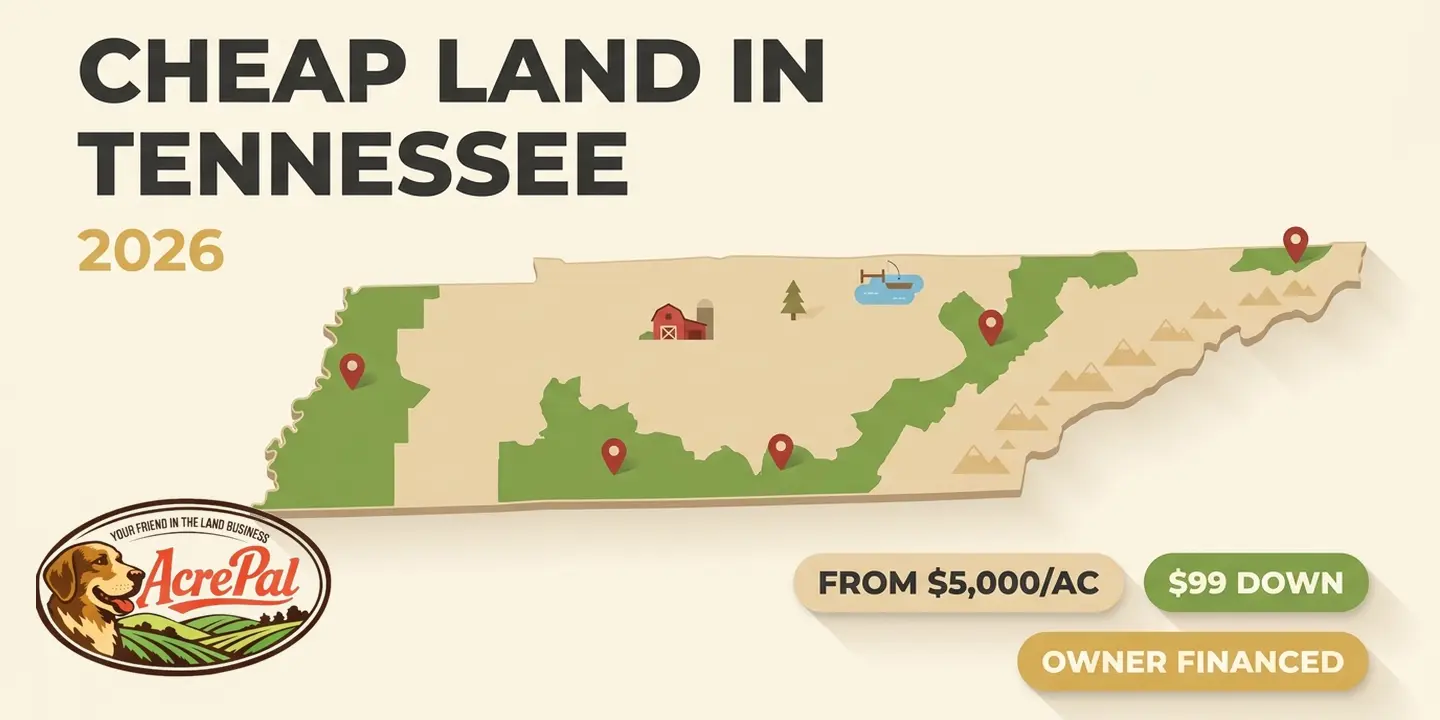
Yes, genuinely cheap land for sale in Tennessee is real. In the right rural counties, raw acreage runs roughly $5,000 to $8,000 an acre, and it drops toward $5,000 an acre once you buy 20-plus-acre tracts. Owner financing pushes the entry point even lower, with some sellers taking $99 to $249 down and about $99 to $250 a month, no credit check. The catch is the part most listings bury. The cheapest parcels are cheap for reasons hidden below the sticker price, mostly septic feasibility, legal road access, and site-work costs that can quietly cost more than the land itself. This guide ranks the counties cheapest-first and tells you the exact catch on each one.
Why Statewide Tennessee Land Prices Mislead Cheap Land Buyers
If you searched "Tennessee land" and saw scary numbers, you were probably looking at the wrong Tennessee. Statewide median list prices sit around $13,000 to $15,000 an acre in 2026, and that average is dragged up by Nashville-metro counties like Williamson and Davidson, where small lots run $60,000 to $400,000 an acre. That is a different market with a different buyer.
The genuinely cheap land sits in three pockets. The West Tennessee flatlands, the Western Highland Rim counties like Perry, Wayne, Lewis, and Decatur, and the Cumberland Plateau. Out there, rural acreage runs about $5,000 to $8,000 an acre and slides toward $5,000 an acre on the biggest tracts. Cheap does not mean worthless, either. USDA pegged Tennessee farm real estate near $5,710 an acre, up 10.7 percent in 2024 and another 7.7 percent in 2025, so this is a rising market, not a dead one.
The lesson is simple. Read county prices, not state averages. That is the same cheapest-first logic we use nationally when we rank the cheapest places to buy land, and it is exactly how you find the deals below. The ranking starts with the single cheapest county in the state.
1. Hancock County, the Absolute Cheapest Land in Tennessee
Five thousand dollars an acre. That is the floor for large tracts in Hancock County, and no county in Tennessee beats it. On 20-plus-acre parcels Hancock runs roughly $5,000 to $6,000 an acre, climbing to about $8,000 an acre for 5 to 10 acres and $13,000 an acre on tiny 0-to-2-acre lots. In every size bracket, it is the cheapest name on the board.
The reason is geography. Hancock sits in the far northeast corner of the state, right on the Virginia line, and it is one of the most rural, lowest-population counties in Tennessee. The terrain is steep Appalachian ridge-and-valley ground, jobs are scarce, services are thin, and any real metro is a long drive away. That isolation is the whole reason the price is what it is.
The steep ground matters for more than the view. Slopes raise both septic and driveway costs, which is the exact trap we cover later. Still, if your goal is the lowest possible dollar-in, 20-plus-acre tracts here hit that $5,000 to $6,000 floor and hold value in a rising market.
Best for land bankers and deep-woods hunters who want the lowest dollar-in and do not need to live there. Skip it if you want flat build-ready ground or services within easy reach.
2. West Tennessee Flatlands, the Cheapest Land You Can Actually Build On
Hancock wins on raw price, but West Tennessee is where a cheap parcel stays cheap after you build on it. That distinction is worth real money. The West Tennessee flatland counties, Lake, Lauderdale, Carroll, Weakley, Benton, and Dyer, run roughly $3,000 to $6,000 an acre for unrestricted rural land, with Lake and Lauderdale among the cheapest in the entire state on acreage. Flat terrain, agricultural zoning, and low property taxes come standard.
What sets this region apart is how it builds. Flat, firm ground means cheaper driveways, no earthmoving, and no engineered grading. Better still, West Tennessee's sandy loam and silt loam soils generally pass a perc test where clay and rock fail, so the septic system that sinks buyers on the Plateau is far cheaper here. When the land is cheap and the site work is cheap too, the budget actually holds.
There are honest catches. This is the farthest corner of the state from mountains and metros, so the scenery is farmland flat, not dramatic. Some low-lying river-bottom ground near the Mississippi carries flood risk, so pull the FEMA map before you fall for a bargain acre. For flat, farmable ground, this region ranks among the better places to build a homestead without the site-prep bills that eat a cheap parcel alive.
Hancock is cheaper on paper. West Tennessee is the cheapest place to actually put something on the ground.
3. Perry and Wayne Counties, Tennessee's Owner-Financing Heartland
If you have browsed cheap Tennessee land online, you have already scrolled past Perry and Wayne a dozen times. You just may not have known why they keep showing up. These two Western Highland Rim counties are where owner-financed Tennessee land concentrates, and there is a reason the listings cluster there.
Perry sits about 90 miles southwest of Nashville, and Wayne runs down to the Alabama line. Both are wooded, rolling-hill country with spring-fed creeks, hardwood forest, and genuine homestead and hunting appeal. Prices land around $7,000 to $11,000 an acre depending on lot size, dropping toward $6,000 to $7,000 an acre on larger tracts. That is more than Hancock, and you are paying for scenery and reach to Nashville.
What makes Perry and Wayne the owner-finance capital of cheap Tennessee land is who is selling. Companies like Classic Country Land focus their inventory on Perry, Wayne, Decatur, Henderson, and Sequatchie, with entry points around $249 down and no credit check. Other Tennessee sellers advertise $99 down and $99 a month. A five-acre Perry County parcel near $9,000 an acre runs about $45,000, which with $249 down and a typical 20-year term lands close to $430 a month. We save the full math for the financing section, but you can see why the marketing writes itself.
Values here are rising, though, so the true bargains are the raw, wooded, access-limited parcels, not the premium road-frontage lots. Many of these are the small 3-to-5-acre owner-financed lots that dominate the listings, and the cheapest ones are cheap because access is limited. Read the access before you read the payment.
For a low-money-down entry into scenic Middle Tennessee land, this is the easiest door, as long as you buy the raw parcel and not the marked-up road-frontage lot.
4. McNairy, Hardeman, and Decatur Counties, Below the State Average
These are the counties locals buy when they want acreage without paying the Nashville tax. McNairy is a first-time-buyer favorite that sits consistently below the state average, and Hardeman and Decatur sit right alongside it, with Haywood and Chester filling in just above the floor. None of them are famous, which is exactly why they are cheap.
Expect roughly $6,000 to $8,000 an acre on real acreage, some of the lowest pricing in Tennessee, across flat-to-rolling agricultural ground with low property taxes. There is a real trade-off. Local services are thinner and the buyer pool is small, so resale can take a while. What you get in return is genuinely buildable ground with decent perc in the flatter areas, plus Tennessee River access near Decatur and Hardin if you want a recreation angle.
This is the sensible middle of the cheap-Tennessee map. Cheaper than the metros, less remote than Hancock, and more buildable than the steep Plateau. A typical 10-acre parcel in this band gives a first-time buyer real room without a scary price tag.
Best for budget buyers who want a middle path and usable ground. The compromise is patience on resale.
5. The Cumberland Plateau, Cheap and Scenic With a Rocky Catch
The Plateau has the best scenery on this list and the most expensive dirt to build on, even when the land itself is cheap. Hold that contradiction in your head before you fall for a listing photo. The merged Plateau counties, Fentress, Morgan, Scott, Van Buren, Grundy, and Bledsoe, run roughly $6,000 to $8,000 an acre.
The draw is easy to see. Most of this land is unrestricted with relaxed or nonexistent county zoning, set across rolling hardwood forest with waterfalls, cooler summers, and outdoor recreation near the Big South Fork. For an off-grid buyer, it looks like paradise on a budget.
The scenery is where the money stops being simple. Rocky soils and steep slopes here make perc tests fail often, which pushes you into an engineered or mound septic system at $15,000 to $25,000 instead of the $6,000 to $10,000 a conventional system costs. Wells must be drilled deeper into rock at $20 to $30 a foot, and driveway cuts on slopes add more. The math is brutal. A $20,000 raw parcel can need $30,000 to $40,000 of improvements before you can legally live on it.
Buy the Plateau for the scenery and the recreation, and only if you will budget for the site work or commit to staying off-grid. Do not buy it because the sticker price looks like a steal.
6. Lake and River Counties, Cheap Land Near the Water
Spend a little more here and the land comes with a lake attached. That is the trade-off, and for the right buyer it is worth it. Hardin County sits on the Tennessee River and Pickwick Lake, Stewart and Benton border Kentucky Lake and the Land Between the Lakes National Recreation Area, and Humphreys rounds out the group.
The pricing play is all about distance from the water. Rural acreage set back from it runs roughly $6,000 to $8,000 an acre, while actual waterfront commands far more. So the smart move is cheap acreage near the water, not on it. You still get the fishing, boating, and duck and deer hunting, plus a base for a weekend cabin or an RV, without paying the waterfront premium.
Prime waterfront is not cheap, and floodplain parcels near the river carry FEMA flood-zone and insurance headaches, so verify the flood map before you commit. For recreation and weekend-property buyers who want water access on a budget, this is the group to watch.
That closes the ranked list. Cheapest-to-hold is Hancock, cheapest-to-build is West Tennessee, best low-money-down is Perry and Wayne, and this is the cheapest way to get near the water.
The Perc Test Catch That Kills Cheap Tennessee Lots
The number one way a cheap Tennessee parcel becomes a money pit is a failed perc test, and it hits after you have paid. Almost no listing warns you.
Tennessee requires a percolation or soil evaluation and a subsurface sewage disposal permit from the county health department before you build, because almost no cheap rural parcel sits on a sewer line. No passing soil means no septic permit, and no septic permit means no house.
The test is cheap relative to what it prevents.
- A Tennessee perc test runs about $750 to $1,850, and up to $3,000 on complex sites.
- A certified soil scientist must perform it for permitting, not any contractor.
- Get it done before you close, so a failure costs a contingency, not a purchase.
Certain ground fails predictably. Heavy clay, solid rock, a high water table, and steep slopes all drain too slowly or too fast, exactly the cheap ground on the Cumberland Plateau and in wet river bottomland. West Tennessee sandy loam usually passes, which is why that region ranks so well for building.
The cost gap when the soil barely passes is where budgets die.
- A conventional gravity septic system runs $6,000 to $15,000.
- A failed or marginal perc pushes you to an engineered, mound, or pump system at $10,000 to $25,000 or more.
- On a cheap parcel, that septic upgrade alone can cost more than the land.
Protect yourself before you sign. Make your offer contingent on a passing perc test, or buy land that already has a valid perc or septic permit on file. Before you drive out, check the free USDA Web Soil Survey to see whether soils can handle a conventional drain field. Budget for water too, since Tennessee wells run $4,000 to $15,000 at $15 to $30 per foot, deeper and pricier in Plateau rock.
On cheap rural land, the perc test matters more than the view. Get it done first, before you fall for the photos.
What Unrestricted Land Actually Means in Tennessee
Unrestricted does not mean you can do anything you want. It is one of the most oversold words in cheap-land marketing, and the word promises more than the law actually delivers.
- No statewide zoning. Tennessee has no statewide zoning, and many rural counties like Scott, Morgan, and Fentress have little or none, so "unrestricted" usually means no HOA, no subdivision covenants, and county-level agricultural or rural-residential use.
- Permits still apply everywhere. Tennessee requires permits and inspections for new construction, electrical, plumbing, and septic anywhere in the state, plus property-line setbacks that typically run 25 to 75 feet. Even truly unrestricted land is not permit-free.
- Mobile homes and RVs, with a caveat. On genuinely unrestricted land with no deed restrictions, HUD-code manufactured homes and RVs can generally go in as a primary dwelling, subject to septic and permit rules. A recorded deed restriction can still forbid them, so read the deed.
- Deed restrictions bind regardless. A parcel can have zero zoning and still carry deed restrictions from a prior owner or an old subdivision plat. Those run with the land, so confirm in writing that there are none.
One real upside lowers your carrying cost. Tennessee's Greenbelt law, formally the Agricultural, Forest and Open Space Land Act of 1976, lets 15-plus-acre parcels used for agriculture or forestry get assessed at use value instead of market value. That cuts assessed value by 60 to 90 percent in suburbanizing areas and can drop the annual tax bill from over $1,000 to under $200 on a 20-acre parcel. Pull the land out and a rollback tax of up to three years applies, so keep the qualifying use.
Unrestricted Tennessee land is genuinely freer than most states allow. You still have to read the deed and pull the permits, but the ceiling on what you can do is high.
Owner Financing and the True All-In Cost of Cheap Tennessee Land
The monthly payment on cheap Tennessee land is often smaller than a car payment. The honest total, though, is bigger, and almost nobody prints it.
Start with the owner-financing math. Typical terms run $99 to $249 down, roughly $99 to $250 a month, over 10 to 30 years, with no credit check, no bank, and usually no prepayment penalty. The tradeoff is the rate, 10 to 12.99 percent APR versus 7 to 9 percent on a conventional loan. Take a $12,000 parcel at $249 down and roughly $180 a month. The total lands well above the cash price, and paying cash often earns about 20 percent off.
Understand the mechanics. The seller holds the deed or uses a land contract until your final payment, and the deed transfers to you on payoff, so get the early-payoff terms in writing.
Then the improvements land on you, and on raw land they usually cost more than the dirt. The typical Tennessee numbers stack up fast.
- Perc test, $750 to $1,850.
- Septic, $6,000 to $15,000, and up to $25,000 for an engineered system.
- Well, $4,000 to $15,000.
- Driveway and culvert, $3,000 to $12,000.
- Power line extension, often $18,000 or more if the pole is far.
That stacks to $20,000 to $40,000 of site work, often more than the land price. Worse, banks generally will not lend on raw unimproved land, so you self-fund it. That is the real number to plan around.
We should be upfront here. We sell owner-financed rural land in the West and South, not Tennessee. If these numbers do not pencil out once you stack the site work, owner-financed parcels in cheaper-to-develop markets are worth a look, and you can see how AcrePal structures those deals.
Owner financing makes the land a small monthly decision. Budget for the site work, because that is the real cost.
The Bottom Line
Match the region to the buyer and the choice gets simple. If you want the lowest dollar-in as a land banker or a deep-woods hunter, lean Hancock. If you actually want to build a homestead cheaply, the West Tennessee flatlands give you the lowest all-in cost. For low-money-down owner financing with real scenery, Perry and Wayne are the heartland. For scenery and recreation with a site-work budget, the Cumberland Plateau delivers, and for water access on a budget, look at Hardin, Stewart, or Benton.
Whichever region you pick, run the same pre-buy checklist before you sign anything.
- Confirm a passing perc test or an existing septic permit before closing.
- Verify legal deeded road access, not just a dirt track you can drive on, to avoid a landlocked parcel.
- Check the FEMA flood map on any river or bottomland parcel.
- Read the deed for restrictions even when the listing says "unrestricted."
- Price out the full site-work stack, well, septic, driveway, and power, before you fall in love.
- Verify the property taxes and whether Greenbelt applies to your acreage.
- Use a title search and a survey on any cheap FSBO or tax-sale parcel.
Do the homework and cheap Tennessee land is a genuine opportunity. Skip it and the bargain becomes your most expensive mistake.
Cheap Tennessee Land, Frequently Asked Questions
What is the cheapest county to buy land in Tennessee?
Hancock County is the cheapest, at roughly $5,000 to $6,000 an acre on larger tracts, the lowest in the state across every lot-size bracket. It sits in the far northeast corner and is one of Tennessee's most isolated counties, which is why prices are so low. West Tennessee counties cost a little more but are cheaper to actually build on.
Can I really buy Tennessee land for under $5,000?
Yes, but under $5,000 total almost always buys a small sub-one-acre lot or a raw parcel with limited or steep access. LandSearch shows about 174 Tennessee listings under $5,000 total, and most have no utilities and sometimes no recorded legal access. To get buildable 5-plus-acre ground, budget $30,000 to $60,000 total.
What does unrestricted land actually mean in Tennessee?
It means no county zoning, no HOA, and no subdivision covenants. It does not mean permit-free. Statewide building, electrical, plumbing, and septic permits still apply, setbacks still exist, and a deed restriction from a prior owner can still bind the land. Always confirm with the county clerk, not just the listing agent, and read the deed.
Is owner-financed land in Tennessee legit and safe?
Generally yes with a reputable seller. Owner financing is a formal legal transaction documented with a promissory note and a deed of trust or land contract, not a handshake. Expect $99 to $249 down and 10 to 12.99 percent APR with no credit check. Run a title search, have an attorney review the contract, and confirm the deed transfers to you on payoff in writing.
Do I need a perc test before buying?
Effectively yes if you plan to build anything with plumbing. A failed perc test means no septic permit, which means no house, so the soil decides whether the parcel is usable. Make your offer contingent on a passing test, which costs about $750 to $1,850. Clay-heavy and rocky soils fail most often, so check the free USDA Web Soil Survey first.
What is the real all-in cost to make cheap raw TN land livable?
Budget $20,000 to $40,000 on top of the land price for well, septic, driveway, and power. On a cheap parcel that site-work stack often costs more than the land itself. Banks generally will not finance raw unimproved land, so you self-fund the improvements. Price out the full stack before you buy, not after.
What is Tennessee's Greenbelt law?
It assesses qualifying 15-plus-acre agricultural or forest parcels at use value instead of market value, cutting assessed value by 60 to 90 percent and shrinking the annual tax bill, sometimes to under $200 on 20 acres. Open-space land qualifies at 3 acres. If you convert or sell out of the program, a rollback tax of up to three years of the difference applies.
Can I put a mobile home or RV on cheap Tennessee land?
Usually yes on genuinely unrestricted land with no deed restriction against it, subject to a septic permit if the structure has plumbing. Many rural counties allow manufactured homes and even full-time RV living. Always confirm with the county clerk and read the deed first, since some parcels marketed as unrestricted sit in old platted subdivisions with housing bans.