
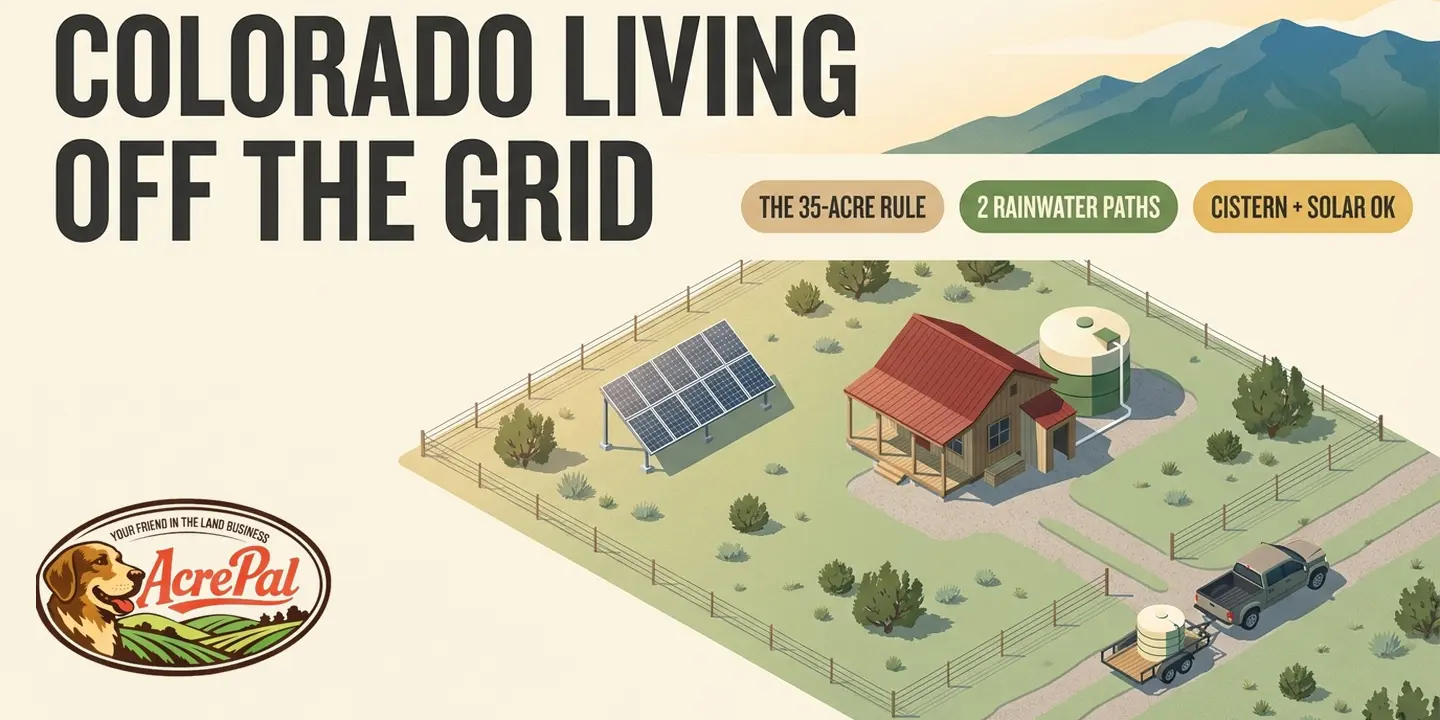
A page-one result from a licensed real estate brokerage says a Colorado property must be at least 35 acres to qualify for a well. Another says parcels under 35 acres get a household-use permit instead. One of those sentences decides whether a cheap 5-acre lot is worth an offer.
Camping runs the same way. One page states flatly that Costilla County has prohibited camping on private property. The county's own land use code carries a 14-day baseline plus a permit path for longer stays.
That is the real problem with researching Colorado living off the grid. These pages sit side by side, written with equal confidence, and you cannot tell which one is stale.
Every legal claim below carries a statute section, bill number, regulation citation or county code article you can pull up and read yourself. Colorado only from here, so if you are comparing states, start with our best states for homesteading guide.
The 110-gallon rain barrel cap every page repeats is real, and it is not the cap that applies to most off-grid households in this state.
Well Permits and the 35 Acre Rule Colorado Buyers Keep Getting Wrong
Colorado's State Engineer publishes Guideline 2023-1, "Uses of Water From Exempt and Small Capacity Wells," 24 pages. It answers the 35-acre question directly.
Colorado runs on prior appropriation, and the exempt well is the rural carve-out. C.R.S. 37-92-602(1) exempts wells outside Designated Ground Water Basins whose uses stay inside a fixed list, quoted in the guideline as "ordinary household purposes, fire protection and fire-fighting, the watering of poultry, domestic animals, and livestock on farms and ranches, the irrigation of not over one acre of home gardens and lawns," plus monitoring wells and commercial sanitary facilities. The cap is 15 gallons per minute, and one exempt well may serve up to three single-family dwellings.
Most exempt wells are permitted under C.R.S. 37-92-602(3)(b)(II)(A), which the guideline says covers "the majority of exempt wells." Permits under it on parcels less than 35 acres, outside a cluster development, are "limited to ordinary household purposes inside one single-family dwelling, with no allowed outdoor uses."
So the 35-acre line controls the scope of use, not whether water is available at all. At 35 acres or more that same permit adds an acre of lawn and garden irrigation, livestock and domestic animal watering, and up to three dwellings. Only one permit issues per legal parcel, cluster development lot or tract of that size.
Credit where due. That brokerage page is right that one well can serve three residences. A survival-focused site in the same results has household-use versus domestic permits broadly right too. It just cites nothing you can check.
What bites cheap parcels is a date, not a number of acres. For subdivisions approved on or after June 1, 1972, every well's cumulative effect is weighed in the material injury determination and a permit can be refused. That call is parcel-specific, the guideline is explicitly a guide for administrative decisions, and cheap 5-acre San Luis Valley lots are where it lands.
Colorado water law gets described as uniformly hostile to off-grid households. C.R.S. 37-92-602(6) declares "that the exemptions set forth in this section are intended to allow citizens to obtain a water supply in less densely populated areas for in-house and domestic animal uses where other water supplies are not available." The exemption was built for exactly these households.
Division 3 rules require the valley's roughly 7,500 non-exempt well users to augment depletions, while exempt household wells sit on a different track, and what it costs to dig a well is a separate question from whether you can permit one.
Call the Division of Water Resources with the parcel number before you make an offer.
Colorado Rainwater Law Has Two Pathways, and Off Grid Homes Get the Bigger One
Two barrels and 110 gallons is not the whole rule. Colorado runs two independent rainwater pathways, and the Division of Water Resources sets both out in its Rainwater Collection Information Table.
Pathway one is the famous one. HB16-1005, effective August 10, 2016 and codified at C.R.S. 37-96.5-103, covers any single family residence or multi-family residence with four or fewer units, and DWR is blunt, "No permit or other approval is required." You may "fill and refill" two sealable-lid rain barrels with a combined storage capacity up to 110 gallons "throughout the year," for outdoor use on the property where it was collected. The water "cannot" be used for drinking or indoor household purposes.
Note the refill language. The 110 gallons is a storage capacity limit, not an annual volume cap, though one competitor reads it as an annual total and sends readers to a different state.
Pathway two is the one nobody mentions. SB09-080, at C.R.S. 37-92-602(1)(g), created the Rooftop Precipitation Collection Permit for "Any residence that has, or can qualify for, an exempt residential well permit through DWR. This law operates independently of HB16-1005." You file before collecting, and the notice carries no fee. DWR states "There is no limit to the amount of water you can collect," so long as it comes off the roof of a building used primarily as your residence.
Storage is not limited to barrels, the table says "Rain barrels or other types of water storage structures."
Then the disqualifier. If the residence is served by a municipal tap or a shared well supplying more than three single family dwellings, rooftop collection is not allowed. The person genuinely capped at 110 gallons is the suburban homeowner on city water, not the off-grid household on an exempt well.
Permit type decides the details. On an exempt domestic well, rainwater may also be captured for the outdoor and indoor uses the permit allows. On a household-use-only well, which is what an under-35-acre parcel gets, barrels serve indoor household use, with only the 110 gallons under HB16-1005 outdoors. On tap water, no.
SB09-080 did not widen what an exempt well permit allows, it added a second lawful way to obtain the water, so the permit still sets the ceiling. The DWR table we used is dated September 2016, so confirm current forms.
Who Actually Issues Your Electrical and Plumbing Permits
The county has no building department, so nobody inspects anything, right? Not for electrical work, and not for plumbing.
C.R.S. 12-115-120 provides that anyone required to have electrical inspection under article 115 shall apply to the board for an electrical permit, excepting jurisdictions whose building departments meet state minimum standards. Where no qualifying local program exists, state electrical inspectors have jurisdiction. Qualified applicants expressly include homeowners working on their own residence, so this is a permit you can pull yourself.
Plumbing runs a parallel track under the State Plumbing Board at C.R.S. 12-155-120, where the permit and inspection come from either the state board or the local authority having jurisdiction. A Colorado county says it out loud. Gunnison County's official plumbing permits page states "Gunnison County does not perform plumbing inspections. Plumbing permits are issued, and inspections are conducted by a state plumbing inspector."
The same page carries the homeowner exemption in usable detail. A homeowner may perform the work personally where the property is not for sale or resale, is not rental or lodging property occupied by tenants, and is not generally open to the public. Contractors need a master plumber's signature.
Chad Robinson, documenting his own Colorado off-grid build on YouTube, had an inspector require 20 amp receptacles throughout a solar-powered house. "I'm on solar. I'm not running 20 amp appliances anywhere and they're making me put 20 amp receptacles for the microwave, the fridge, and all kinds of stuff like that. My whole inverter can only put out a 100."
HB22-1362 created Colorado's Energy Code Board, and its Model Low Energy and Carbon Code becomes the state's minimum energy code on July 1, 2026. The trigger is updating a building code, so a county that never adopted one is not pulled in by that mechanism.
"This county has no building code" and "no permits are required here" are two different sentences. The second one is not true anywhere in Colorado for permanent electrical work.
The No Code County Test, Run on Saguache's Own Land Development Code
"These regulations are designed and enacted for the purpose of protecting the health, safety and welfare of present and future inhabitants of Saguache County, Colorado, by ensuring that all new structures and dwellings conform to current State electrical, plumbing, gas and sewage regulations."
That is Article XIII.2 of the Saguache County Land Development Code, effective August 21, 2018 with the code effective May 19, 2020. Saguache gets named the most permissive county in Colorado on every page-one result, and one entry consists of nothing but the claim that it has no codes. Readers come away believing there are no permits here.
XIII.4.16 has teeth at the back end. "At the completion of construction, applicant must supply Saguache County Land Use office with copies of approved State plumbing, gas and electric permits, if required. Permits will remain incomplete until these copies are supplied."
The rest of Article XIII is where plans quietly break.
- XIII.4 applies to "ALL structures or dwellings constructed within the unincorporated areas within Saguache County," including barns, storage facilities and greenhouses.
- XIII.4.15 bars accessory structures on vacant parcels, naming garages, storage sheds, shipping containers, outbuildings, studios and carports, unless a construction permit for a residence has been applied for and paid, with no greenhouse or hoop house until a residence is complete. Agricultural structures may be exempt. The off-grid plan of shed first and house later runs backwards here.
- XIII.4.3 caps RV occupancy at sixty days during construction and never as a permanent residence, tighter than Costilla.
- XIII.4.14 sets a 600 square foot minimum, XIII.4.10 a finalized sewage disposal permit when you apply, XIII.4.11 a copy of the well permit, water court decree or water service agreement, XIII.4.12 an approved physical address, and XIII.4.2 a two-year expiry with one six-month extension.
One clause we are not going to interpret for you. XIII.4.10.1 in both published versions carries flattened tracked-change text reading "Composting toilets, incinerating toilets, and vault systems are not permittable or allowed in Saguache County shall not be allowed for commercial purposes." Two conflicting edits collapsed into one sentence, and there is no telling whether it bans those systems outright or only for commercial use. If a composting toilet is in your Saguache plan, call Land Use with your parcel number first.
Septic, Composting Toilets and Graywater in Colorado
Your plan is probably a composting toilet plus a graywater line to the garden and no septic budget. Colorado's OWTS regulation closes that door in one sentence. 5 CCR 1002-43.12 allows that "An incinerating or composting toilet may be used for toilet waste where an OWTS is installed for treating wastewater remaining after removal of toilet waste."
The composting toilet is allowed on top of a permitted system, not instead of one. A local board of health may permit incinerating, composting and chemical toilets, and a composting toilet may justify reducing the soil treatment area by no more than 25 percent of estimated wastewater flows, though the tank size cannot be reduced and chemical toilets earn no reduction. Counties do the permitting under Regulation 43, which can also land with the local plumbing authority or the Colorado Plumbing Board.
One competitor gets this exactly right. A survival-focused site is the only page in the results that puts the composting toilet alongside an OWTS rather than in place of one.
Graywater is the other assumed escape hatch, and it is opt-in rather than statewide. Delta County's official graywater page says "Regulation 86 provides for an 'opt-in' program for local jurisdictions and not a statewide program," that the county "doesn't have a graywater ordinance at this time," and answers "In short, no." when asked whether graywater capture is allowed in unincorporated Delta County. Three page-one pages cite Regulation 86 as though it legalizes reuse statewide.
On most rural Colorado parcels graywater reuse is not legal, and a graywater plan is not a substitute for a permitted OWTS. Ask your county environmental health office before the well and septic budget is locked and before you pay for a perc test. Sinks and showers keep producing wastewater whether or not the toilet composts, and without a permitted system there is nowhere legal for it to go.
When a Well Permit Is Not Available, the Cistern Path
Twenty-five dollars fills 500 gallons at the San Luis Water Department in the Costilla County seat, roughly a nickel a gallon.
A parcel in a subdivision approved on or after June 1, 1972 may get an indoor-use-only well permit, or none at all. Costilla County's Land Use Code answers with one line. "Prior to permit approval for Single Family Dwellings or Mobile Homes/Manufactured Homes, the applicant needs to demonstrate the type of water supply (water well or water cistern), septic system and electrical utilities. (Solar and Wind Power)."
Read that twice. The county's own approval criteria name a cistern and name solar and wind.
A land-industry guide to Costilla County water lists the options.
- San Luis Water Department self-haul fill, about $25 per 500 gallons, roughly $0.05 per gallon.
- Sangre de Cristo Water Services, $6.50 per mile to the property plus $100 per 1,000 gallons, with a 1,000 gallon delivery minimum.
- Moreland Mercantile LLC, up to 1,000 gallons at $0.15 per gallon.
Cistern sizing on high-desert parcels without a well runs 1,500 to 3,000 gallons. Match the trailer to the loaded weight, because a full 275 gallon water cube weighs about 2,300 lbs and blew past one builder's 1,000 lb rating.
Where you live while you build is its own permit question. Costilla's baseline is 14 days of camping in any consecutive three-month period, with a long-term permit from the Planning Department that renews in 60-day increments, caps under 180 days a year, and requires a septic system and a water source. The claim that Costilla banned camping on private property reflects the restriction without the permit sitting beside it in the same code.
We are not publishing a fee for the long-term RV permit, because two sources give different numbers and we cannot verify either. Confirm it with Costilla County Planning and Zoning.
Policy does move, and buyers who bought under one enforcement posture have watched it tighten. The channel Off Grid Reality puts it plainly, "Then the county cracked down, banned camping on your own land for more than 2 weeks without demonstrating construction progress... The land didn't change. The policy did."
The sequence holds together. The well permit may be limited or refused, the county accepts a cistern and accepts solar, the cistern fills at about a nickel a gallon with named vendors as backup, and the rooftop permit supplements it. That is a legal, costed path on a parcel most of page one would call unusable.
Off Grid Solar in Colorado, Sized for December and Not the Brochure
Three hundred days of sunshine. Every page repeats it, and it has never sized a single system, because a solar array does not fail in July.
The numbers that do size a system are monthly. Colorado's statewide average runs 5.0 to 6.5 peak sun hours according to NREL's National Solar Radiation Database, and the San Luis Valley at roughly 7,500 feet gets 5.5 to 7.0 peak sun hours daily, among the strongest solar resource in the continental United States. Above 9,000 feet, winter shading plus snow accumulation can strip 20 to 30 percent off effective peak sun hours from December through February. Size to the worst month, usually December or January, and NREL's PVWatts calculator at pvwatts.nrel.gov returns monthly radiation data from a ZIP code.
For a reference point, one documented San Luis Valley build runs 16 installed 360W panels against 28.6 kWh of battery and never ran out of power in over a year.
Colorado also grants a 100 percent property tax exemption for residential renewable energy personal property that sits on residential-classified property, is owned by the owner, and produces energy used by that property, traced to HB14-1101. It covers the equipment rather than the land underneath, and one competitor's bare claim that solar is exempt from property tax is directionally right.
Run the December number against the cost of bringing utilities to the parcel before you decide solar is the cheap option.
What Off Grid Living in Colorado Actually Costs
$180,299. One documented owner-reported build near Blanca in the San Luis Valley, a 900 square foot two-bedroom with septic, a 2,000 gallon cistern, solar and a 500 gallon propane tank, on 5 acres bought for $7,000. One build, not a Colorado average. Selected line items from his own recap.
- Driveway, septic and cistern install, $25,000.
- 30 by 30 slab with floor heat, $14,000.
- House shell, $25,000.
- Rough plumbing, $5,200.
- Rough electrical, $4,950.
- Full solar system including install, $17,125.
- Solar shed kit, $2,225.
- Occupancy permit, $300.
The plumbing and electrical lines are the ones worth a second look. A fully off-grid house in a rural Colorado county still carried paid, permitted trade work, which is what the statutes above look like once they reach a budget.
Nearly 4 acres in Gilpin County at 9,000 feet went another way, built in phases over 8 years for under $200,000 on a timber-frame home now valued around $450,000. Mountain sites run near $400 per square foot and past $500 on difficult ones, with well drilling around $10,000 per 100 feet.
Then there are the line items nobody budgets. Good electricians and plumbers around Blanca book roughly two months out. Unplowed private road maintenance can run $2,000 or more a year, mud season strands trucks after the snow is gone, and a 500 gallon propane tank leases for about $100 a year with summer fills near $1.69 a gallon.
Fencing surprises people most, because Colorado is a fence-out state. Under C.R.S. 35-46-102 nobody recovers damages for livestock trespass unless the crops were "protected by such a lawful fence," so keeping cattle out starts with your fence. The statute is not one-sided, though. Where livestock breach a lawful fence, the owner may recover as if the land had been fenced on all sides, with exemplary damages for willful or reckless disregard.
One high-desert builder lost a 320 bale straw delivery to a herd out of an adjoining BLM allotment and paid more to reorder.
The land is usually the smallest number in the project, worth remembering if you are weighing how to buy land with little or nothing down.
The builder who spent $180,299 figures he could have saved $20,000 to $30,000 with more of his own framing and finish skills. He also says he hit a point of being completely overwhelmed, and some of it he simply did not know how to do.
Off Grid Homes for Sale in Colorado, How to Read a Listing
"20 unrestricted acres in Costilla County, CO, flat, buildable, and perfect for off-grid living with easy B-road access and epic dark skies." Real listing copy, lifted word for word. Unrestricted means no covenants. It does not mean no state electrical permit, no state plumbing permit, no county construction permit, and no OWTS.
LandSearch's off-grid category listed 965 Colorado properties averaging $298,124 in late July 2026. That average describes the tag, not the market. Near Grand Junction the same portal showed 4 off-grid listings averaging $1,416,667 and $8,757 per acre, so a few Western Slope parcels drag the mean far above what off-grid land trades for. Southern Colorado carried the largest regional share that day, and we are not breaking the 965 into percentages, because the regional figures do not reconcile with the statewide count.
Expect land rather than houses. Most of what carries an off-grid tag is raw ground, so anyone searching off grid homes for sale in Colorado should plan to build rather than move in. Flat San Luis Valley and Costilla acreage trades well below that average, with 5-acre valley lots reported near $7,500, and our cheap land in Colorado for sale post carries the county-by-county pricing.
Run this list against the next listing you open.
- Ask for the well permit number, not the word "well," and confirm the type and allowed uses with DWR.
- Ask when the subdivision was approved, since on or after June 1, 1972 changes the material injury analysis.
- Ask the county verbatim, what permits do you require for residential construction in unincorporated areas, and press them on septic.
- Confirm legal recorded access rather than a track visible on satellite.
- Check for a POA or HOA and read the covenants, which can be stricter than the county and sit on the title either way.
- If you need financing, confirm what is on record, because many lenders decline a construction loan where no permit documents what was built, which is why no-permit builds suit cash buyers.
Those six answers together tell you whether the cistern-and-solar path from earlier is actually available on the parcel in front of you. We sell in Costilla County ourselves, and we run this same list with buyers on our own parcels at AcrePal. Start with the well permit number.
Frequently Asked Questions
Is off grid living legal in Colorado?
Yes. Living off-grid is legal statewide, and the question that decides a build is not legality but which permits apply and who issues them. That splits three ways, the county for construction and septic, the state electrical and plumbing boards where a county has no qualifying program of its own, and the Division of Water Resources for anything involving water.
Can you collect rainwater in Colorado?
Yes, through two separate pathways. HB16-1005 lets any single family residence keep two rain barrels totaling up to 110 gallons of storage for outdoor use, with no permit required. SB09-080 lets a residence that has or can qualify for an exempt well permit obtain a rooftop precipitation collection permit, which DWR says carries no limit on the amount collected, tied to the uses the well permit allows.
Can you get a well permit on less than 35 acres in Colorado?
In most cases, yes. Under 35 acres the exempt well permit is limited to ordinary household purposes inside one single-family dwelling with no outdoor uses, per C.R.S. 37-92-602(3)(b)(II)(A) as stated in DWR Guideline 2023-1. The 35-acre line controls what you may use the water for, not whether a permit exists. Subdivisions approved on or after June 1, 1972 get a parcel-specific review that can end in refusal.
Do you need a permit to build in a Colorado county with no building code?
Yes, for at least part of the build. Where a county has no qualifying local program, state electrical inspectors have jurisdiction under C.R.S. 12-115-120, and plumbing follows a parallel track under the State Plumbing Board. Gunnison County states on its own permits page that it does not perform plumbing inspections and that a state plumbing inspector does.
Is a composting toilet enough, or do you still need a septic system?
You still need a permitted OWTS. 5 CCR 1002-43.12 allows a composting or incinerating toilet where an OWTS is installed to treat the wastewater remaining after toilet waste is removed. A composting toilet may justify reducing the soil treatment area by no more than 25 percent of estimated flows, and the septic tank size cannot be reduced at all.
Can you live in an RV on your own land in Colorado while you build?
It depends on the county, and the limits are shorter than most people expect. Saguache allows RV occupancy for a maximum total of 60 days during construction and never as a permanent residence. Costilla runs a permit system with a 14-day baseline in any consecutive three-month period plus longer-term permits on top. Confirm current terms with the county before you tow anything out there.
How much does it cost to build an off grid home in Colorado?
One documented owner-reported build in the San Luis Valley came to $180,299 all in for a 900 square foot home, on 5 acres bought for $7,000. A Gilpin County owner-builder spent under $200,000 across 8 years at 9,000 feet. Mountain sites run higher, near $400 per square foot and past $500 on difficult ones. None of these is a Colorado average.
What do off grid properties in Colorado sell for right now?
LandSearch's off-grid category listed 965 Colorado properties averaging $298,124 in late July 2026. Treat that average carefully, because a small number of expensive Western Slope listings pull it upward and it does not describe a typical parcel. Regional pricing inside Colorado varies more than the statewide number suggests.