
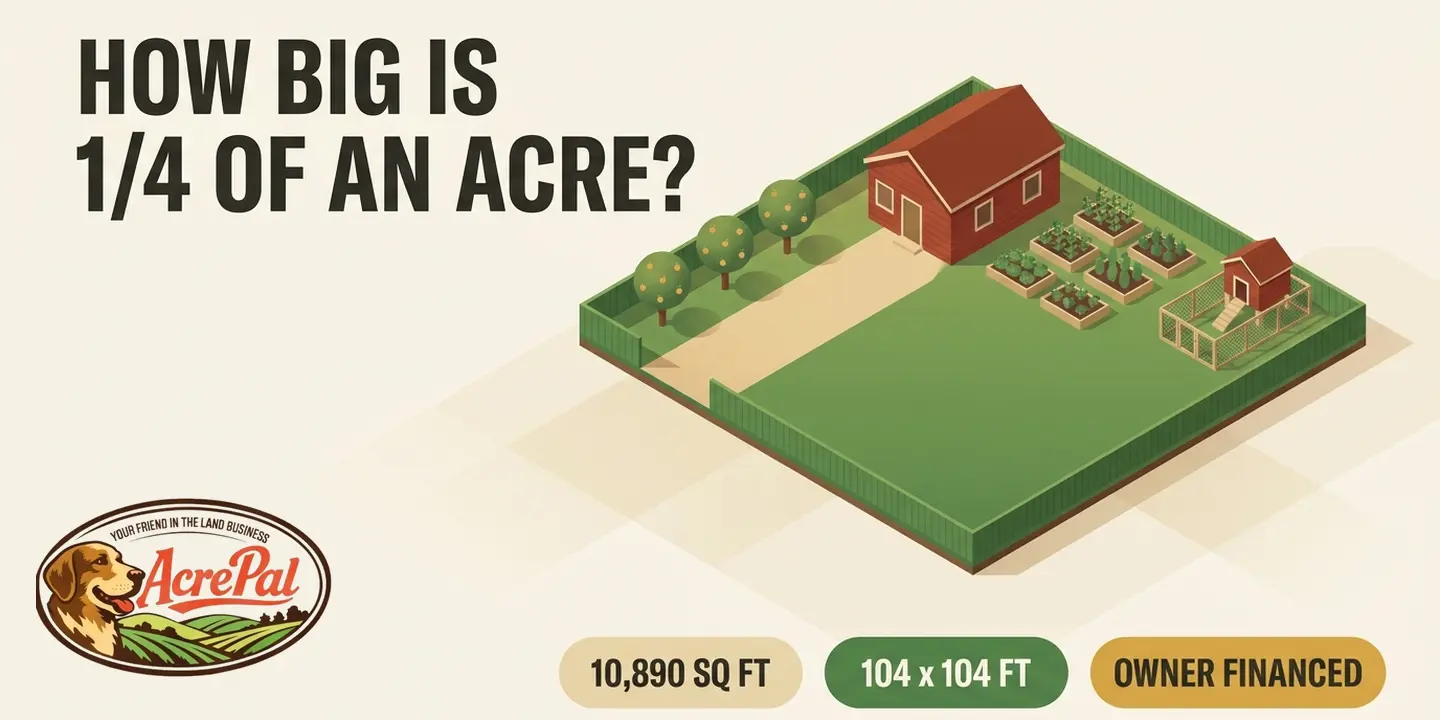
1/4 of an acre is exactly 10,890 square feet, or roughly a 104 by 104 foot square. That number is easy to look up, but it rarely settles the real question. What you actually want to know is what a quarter acre looks like when you stand on it, what you can build or grow, and what one costs in 2026.
So we go past the conversion. Below you get the exact math and dimensions, an honest visual you can picture, a side by side of the common lot fractions, and a straight answer on what fits. We also cover the stuff most pages skip, like whether a well and septic can share the lot, real 2026 prices, and monthly owner-finance numbers. Prices in 2026 swing from a few hundred dollars for raw rural dirt to $30,000 or more for a hooked-up suburban lot. We tell you what does not fit too, because that is the part that saves you money.
1/4 of an Acre in Square Feet, Dimensions, and Other Units
Start with the division. One acre is 43,560 square feet, so a quarter of that is exactly 10,890 square feet. As a perfect square, that lot runs about 104.35 feet on each side, with a diagonal of roughly 147.6 feet corner to corner.
Most real lots are not perfect squares, though. Any length times width that hits 10,890 square feet counts as a quarter acre. The common shapes all equal 10,890 square feet.
100 feet by 109 feet
90 feet by 121 feet
80 feet by 136 feet
If you think in other units, a quarter acre is 1,210 square yards, about 1,011.7 square meters, or roughly 0.101 hectares. Four quarter-acre lots fit inside a single acre, which is the cleanest way to hold the size in your head.
One correction is worth making, because a popular article gets it wrong. A quarter acre is not 1/16 of a square mile. A square mile holds 640 acres, and 640 times 4 gives you 2,560 quarter-acre lots, so a quarter acre is 1/2,560 of a square mile. One-sixteenth of a square mile would actually be 40 acres, which is a completely different animal. If you are sizing up instead of down, our 5 acres in square feet breakdown is the natural next step.
What 1/4 of an Acre Actually Looks Like
Picture a classic suburban yard from the 1950s and 60s. That plot, the one a 1,500 to 2,000 square foot house sat on for decades, is a quarter acre. After World War II it became the default American lot size, so odds are you have walked across dozens of them without counting.
The football-field correction
The lazy comparison you see everywhere is "about a fifth of a football field," and it is close but sloppy. A full NFL field with both end zones runs 360 by 160 feet, which is 57,600 square feet, or 1.32 acres. The playing area alone, no end zones, is 300 by 160 feet, so 48,000 square feet and 1.10 acres.
Against the full field, a quarter acre is about 19 percent of the surface. Put another way, it takes about 5.3 quarter-acre lots laid side by side to cover one football field. A regulation basketball court runs around 4,700 square feet, so roughly 2.3 courts fit on a quarter acre. Stand in one corner and the opposite corner sits only about 147 feet off, a walk of maybe 15 seconds.
The honest version
We are skipping the dollar-bill, iPhone, and parked-Tesla comparisons on purpose, because none of them help you picture standing on the dirt. A suburban yard and a fifth of a football field are things you have actually seen at human scale. If a quarter acre feels smaller than you hoped, 2 acres is the next honest step up to weigh.
1/10, 1/4, 1/3, and 1/2 Acre Compared
You are reading a listing, and the sizes are all fractions with no context. Here is the whole ladder in square feet so you can compare at a glance.
1/10 acre is 4,356 square feet, about a 66 foot square
1/8 acre is 5,445 square feet, about a 74 foot square
1/4 acre is 10,890 square feet, about a 104 foot square
1/3 acre is 14,520 square feet, about a 120.5 foot square
1/2 acre is 21,780 square feet, about a 147.6 foot square, the same length as a quarter-acre diagonal
1 acre is 43,560 square feet, about a 208.7 foot square
Now the trap that costs people money. A lot advertised as 10,000 square feet sounds bigger than a quarter acre, but it is not. Ten thousand square feet works out to just 0.2296 acres, which is less than a quarter acre by nearly 900 square feet. That gap between a 10,000 square foot lot and a true quarter acre is small on paper and easy to miss when you are comparing prices. If your search is heading the other direction, our 10 acres guide sits further up the same ladder.
What Actually Fits on a Quarter Acre (and What Does Not)
Setbacks shrink your lot before you place a single thing. On a 104 by 104 foot square with about 15 feet of setback on every side, the buildable core drops to roughly 74 by 74 feet, near 5,476 square feet. That is about half the lot you paid for, and it is the number that decides what is realistic.
Inside that reality, a lot still fits. A 1,500 to 2,000 square foot home with a two-car garage sits comfortably with room left for a driveway, a front lawn, and a private backyard. This was the postwar template for a reason.
The garden and orchard
Food is where a quarter acre punches above its size. Four to eight raised beds at 4 by 8 feet each, so 32 square feet per bed, run 128 to 256 square feet total and can supply a real share of your summer produce. Add three to five dwarf fruit trees at roughly 25 square feet of footprint apiece and you have a small orchard.
For scale, one viral video shows a 1/8 acre garden, half the size of your lot, feeding a family of six across the year. That means a quarter acre has genuine headroom. It also takes serious labor and skill, which the honest homesteaders will tell you straight.
Animals, what works and what does not
Chickens are easy. Six hens need only about 84 square feet total, roughly 24 for the coop and 60 for the run, which is nothing on 10,890 square feet, and many codes allow four to six birds.
Horses and cattle are a hard no. Guidelines from Rutgers put large animals at a two-acre minimum, so a quarter acre is one-quarter to one-eighth of the floor for a single animal. If livestock is the dream, size up before you buy, and our 3 acres guide shows the room that actually starts to work.
Can You Put a Well and Septic on a Quarter Acre?
Here is the question rural buyers forget to ask until the permit gets denied. Can a single quarter-acre lot hold both a private well and an on-site septic system? The geometry is brutal, and the honest answer is usually no.
A private well typically needs about 100 feet of clearance from the septic drain field, plus 50 feet from the tank, and some states push that separation to 200 feet. Your lot is only 104 feet on a side. Drawing a 100-foot buffer on a 104-foot square eats nearly the whole parcel, so fitting both systems with proper setbacks is often physically impossible and rarely permitted.
The rule of thumb tracks that math. Around 0.25 acres can be enough for septic alone if the lot is on public or municipal water. Once a private well enters the picture, most jurisdictions want 0.5 to 1 acre minimum. Texas is a clear example, requiring 0.5 acre with public water, 1.0 acre when a private well is added, and 2 acres for both in some areas.
Your move before you buy is simple. Call the county health department and ask, in writing, the minimum lot size for septic on a private well with no public hookup. Then ask whether aerobic or alternative systems, which need less drain-field space, are approved for constrained lots. That one phone call separates a buildable lot from an expensive mistake.
What a Quarter Acre Costs in 2026
Price depends almost entirely on location and whether utilities are already there, so the honest answer starts with "it depends." Then it gets specific fast. The national median for raw land in 2026 is about $22,682 per acre, which pencils a quarter acre at roughly $5,671 of raw land value.
Rural markets run far below that median. Real per-acre figures show the spread.
Costilla County, Colorado, median about $1,575 per acre, so a quarter acre lands near $400 to $900 at median-to-average rates
Elko County, Nevada, median about $1,187 per acre
Mohave County, Arizona, small parcels often listed under $8,000 cash
Modoc County, California, roughly $7,000 to $19,000 per acre, the cheapest land market in the state
Putnam County, Florida, 0.22-acre lots listed at $6,995 to $9,999, with a 0.32-acre lot changing hands in March 2026 for $14,434
County-wide averages mislead here, because improved parcels drag the number up. Putnam pencils out near $47,564 per acre on paper, yet its raw vacant lots stay in the single-digit thousands. Compare that to a utility-served suburban quarter acre in Florida, which can run $30,000 or more. The gap between raw rural dirt and a hooked-up suburban lot in the same state is often 10 to 20 times per acre, and it is almost entirely infrastructure. If low price is the whole goal, our cheapest places to buy land rundown goes deeper. For what it is worth, AcrePal sells owner-financed rural lots in exactly these counties, which is why the numbers above come from markets we know firsthand.
Owner-Financed Monthly Payments on a Quarter Acre
Skip the bank and the picture changes. Sellers who carry the note let you own a quarter acre on a monthly plan, and the real 2025 to 2026 examples are modest.
Putnam County, Florida, 0.22-acre lots at $189 to $199 per month for 60 months, no credit check
Mohave County, Arizona, small parcels at $99 to $149 per month
Texas quarter acre at $250 per month with $400 down
The terms are why this works for buyers banks turn away. Down payments run as low as $500 to $1,000, or typically 10 to 25 percent, against the 20 to 40 percent and 680-plus credit score a bank wants for raw land. Interest sits higher, around 8 to 15 percent, because the seller is carrying the default risk. Deals also close in 7 to 10 days instead of the 45 to 60 a mortgage takes.
Name the cost honestly, because there is one. An $8,000 lot at 10 percent over five years runs about $10,200 total, roughly $1,200 in interest. That premium is the price of skipping the bank, and it matters because the old system sidelines about 8 of 10 raw-land buyers with steep down payments and credit hurdles. For a lot you would otherwise never qualify for, plenty of buyers decide $1,200 over five years is a fair trade.
Before You Buy a Quarter Acre, a Quick Due-Diligence Check
A cheap lot is only a deal if you can actually use it. Run this short list before you sign anything.
Confirm legal and physical road access, or a recorded easement to reach the parcel
Get a perc test to prove septic will work, since that decides whether the lot is buildable at all
Check setback and lot-coverage rules that shrink your usable core
Verify zoning and allowed uses, including camping, an RV, a permanent structure, and chickens
Nail down the water source, public hookup versus private well, which ties straight back to the septic question
Pull back taxes and liens with the county treasurer before money changes hands
The through-line holds. A quarter acre is plenty for a home and a serious garden, but the paperwork decides whether one specific parcel delivers. Spend an afternoon on these checks and you protect the whole purchase.
Quarter-Acre FAQ
How big is 1/4 of an acre in square feet?
A quarter acre is exactly 10,890 square feet, since one acre is 43,560 square feet divided by four. As a perfect square it measures about 104.35 feet on each side. Common rectangular versions include 100 by 109 feet, 90 by 121 feet, or 80 by 136 feet.
How big is a quarter acre visually?
A quarter acre looks like a standard post-World War II suburban yard, the kind that held a 1,500 to 2,000 square foot house for decades. Compared to sports fields, it covers about 19 percent of a full NFL football field including the end zones, so a bit under a fifth of the surface.
How much does a quarter acre cost?
It varies enormously by location and utilities. Raw rural land in affordable markets can run a few hundred dollars to about $10,000 for a small lot, while a utility-served suburban quarter acre near town often costs $30,000 or more. The national median for raw land in 2026 is about $22,682 per acre, which puts a quarter acre near $5,671.
Can I put a well and septic on a quarter acre?
Usually not easily. A private well typically needs about 100 feet of separation from the septic drain field, and a 104-foot-wide lot barely provides that. Most jurisdictions require 0.5 to 1 acre when both a private well and on-site septic are needed. Call your county health department and ask about aerobic or alternative systems for tight lots.
Can I have chickens on a quarter acre?
Yes, in most cases. Six hens need only about 84 square feet total, roughly 24 for the coop and 60 for the run, which barely dents a 10,890 square foot lot. Many suburban and rural codes allow four to six hens. Always check local zoning and HOA rules, since some areas cap flock size.
Can I have horses or cattle on a quarter acre?
No. Horses and cattle need 1 to 2 acres per animal in nearly every US jurisdiction, and common guidelines set a two-acre minimum for large livestock. A quarter acre is only one-quarter to one-eighth of that floor. Raising large animals means sizing up well beyond a quarter acre.
Can I owner-finance a quarter acre with bad credit?
Yes. Most owner-financed land deals require no credit check, because the seller accepts a down payment in place of a credit review. Down payments often run 10 to 25 percent, sometimes as low as $500 to $1,000. Interest sits higher at 8 to 15 percent, and the seller holds title until you pay in full. These deals typically close in 7 to 10 days.
How does a quarter acre compare to 1/3 or 1/10 acre?
A quarter acre sits in the middle of the common ladder. One-tenth acre is 4,356 square feet, one-eighth is 5,445, one-quarter is 10,890, one-third is 14,520, and one-half is 21,780. Watch the listing trap, because a 10,000 square foot lot is only 0.2296 acres, slightly less than a full quarter acre despite the bigger-sounding number.