
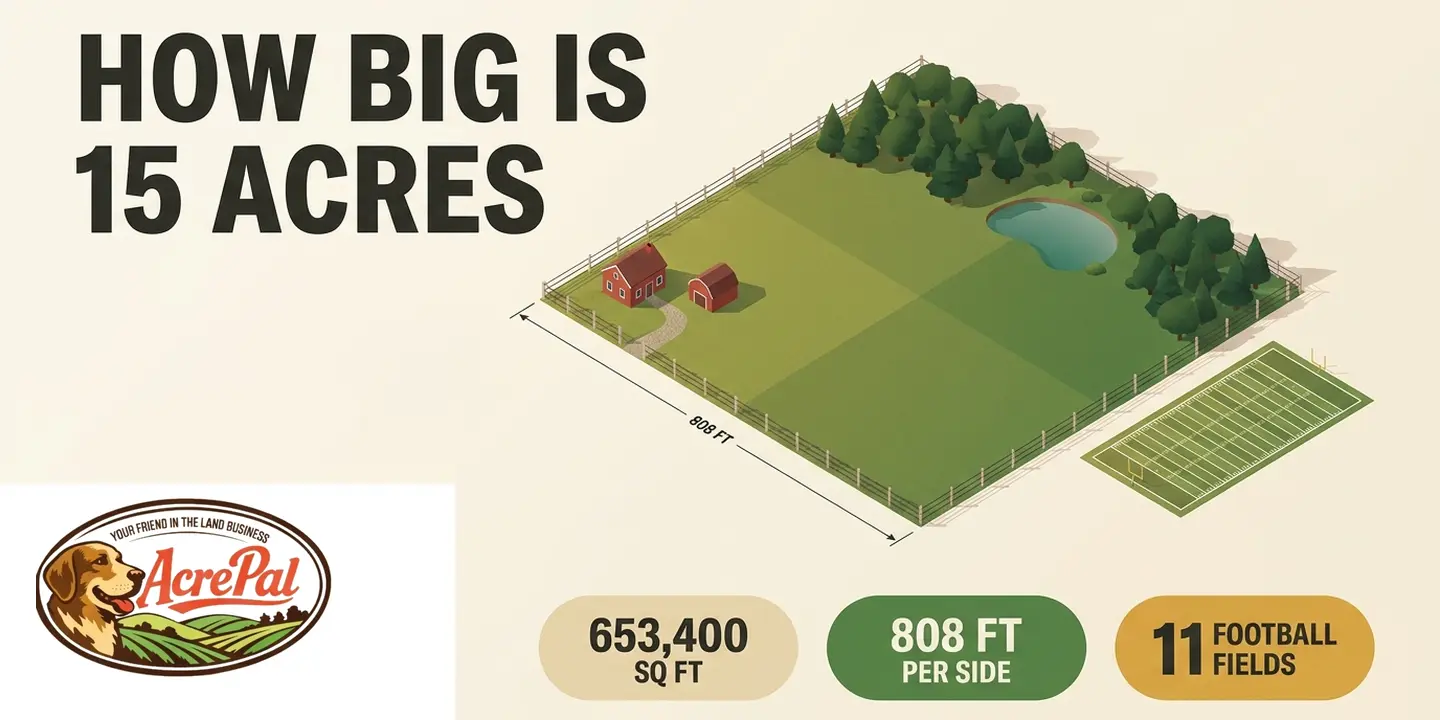
How big is 15 acres? It comes to 653,400 square feet, and if that land were a perfect square, each side would run about 808 feet. That means you could walk straight across it in roughly 3 minutes at a normal pace. So when you ask how big is 15 acres of land, the honest short answer is that it is a large, walkable parcel that still fits in one clear mental picture.
A lot of the pages that rank for this question contradict each other and get basic figures wrong. One claims it takes 3 hours to walk across, and another botches the metric conversion by a factor of ten. We wrote this guide to stick to numbers you can verify yourself with a calculator, so you are not building plans on a bad figure.
This article does two jobs. First, we give you an accurate picture of 15 acres in every unit and comparison that matters, from square feet to football fields to walk times. Then we help you decide whether 15 acres is actually enough for what you want to do with it, whether that is a homestead, running livestock, hunting, or just buying yourself some room and privacy. No hype, just the figures and the tradeoffs you will actually face.
15 Acres in Square Feet, Miles, and Other Units
The shape is what turns a raw number into something you can picture. A square 15-acre parcel measures about 808 feet on each side, which is roughly 2.7 standard city blocks in a 300-foot grid. That single figure does more work than any unit conversion, because it tells you how the land actually sits in front of you.
The clean conversions all trace back to the same base figure of 653,400 square feet.
- 653,400 square feet
- 72,600 square yards
- 60,703 square meters, which is 6.07 hectares
- 0.0234 square miles
That metric number is worth a second look. Some pages list around 6,073 square meters, which is off by a factor of ten. The real figure is about 60,703 square meters, so check your source if you see the smaller one.
One more useful frame. A US survey section is 640 acres, so 15 acres is about 1/42.7 of a section. Worth noting, 15 acres is not a clean part of the standard survey grid, since the standard aliquot parts are 640, 160, 40, and 10 acres and 15 falls between them. That matters for the legal description we cover later, because your deed will lean on a metes-and-bounds or lot description rather than a tidy fraction.
Keep these figures handy when you are scanning listings, since agents rarely translate acres into feet for you. Once you know the 808-foot side and the 653,400 square feet, you can sanity-check any parcel description in seconds.
If you want the full breakdown of how a 640-acre section is carved up, we cover it in our guide on how many acres are in a section of land.
What 15 Acres Looks Like in Football Fields and Landmarks
The football field is the comparison most people reach for first, and it is worth getting exactly right. Fifteen acres is about 11.35 NFL fields if you count the full field including the end zones, where each field is 1.32 acres. It works out to about 13.6 fields if you picture just the playing surface without the end zones, where each is 1.10 acres.
Both numbers are correct. They differ only because one includes the end zones and the other does not, so pick whichever field you actually picture in your head. Line up eleven full fields end to end and you have walked the area of your parcel.
For a landmark you can hold onto, think of Liberty Island in New York Harbor, home of the Statue of Liberty. Per the US Census Bureau it is 14.717 acres, so it is essentially a 15-acre island. Stand on the ferry, look at the whole island, and you are looking at roughly 15 acres. The original island before landfill was only about 4 acres, so most of what you see today is the size we are describing.
A few everyday-scale anchors round it out.
- About 2,400 standard parking spaces
- Roughly 3.6 Walmart Supercenters
- About 7.5 Manhattan-style two-acre blocks
None of these is a perfect match, but together they fence in the size from a few directions. If you have ever parked at a big stadium lot, you have already stood on something close to 15 acres. No single one of these nails it, but stacked together they give you a reliable feel for the size.
How Long It Takes to Walk 15 Acres
The walk math is the fastest way to catch a bad source, so it is worth getting right. Walking straight across a square 15-acre parcel, about 808 feet, at a normal 3 mph takes about 3 minutes. That is roughly the length of a short song.
Walking the full perimeter is a different trip. The perimeter of that square runs about 3,233 feet, or 0.61 miles, which takes about 12 minutes at the same pace.
- Across a square parcel, about 808 feet, roughly 3 minutes
- Around the full perimeter, about 3,233 feet, roughly 12 minutes
- Corner to corner on the diagonal, about 1,143 feet, useful for planning a sightline or a shooting lane
You will still find pages claiming it takes 3 hours to walk across, or that the parcel is 9 miles across. Both are wrong by somewhere between fifteen and sixty times over, because the across distance is only about 808 feet. The likely mix-up is that they confused the perimeter distance, the cross distance, and the area figure and let the numbers blur together.
Buyers genuinely search for a straight walk-time answer and rarely get one. A common Quora question even asks how long it takes to walk the perimeter of 15 acres, with no clean answer in sight. Now you have it, and you can check it in your own driveway with a stopwatch.
How Big Is 1.5 Acres Compared to 15 Acres
Fifteen acres and 1.5 acres are easy to mix up on a listing, and they are very different sizes. One missing decimal point changes the whole picture, so it is worth pinning both down side by side before you get attached to a price.
On its own terms, 1.5 acres comes to 65,340 square feet, about 255.6 feet per side as a square, with a perimeter around 1,022 feet, or about 0.19 miles. In football-field terms that is roughly 1.36 fields. A relatable anchor is a typical big-box store parking lot, or a little under one standard city block per side.
Set the two against each other and the gap is obvious.
- Square feet, 65,340 for 1.5 acres versus 653,400 for 15 acres
- Per side as a square, about 255.6 feet versus about 808 feet
- Football fields, about 1.36 versus about 11.35
Fifteen acres is ten times the land of 1.5 acres. If you are comparing listings, check the decimal point carefully, because that one dot is the difference between a large homestead and a generous suburban lot. It also swings the price, the tax bill, and what you can legally do with the land, so it is not a rounding detail to gloss over.
Is 15 Acres a Lot of Land or Is It Enough
Fifteen acres is a genuinely large parcel for most uses. It is big enough to run a serious homestead, yet small enough that one person or one family can actually manage it without a crew.
The homestead proof point is real, not theoretical. Homesteader Justin Rhodes feeds a family of seven from a 15-acre rotational setup, using mobile chicken coops moved daily and multi-species stacking so every animal has a job to do fertilizing the ground. That is a working system, not a brochure.
Push the design further and the ceiling climbs. A carefully planned 15-acre layout can theoretically produce around 60,000 pounds of food a year, with something like 65 raised beds and 140 fruit trees. Be honest with yourself, though. That is a designed maximum after years of buildout, not what you harvest in year one.
On privacy, 15 acres usually delivers. With a road setback and a tree buffer along the edges, you get real seclusion from neighbors, the kind of parcel real estate listings describe as far removed from everyday noise. Subdivision is possible too, but whether you can split it depends on your county's minimum lot size, so check the local rule before you count on it.
Owner-financed rural parcels in this size range are exactly what we focus on at AcrePal, and real buyers do reach them on ordinary incomes. One buyer picked up a house plus 15 acres for about $140,000 on a $65,000 income.
If you want more room to spread out, our guide on how big 20 acres is covers the next step up, and for a deeper look at land pricing we break it down in how much 50 acres of land costs.
How Many Cows or Animals 15 Acres Can Support
There is no single answer here, and that is the honest part most quick guides skip. The number of cattle 15 acres can carry swings by about 150 times depending on your region and rainfall. Grass type and management push it further still, so a neighbor's stocking rate tells you almost nothing about your own.
The ranges swing hard from one region to the next.
- East Texas improved pasture, roughly 5 to 15 cow-calf pairs on 15 acres, or 1 to 3 acres per animal unit
- Average managed pasture, roughly 3 to 7 pairs
- West Texas native range, only about 0.1 to 0.4 pairs, needing 35 to 150 acres per animal unit
That spread is why the generic "1 cow per acre" rule you see online is dangerous. In a dry region it will lead you straight into overgrazing, and overgrazing 15 acres even once can set pasture recovery back a couple of years.
A couple of definitions make those numbers usable. One animal unit is a 1,000-pound cow with her calf, and it eats roughly 26 pounds of dry forage a day. If you are running smaller stock instead, plan on about 5 sheep or 5 to 7 goats per animal unit.
The right method is not complicated. Check your pasture type, get the forage rate for your area from the NRCS or a local extension office, and then build in a 20 to 25 percent safety margin so a dry year does not wreck your grass. The NRCS and groups like Texas AgriLife Extension and the Texas Landowners Association publish these rates for a reason, so use them instead of guessing from a neighbor's herd.
Is 15 Acres Enough for Hunting
The answer depends on your weapon, so start there. For bow hunting deer, 15 acres is viable in decent cover, since 10-plus acres is the working minimum. For rifle hunting deer, 15 acres sits below the comfort line, because rifle hunting is marginal under 25 acres for one hunter and really wants 50-plus for two or more.
Habitat quality beats raw acreage. A well-featured small parcel can out-hunt a big flat one every season.
A real Kansas case makes the point. A 15-acre permission piece with a creek running through the center, several draws, heavy wooded cover, and elevation change in one corner produced a trophy buck in only two sits. It was one of the most wooded properties around, and the deer had room to disappear in the middle of it.
The features that make a small parcel huntable are consistent.
- A water source, which is king for pulling wildlife in
- Heavy cover the deer can hide in
- Elevation change and draws that funnel movement
- A border on larger timber or ag fields
- Established deer travel corridors running through it
The main limitation is worth respecting. On small acreage a wounded deer can wander onto a neighbor's land, so access discipline, entry and exit routes, and playing the wind matter more than they would on a big tract. Bow-versus-rifle rules and small-parcel baiting laws also vary by state, so confirm your local regs before you plan a hunt.
The Shape and Fencing Reality of 15 Acres
That neat 808-foot square we have been using is a convenient fiction. Real 15-acre parcels are rarely perfect squares, and the shape changes everything about what fencing costs.
Take the same 15 acres as a long 200-by-3,267-foot strip. Its perimeter is 6,934 feet, more than twice the 3,233-foot perimeter of the square. Same acreage, more than double the fence, so more than double the cost.
For the square case, the real installed numbers for that 3,233-foot perimeter run like this.
- Barbed wire, about $9,700 to $19,400
- Woven or field fence, about $4,850 to $19,400
- No-climb horse fence, about $9,700 to $16,200
Call the headline range roughly $10,000 to $20,000 to fence a square 15 acres, and remember the perimeter you are paying for is the same 0.61 miles you would walk in about 12 minutes. A narrow strip of identical acreage can push the bill past $40,000.
There is a paperwork wrinkle too. Because 15 acres is not a clean part of the survey grid, it gets described by metes-and-bounds or by a lot number rather than a tidy fraction of a section. That is normal, but confirm the legal description is unambiguous before you close.
A little homework saves real money. Get the actual dimensions from the deed or the county GIS instead of assuming a square, budget for gates and corner bracing on top of the per-foot cost, and get three bids after closing since terrain and soil hardness move the price. If you are curious how perimeter distance scales on smaller parcels, we cover it in how many miles ten acres is.
Frequently Asked Questions About 15 Acres
How big is 15 acres in square feet and football fields?
Fifteen acres is exactly 653,400 square feet. In football-field terms that is about 11.35 NFL fields if you include the end zones, where each field is 1.32 acres, or about 13.6 fields if you count only the playing surface without end zones. Both numbers are right, they just measure the field differently.
How long does it take to walk across 15 acres?
For a square 15-acre parcel, the sides run about 808 feet, so walking straight across at a normal 3 mph takes about 3 minutes. Walking the full perimeter, about 3,233 feet or 0.61 miles, takes about 12 minutes. Ignore any page claiming it takes 3 hours to walk across, since the across distance is only 808 feet.
How many cows can you have on 15 acres?
It depends entirely on region and pasture type. East Texas improved pasture can carry roughly 5 to 15 cow-calf pairs on 15 acres, average managed pasture lands around 3 to 7 pairs, and arid West Texas native range supports under half a pair. Skip the generic "1 cow per acre" rule, since it causes overgrazing in dry country.
Is 15 acres enough to homestead?
Yes, with the right approach. Homesteader Justin Rhodes feeds a family of seven from a 15-acre rotational setup using mobile coops and multi-species stacking, so the acreage is plenty for serious food production. Most homesteaders point to the 15 to 40 acre range as the common starting point for a self-sufficient operation, with water, soil, and management skill mattering as much as size.
How big is 1.5 acres?
One and a half acres is 65,340 square feet, or about 255.6 feet per side as a square, with a perimeter near 1,022 feet. That is roughly 1.36 football fields, or about one tenth of 15 acres. The two sizes are easy to confuse on a listing, so always check the decimal point before comparing prices.