
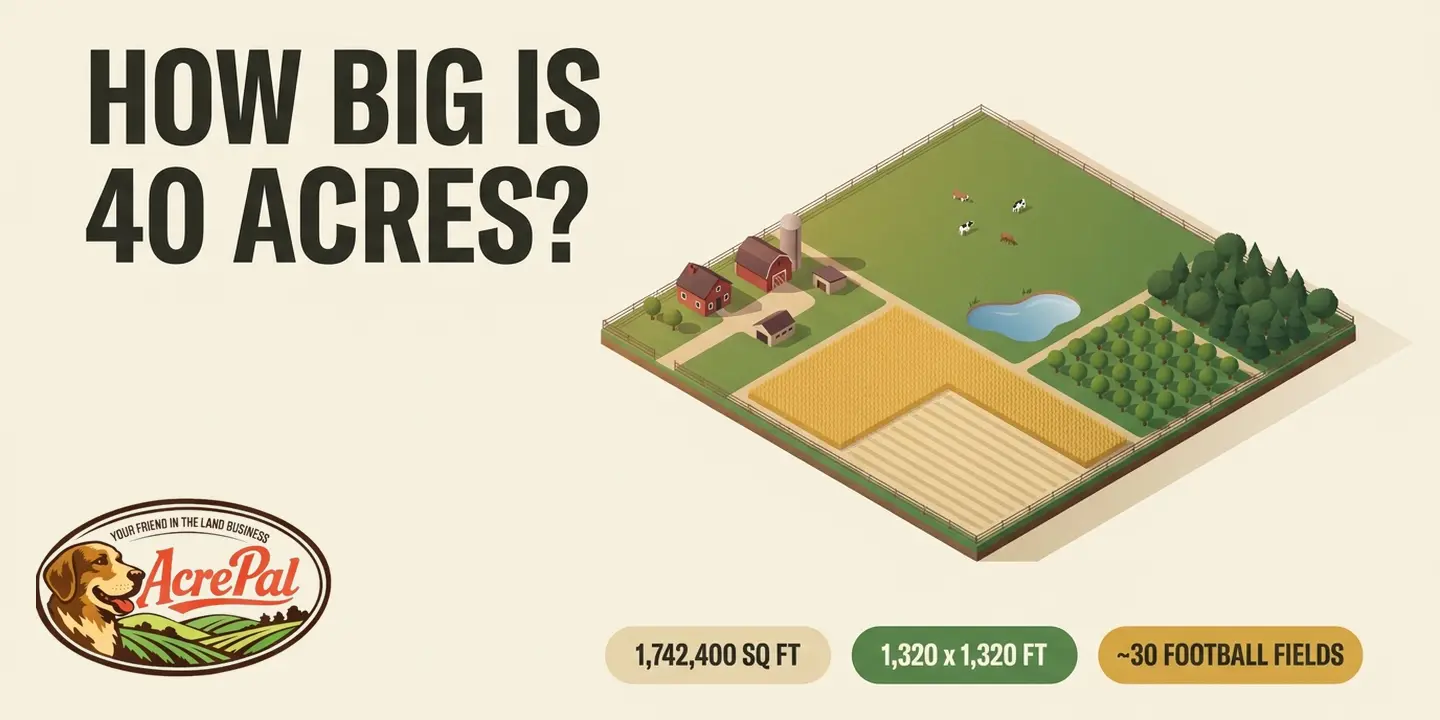
40 acres is 1,742,400 square feet, a square about 1,320 feet on each side, which works out to exactly a quarter mile per side and roughly 30 football fields. Fenced as a square, its perimeter runs exactly one mile, so a lap around the boundary is a genuine mile walk. You have heard the size before too, because it is the "forty" behind "40 acres and a mule," the standard parcel the American land survey was built around. Size is the easy part, so this guide also covers what 40 acres is actually for, what it holds, and what it costs in 2026.
40 Acres in Numbers, the Exact Size
The math is simpler than it looks. One acre is 43,560 square feet, so 40 acres is just that figure times 40. Everything else is a conversion of the same number.
- 1,742,400 square feet (the square-feet figure is the one most buyers search for).
- 193,600 square yards.
- 0.0625 square miles, which is exactly one sixteenth of a square-mile section.
- About 16.19 hectares.
- As a square, 1,320 feet on each side, which is exactly a quarter mile per side.
- A perimeter of 5,280 feet, which is exactly one mile, so it is easy to fence and easy to remember.
- A diagonal of about 1,867 feet corner to corner.
For anchors you can actually feel, 40 acres is about 30 football fields including the end zones, since each field covers 1.32 acres. It is also roughly 24 soccer fields, or about 371 basketball courts. Walk straight across one side at a normal pace and it takes about five minutes. That one-mile perimeter also means a full perimeter fence runs about a mile of wire, roughly $15,800 to $42,000 at $3 to $8 per linear foot for barbed wire.
One mix-up trips up a lot of first-time buyers. A true 40-acre square is 1,320 by 1,320 feet, not some stretched rectangle, though real parcels on the ground are rarely perfect squares.
Why 40 Acres Is Everywhere, the Quarter-Quarter and the Mule
Forty is not a random number. It is baked into how America was surveyed and sold, which is why it shows up again and again in listings and deeds. The system that did it is the Public Land Survey System, and the hierarchy is easy to follow.
A section is one square mile, 640 acres. Cut that into four and you get a quarter-section of 160 acres, the exact amount the Homestead Act of 1862 handed to settlers. Cut one of those quarters into four again and you land on 40 acres, the piece old-timers nicknamed "a forty." In 1832 the federal government dropped the minimum land purchase to 40 acres, and that decision locked the size into American land culture for good.
The payoff shows up every time you read a deed. Because of this survey grid, most rural land is legally described in aliquot parts, so a title might read like the NW1/4 of the NE1/4 of Section 34, which is simply one 40-acre forty. That phrasing is why so many rural Americans still call a 40-acre parcel a forty.
The phrase itself carries real history. "40 acres and a mule" comes from General Sherman's Special Field Order No. 15 in January 1865, which set aside coastal land in 40-acre plots for freed families, a promise President Andrew Johnson reversed later that same year.
For a buyer today, the forty is the most commonly sold rural parcel in the country, which means clean legal descriptions and easy comparable sales.
What 40 Acres Looks Like Next to Land You Know
Numbers stay abstract until you stack them against land you have already stood on. A typical suburban lot is about a quarter acre, so 40 acres is roughly 160 of those lots side by side. Step up from the parcels most buyers picture and the scale starts to click.
It is more than 13 times a 3-acre parcel and four times a 10-acre parcel. Put another way, it is double a 20-acre parcel laid end to end. At a quarter mile per side, a square 40 covers about the footprint of a small neighborhood grid, and the one-mile perimeter means a full lap is a mile walk or a short bike ride.
In practical terms, you can drop a house, a barn, a pond, a big garden, and a woodlot on 40 acres and still have open ground to spare. Stand in the center and every boundary sits about 660 feet away, close enough to see but far enough that the land feels genuinely private. Yet it stays small enough that one family can genuinely manage it and walk every corner, which is exactly why it works for so many of the uses below.
What You Can Actually Do With 40 Acres
Forty acres sits in a sweet spot. It is big enough to do real things and small enough for one household to run without hired help. The best use depends on your goal, so match the land to what you actually want out of it.
- Self-sufficient homestead. A family can grow most of its food on under 5 acres of the parcel, which leaves the rest for orchard, pasture, pond, and woodlot, and a fully used 40 can produce a large food surplus. This is one of the strongest states for homesteading plays when the land and climate line up.
- Small or hobby cattle ranch. Very workable in the humid East, but 40 acres is too small for a commercial cattle operation in the arid West, which the next section breaks down honestly.
- Hunting and recreation. Plenty of room for deer and small game, with a common guideline of 1 to 5 percent of the land in food plots, so roughly half an acre to 2 acres of plots. At a healthy whitetail density near one deer per 43 acres, and up to one per 5 acres in prime habitat, a 40 can hold a real resident herd.
- Timber or woodlot. A real income stream worth roughly $3,000 to $8,000 an acre in standing hardwood, and owners who brought in a professional forester before a timber sale averaged about 23 percent more income per acre.
- Subdivide. A 40 splits cleanly into four 10-acre or eight 5-acre parcels where local zoning allows it.
- Long-term hold. A tangible asset with no depreciation that tends to hold its value over time.
Most buyers end up blending two or three of these on the same parcel. A homestead core, a hunting woodlot, and an ag exemption can all live on one 40 at the same time.
How Many Cows 40 Acres Really Holds
You will read online that 40 acres holds 9 cows. In the arid West, that number can honestly be zero. The whole gap comes down to rainfall and how much forage the ground actually grows, not the acreage on the deed.
Ranchers measure this with animal units. One animal unit is roughly a 1,000-pound cow with her calf, and how many of those a parcel feeds swings hard by region. The honest spread runs wide.
- Humid Southeast pasture in states like Tennessee, Arkansas, Alabama, and Georgia. Roughly one cow-calf pair per 1.5 to 2 acres, so a well-managed 40 might carry 20 or more pairs.
- Arizona and high-desert rangeland. Often one pair per 25 to 50-plus acres, so 40 acres may carry only one or two pairs, and in a drought year, none.
- Nevada and New Mexico desert. Thinner still, sometimes zero to one pair on the whole 40.
The animal you run matters too. A horse needs about the same forage as a cow, while goats and sheep pack in tighter per acre. In hilly, poor-forage country like the Texas Hill Country, some ranchers drop cattle entirely and switch to sheep for better return per acre. Before you count on any stocking number, confirm the local rate with your county extension office, because they know your soil and rainfall better than any national average.
What 40 Acres Costs in 2026
The price swing on 40 acres is enormous. The same acreage can run from about $12,000 to well over half a million dollars depending on where it sits and what comes with it. Real 2026 prices break down by market.
- Cheap arid West in New Mexico, Nevada, and remote Arizona. About $300 to $2,000 an acre, so a 40 lands between $12,000 and $80,000. These are usually the cheapest places to buy land in the country.
- Colorado San Luis Valley in Costilla County. Around $1,575 an acre, so about $63,000 for 40 acres.
- Humid Southeast pasture. About $3,000 to $8,000 an acre.
- Desirable or near-metro farmland. Roughly $8,000 to $15,000-plus an acre, which puts a 40 at $320,000 to $600,000.
Buying big usually earns a discount. Per-acre prices tend to drop as parcel size rises, so 40 acres almost always costs less per acre than a 5-acre lot in the same county. Cheap western 40s are also often sold with owner financing, with down payments around $100 to $1,000 and monthly payments near $89 to $299, no bank and no credit check. If a western parcel is what you are picturing, AcrePal sells owner-financed rural land across the West on acrepal.com, in the Arizona, Colorado, and Nevada markets where 40-acre parcels are common.
The sticker price is not the whole cost. Cheap raw land often arrives with no road, no water, and no power, so budget for access, a well, and utilities on top of it. A well alone can run $10,000 to $60,000 with no guarantee of hitting water, and out West, water rights can matter more to value than the land itself. The upside is the tax break, since 40 acres clears the ag or greenbelt minimum in nearly every state, which can cut the assessed value and the tax bill sharply, with a rollback tax owed only if you later pull the land out of the program.
How Big Is 50, 200, 300, and 10,000 Acres?
Once you have 40 acres anchored in your head, every bigger size scales straight from it, because each is just another multiple of the same 43,560-square-foot acre. Picture the 40, then stack it or split it.
- 50 acres. About 2,178,000 square feet, roughly 38 football fields, a square about 1,476 feet per side.
- 100 acres. About 4,356,000 square feet, roughly 76 football fields, a square about 2,087 feet per side.
- 200 acres. About 0.31 square miles, roughly 151 football fields, a square about 2,951 feet per side.
- 300 acres. About 0.47 square miles, roughly 227 football fields, a square about 3,615 feet per side.
- 640 acres. Exactly one square mile and about 484 football fields, a full section, the parcel every other size is carved from.
- 10,000 acres. About 15.6 square miles and roughly 7,576 football fields, a square nearly four miles per side, larger than plenty of small towns.
Each of these is just a stack of that same acre, so once you can picture 40, you can picture any of them. Double it, halve it, or multiply by sixteen to reach a full section. It scales without any new math.
How Big Is 40 Acres, Frequently Asked Questions
How big is 40 acres in square feet?
Forty acres is 1,742,400 square feet. Drawn as a perfect square, that is about 1,320 feet on each side, which works out to exactly a quarter mile per side. The perimeter comes to exactly one mile, and the corner-to-corner diagonal runs about 1,867 feet.
How many football fields is 40 acres?
About 30 football fields, counting both end zones. A full NFL field including its end zones covers 1.32 acres, and 40 divided by 1.32 lands right around 30. If you count only the 100-yard playing field without end zones, it climbs to roughly 36 fields.
Why is 40 acres such a common size?
Because it is the smallest standard parcel in the U.S. land survey, the quarter-quarter section that folks call a forty. A section holds 640 acres, a quarter of that is 160 acres, and a quarter of the quarter is 40. In 1832 the government made 40 acres the minimum you could buy, which cemented the size.
How much does 40 acres cost in 2026?
Anywhere from about $12,000 for remote western desert to $600,000 for desirable farmland near a metro. Cheap arid land in New Mexico, Nevada, and remote Arizona runs roughly $300 to $2,000 an acre. Humid Southeast pasture sits around $3,000 to $8,000 an acre, and owner financing is common on the cheaper western parcels.
How many cows can you keep on 40 acres?
It depends almost entirely on rainfall. In the humid Southeast, a well-managed 40 can carry 20 or more cow-calf pairs. On arid Western rangeland in Arizona, Nevada, or New Mexico, the same 40 acres may support only one or two pairs, and in a hard drought, none at all.
Is 40 acres enough for a homestead?
Yes, comfortably. A family can grow most of its own food on under 5 acres of the parcel and still have room left for an orchard, pasture, a pond, and a woodlot. The real challenge on 40 acres is rarely land area. It is infrastructure like a well, a road, power, and housing.
What is "40 acres and a mule"?
It is a Civil War promise. General Sherman's Special Field Order No. 15, issued in January 1865, set aside confiscated coastal land in 40-acre plots for about 18,000 freed families, and the Army later lent mules for farming. President Andrew Johnson reversed the order that same fall and returned the land to former planters, which is why the phrase endures as a broken promise.
How big is 50 vs 200 vs 10,000 acres?
Fifty acres is about 38 football fields and a square roughly 1,476 feet per side. Two hundred acres covers about 0.31 square miles, or around 151 football fields. Ten thousand acres jumps to about 15.6 square miles, which is larger than many small towns and a square nearly four miles per side.