
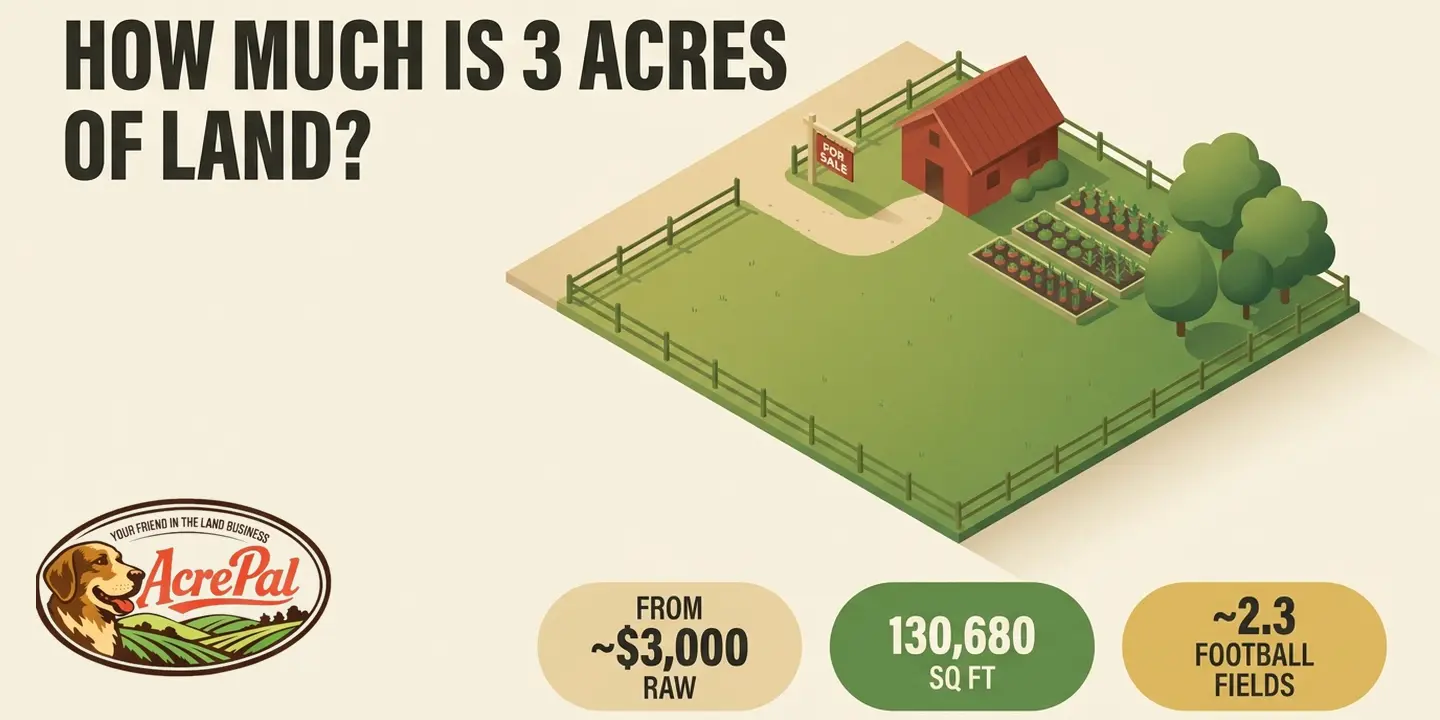
Three acres of raw rural land runs roughly $6,000 to $60,000 in most affordable-to-midtier markets. The cheapest high-desert counties can put 3 acres near $3,000 to $5,000, while metro-fringe parcels push past $200,000 for the same acreage. So how much is 3 acres of land really comes down to where it sits, not how many acres you get. The number swings on location, road access, and utilities far more than on the size of the parcel itself.
Most pages hand you one national average and tell you to multiply it by three, which is the one thing you should not do. We would rather give you the real ranges, show you what 3 acres actually feels like on the ground, walk through the hidden costs, and run the monthly math so you know the all-in number before you fall for a low sticker.
The Short Answer: What 3 Acres Costs in 2026
The honest answer is a range, and where your parcel lands depends on a handful of price drivers we will get to. The tiers break down like this for 3 acres of land in 2026.
Cheapest rural markets, like high desert in rural New Mexico and Nevada or Colorado's San Luis Valley, run about $3,000 to $10,000 for 3 raw acres
Mid-tier rural land, where per-acre prices sit around $5,000 to $15,000 in rural Florida, North Carolina, and Tennessee, puts 3 acres near $15,000 to $45,000
Near-town or lightly improved parcels with power and road frontage often run $60,000 to $200,000 and up
Metro-fringe land climbs higher still, sometimes far past the improved range
For raw undeveloped land, per-acre prices in the cheapest states sit far below any farm benchmark. New Mexico runs about $100 to $500 an acre, Nevada $150 to $600, and Wyoming $150 to $700 in 2026, so 3 raw acres in the right county can total less than a used car.
For context, USDA pegged 2026 farm real estate at about $4,500 per acre, cropland near $6,020, and pasture around $2,000. Multiply the farm-real-estate figure by three and you get roughly $13,500 for 3 acres. That number sounds tidy, but it blends productive farmland with remote raw desert and tells a raw-land buyer almost nothing useful. Your parcel is not the national average, and the cost of 3 acres in one county can be triple what it is one county over.
There is no single price, only a range, and the drivers below decide where you land in it.
How Big Is 3 Acres, Anyway?
Three acres works out to 130,680 square feet, which is a lot more ground than most people picture. Laid out as a perfect square, that is roughly 361 feet on each side, though real parcels are rarely square and often stretch long and narrow along a road. In metric terms you are looking at about 1.21 hectares.
To picture it, line 3 acres up against a few familiar things.
About 2.3 American football fields including the end zones, since one field covers 1.32 acres
Around 12 quarter-acre suburban lots set side by side
Roughly 14,520 square yards
About 27 basketball courts
That footprint is spacious and genuinely private, the kind of room where a neighbor's window is not part of your daily view. Walk the perimeter of a square 3-acre lot and you cover nearly a quarter mile, about 1,446 feet, which is why the interior feels so removed from the road. It is not a ranch, and it will not swallow a cattle herd, but it is a big step up from a typical subdivision lot. If you want the tier below, 2 acres still feels roomy, while 10 acres starts to read as real acreage. For reference, a single 10,000-square-foot building pad is just under a quarter acre, so 3 acres gives you many times that to work with.
Why You Cannot Just Multiply the Average Price by Three
Nearly every cost-of-an-acre page follows the same shortcut. It quotes one average, then quietly implies that 3 acres costs three times as much. That math breaks in three important ways.
First, national and even statewide averages blend productive farmland with remote raw desert and dozens of unrelated markets. Irrigated cropland and off-grid scrubland get averaged into the same number, so the figure is a mirage for anyone shopping for raw rural land.
Second, small parcels carry a per-acre premium, not a discount. A 1-to-10-acre lot usually prices higher per acre than a 100-acre tract down the road, because more buyers can afford a small piece and each parcel carries its own survey, legal, and closing costs. A small, well-placed lot often sells for much more per acre than a big undeveloped tract sitting right next to it.
Third, statewide averages hide brutal county-to-county swings. Raw desert in Mohave or Apache County might trade near $500 to $2,000 an acre while a Phoenix-fringe lot commands many times that, yet a single Arizona average folds both into one figure. So price your parcel from sold comps for similar 3-acre lots in the specific county, not from a state or national number. That is the only figure that reflects what buyers actually paid nearby.
What Actually Sets the Price of 3 Acres
Take the same 3 acres and drop it in two different spots, and the price can swing by a factor of ten. These are the levers behind that spread, ordered roughly by how much each one moves the number.
Location relative to a town or growth corridor is the biggest lever, full stop. Proximity to jobs, services, and paved roads sets the ceiling on everything else.
Legal access and road quality come next. Paved or maintained frontage can cost two to five times what a landlocked or dirt-access parcel does, and a truly landlocked lot with no legal easement is the deal-killer to watch for.
Utilities at the lot line versus raw ground matter a lot. Power, water, and a septic-ready site already in place save you tens of thousands.
Water specifically deserves its own line. An existing well or a live creek can add anywhere from $5,000 to $30,000 or more to a parcel's value.
Zoning and buildable area decide what you can legally do today, from a home to livestock to a short-term rental.
Topography rounds it out. Flat, cleared, high-and-dry ground beats steep slopes or floodplain every time.
Access is where cheap listings hide their catch. A parcel with paved, county-maintained frontage can list for two to five times an otherwise identical lot reachable only by a dirt track, and a landlocked parcel with no recorded easement can be nearly impossible to build on, finance, or resell at any price. Access and location together decide most of the spread, so chase those two first, because a cheap price tag on a landlocked parcel is rarely the bargain it looks like.
Real 3-Acre Prices in Today's Market
Averages are useful, but real listings tell the truth. Cheapest first, this is what 3 acres of land actually trades for in 2026.
Costilla County, Colorado, in the San Luis Valley, has 5-acre parcels listed from about $5,000 to $9,995, which implies roughly $3,000 to $6,000 for 3 acres
Elko County, Nevada, has 2-acre lots at $5,999 to $9,999 with annual taxes of just $25 to $35, putting 3 acres in the high single thousands
Remote New Mexico high desert often runs $300 to $600 per acre, so 3 acres can land near $1,000 to $2,000
Step up to rural North Florida and a real $69,900 listing in Jefferson County buys 3 acres with a block house, a well, septic, and power already in place
Rural North Carolina shows $79,900 for 3.67 acres
The jump from the first three bullets to the last two is what trips buyers up. Raw land and improved land are different products at the same acreage, and the price gap is really the cost of the well, septic, power, and structure someone already paid for. A $3,000 desert parcel and a $70,000 Florida homestead are both 3 acres, but you are buying very different things.
In the cheapest markets, financing is built for small budgets. Sellers like Classic Country Land move 5-acre San Luis Valley parcels with as little as $199 down and $249 in closing costs, no credit check on properties under $30,000. Holding costs stay just as light, since raw parcels like these often carry annual property taxes well under $100.
Some of these low-cost counties are exactly where we operate. AcrePal sells owner-financed rural land in several of them, including Mohave and Apache in Arizona, Costilla in Colorado, Elko in Nevada, Modoc in California, and Putnam in Florida, which is one straightforward route into the cheapest markets to buy land. Everything past that is just doing your homework on the specific parcel.
The Costs Hiding Behind the Sticker Price
The purchase price rarely tells the full story, and on raw land the development costs can quietly exceed what you paid for the dirt. There are two buckets to plan for, and most of them are per-parcel costs, not per-acre, which is one more reason multiplying by three misleads you.
One-time buying costs apply to almost every purchase.
Survey, roughly $500 to $2,000
Title search and insurance, about $200 to $1,000
Closing and recording fees, around $250 to $800
Perc test if you plan to install septic, about $300 to $1,500
If you intend to build or live on the land, add the big-ticket items.
Drilling a well, about $6,000 to $20,000
Installing septic, roughly $5,000 to $25,000
Extending power to the site, $2,500 to $12,500 and up
Driveway and clearing, about $2,500 to $7,500
The small stuff adds up faster than buyers expect. A common first-year budget for a single $3,900 raw acre, once you add survey, title, a perc test, and basic access clearing, lands around $8,700, and that is before a well, septic, or power line ever enters the picture. Put those together and a $6,000 raw 3-acre parcel can need another $40,000 to $60,000 before it is truly buildable. Cheap land is rarely the whole cost. On the holding side, property taxes on cheap raw land commonly run just $25 to $400 a year, and many rural parcels carry no HOA at all.
Budget the all-in number before a low sticker tempts you. That said, if you only plan to camp, hunt, or hold the land as it sits, most of those build costs never apply.
How People Actually Pay for 3 Acres
Banks are not eager to finance raw land, especially remote parcels under 10 acres. They typically want 20 to 35 percent down, strong credit around 680 or higher, and a clear building plan, which prices out most cheap-land buyers before they start. That gap is where owner financing does its work.
With owner financing, the seller carries the note. That usually means 10 to 20 percent down, and on cheap parcels some sellers ask as little as $199 to $300 to get started, with no credit check and a close measured in days. The deed transfers to you once the balance is paid off. The trade-offs are real. Rates run higher, often 8 to 12 percent versus a conventional loan, terms sometimes end in a balloon payment, and you should watch for monthly-payment marketing that advertises a low number while hiding the total price and rate. One recent reel pitched 2 acres in Nevada at $289 a month with no total price anywhere in sight, which is exactly the setup to distrust.
The monthly math on two realistic 3-acre parcels looks like this.
A $9,000 parcel with 20 percent down leaves $7,200 financed. At 10 percent over 10 years, that is about $95 a month.
A $30,000 parcel with 20 percent down leaves $24,000 financed. At 10 percent over 10 years, that is about $317 a month.
Before you sign anything, convert the monthly offer back to a total price and interest rate. A comfortable payment on a badly priced parcel is still a bad deal.
What 3 Acres Can Actually Hold
Homesteaders often call 3 to 5 acres the sweet spot, and 3 acres sits right at the front door of that range. It is enough room to build a real life without the scale, cost, or upkeep of a working ranch. What fits comfortably.
A home plus a genuine yard with deep privacy, roughly the space of 12 quarter-acre lots
A serious food garden, since a well-run 1,500-to-2,000-square-foot raised-row plot can feed a family
Chickens, rabbits, and a few goats
Fruit trees, a shed, and a well and septic set with proper setbacks
Buffer land left over for a workshop, a pond, or just breathing room
A full off-grid layout usually consumes only about half the parcel, roughly 65,000 to 80,000 square feet for the house, drain field, garden, and animal pens, which leaves real buffer around the edges. Productivity comes from system design more than raw acreage. An intensively managed one-acre farm in Vermont, Small Axe, grosses around $250,000 in food per season, which shows how much a small, well-planned footprint can do.
There are limits worth being honest about, though. What 3 acres cannot do.
Run cattle at herd scale, since you should budget at least an acre per cow
Guarantee total isolation from every neighbor
By itself promise year-round off-grid self-sufficiency
For most homestead, recreational, or single-home plans, though, 3 acres is genuinely enough. That is a big part of why so many people search for it in the first place.
Frequently Asked Questions
How much does 3 acres of land cost?
Three acres of raw rural land typically costs between $6,000 and $60,000 in most affordable-to-midtier markets in 2026, with the cheapest high-desert counties running $3,000 to $10,000 and lightly improved near-town parcels reaching $60,000 to $200,000 and beyond. The exact price hinges on the county, road access, and whether utilities are already in place, so always check sold comps for similar parcels nearby rather than a national average.
How big is 3 acres?
Three acres is 130,680 square feet, or about 361 feet per side if you shape it as a square. That is roughly 2.3 football fields including end zones, about 12 quarter-acre suburban lots side by side, 14,520 square yards, or around 1.21 hectares. It reads as spacious and private for a home and garden, but it is smaller than a working ranch.
Is 3 acres enough to homestead?
Yes, 3 acres is enough for most homesteads and sits at the low end of the 3-to-5-acre sweet spot many homesteaders favor. It comfortably holds a house, a family-scale food garden, chickens, rabbits, a few goats, fruit trees, and a well and septic with buffer to spare. It will not support cattle at herd scale or guarantee full off-grid self-sufficiency on its own, but for gardens, small livestock, and privacy it does the job.
Can I buy 3 acres of land with no credit check?
Yes, owner financing lets you buy 3 acres with no credit check, since the seller carries the note instead of a bank. On cheap parcels, some sellers ask as little as $199 to $300 down and can close in a matter of days, with the deed transferring once you finish paying. Expect higher interest rates, often 8 to 12 percent, and sometimes a balloon payment, so read the full terms before you commit.
Why does cheap land per acre not mean cheap 3 acres?
Small parcels carry a per-acre premium rather than a discount, so a 3-acre lot often prices higher per acre than a nearby 100-acre tract. Each parcel also carries its own one-time costs like survey, title, and closing, which are per-parcel rather than per-acre. On top of that, national averages blend farmland with remote raw land, so multiplying a headline average by three rarely matches what a real 3-acre parcel sells for.
What is the monthly payment on owner-financed 3 acres?
Monthly payments usually land somewhere between $95 and $320 for typical owner-financed 3-acre parcels. A $9,000 parcel with 20 percent down leaves $7,200 financed, which runs about $95 a month at 10 percent over 10 years, while a $30,000 parcel under the same terms runs about $317 a month. Always convert any advertised monthly figure back to the total price and interest rate before signing.