
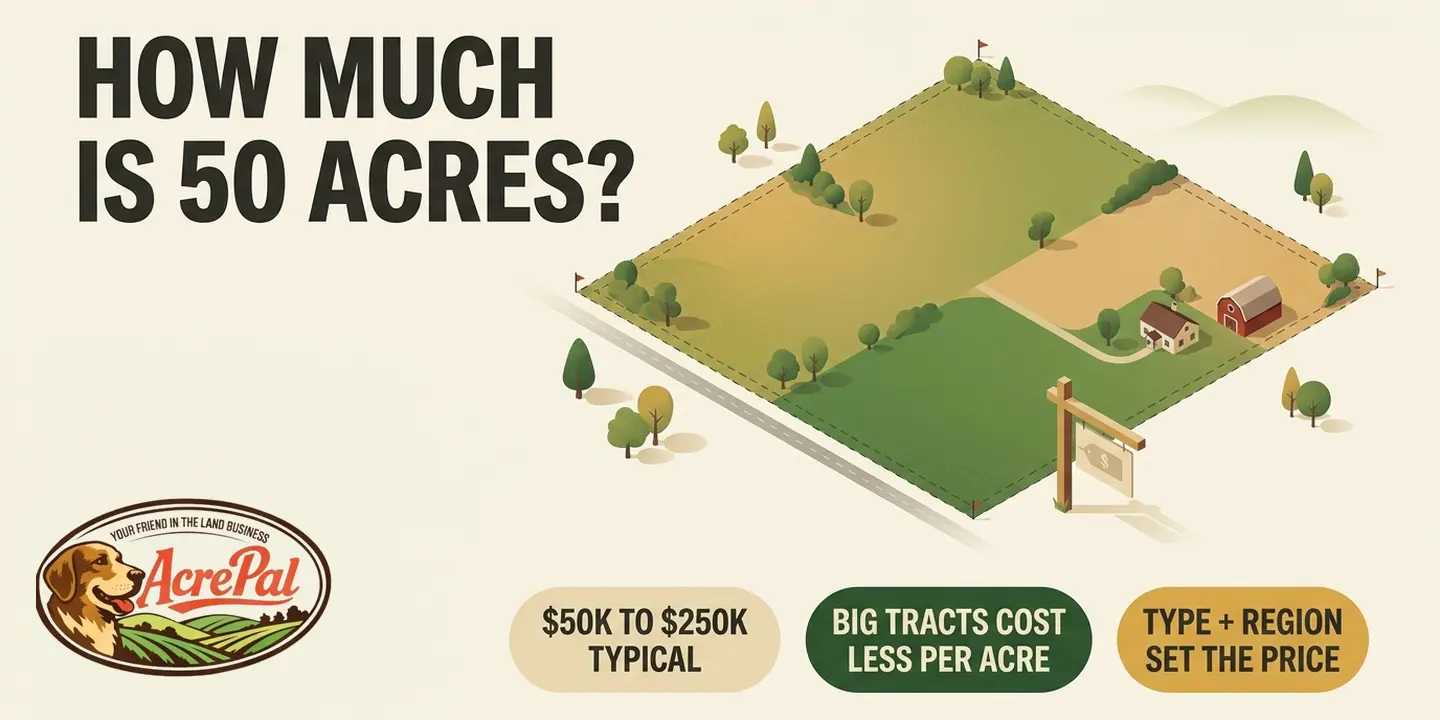
Most people figure out the price of 50 acres the same wrong way. They find a per-acre number from a small listing, multiply it by 50, and walk away with a figure that misses reality by a mile. A 50-acre tract almost never costs 50 times what a single acre costs, because the per-acre price falls as the tract gets bigger.
So how much is 50 acres? Most rural 50-acre tracts bought for homesteading or recreation run $50,000 to $250,000. The floor sits around $25,000 for remote western desert, and the ceiling climbs past $500,000 for near-metro land or prime cropland. Where your tract lands in that range depends on two things, and neither of them is a national average.
Before the money, a quick sense of scale. 50 acres is 2,178,000 square feet, a square about 1,476 feet per side, or roughly 38 football fields laid out end to end. It is a lot of ground, and most of it is not the kind of high-value acreage a small homesite listing implies.
This guide walks you through what 50 acres actually costs, why bigger tracts cost less per acre, what drives the number up or down, the costs that hit after closing, how to pay for it, and how to check whether a listing is priced fairly.
How Much a 50-Acre Tract Actually Costs
One number needs throwing out before anything else. The most-quoted "average" land price is USDA farm real estate at $4,500 per acre in 2026. That figure covers active farmland with buildings, irrigation, and working infrastructure, not raw vacant ground. It badly overstates what a raw-land buyer pays. Raw vacant rural land runs closer to $1,500 to $2,500 per acre nationally, and often far less.
Once you use realistic per-acre numbers, the 50-acre totals sort into clear bands by land type and region.
- Remote western raw land (New Mexico, Nevada, northern Arizona), $500 to $1,500 per acre, about $25,000 to $75,000 total.
- National pastureland at $2,000 per acre (USDA 2026), about $100,000 total.
- Mid-South rural recreational land (Kentucky, Tennessee, Missouri), $2,000 to $4,000 per acre, about $100,000 to $200,000. A real example, a 50-acre Kentucky tract with a cabin and creek listed at $110,000, or $2,200 per acre.
- Productive cropland at $6,020 per acre nationally, about $301,000 total.
- Near-metro or development land at $10,000-plus per acre, $500,000 and up.
That pastureland number swings hard by region too. USDA puts Mountain-state pasture near $946 per acre, about $47,300 for 50 acres, against Southeast pasture around $5,720 per acre, roughly six times higher for the same use. The national $2,000 figure is a blend, not a quote for your county.
Region alone can swing the number harder than most buyers expect. In Texas, where land averages $5,158 per acre statewide, 50 acres runs about $139,000 in Far West Texas at $2,787 per acre, about $385,000 in the Hill Country at $7,704 per acre, and about $571,000 on the Gulf Coast at $11,423 per acre. Moving 200 miles inside one state can change your total by $200,000 or more. If a low sticker price is your priority, our guide to the cheapest place to buy land breaks down where the deals actually are.
Land type plus region set the band you are shopping in, not a national average. Once you know your type and your region, you can start pricing your specific tract instead of guessing.
Why 50 Acres Costs Less Per Acre Than a Single Acre
One rule trips up almost every first-time buyer. The bigger the tract, the lower the price per acre. This is not a rounding effect, it is the core math of land pricing, and it holds across nearly every market in the country.
Real closed-sale data from a single market shows the curve plainly. In that market, 2 acres sold at $12,000 per acre, 8 acres at $9,000 per acre, 50 acres at $4,200 per acre, and 190 acres at $2,200 per acre. Same area, same dirt, wildly different per-acre prices. Brokers see the same tiers everywhere, with 1 to 5 acre lots often running $5,000 to $8,000-plus per acre, 10 to 40 acres near the local market average, and 100-plus acres frequently below it. Small parcels commonly cost 30 to 100 percent more per acre than large tracts in the same area.
Three forces drive this gap. First, more buyers can afford a small total price, so competition bids small lots up. Second, fixed costs like survey, title, and access get spread over fewer acres on a small parcel, raising the per-acre cost. Third, small lots attract homesite buyers paying residential-adjacent prices, while a big tract has lower-value interior acreage and a smaller pool of buyers who can write the check.
The lesson follows directly, so never price a 50-acre tract off a 1-acre listing. If your only comps are small lots, expect your 50-acre per-acre figure to land 20 to 40 percent lower than those small-lot prices. It helps to have a feel for scale here too, since our breakdown of how big 40 acres really is shows just how much interior ground a large tract carries. Worth noting, the old 5x to 10x small-tract premium has compressed since 2007 as demand for big tracts rose, so the discount is real but not as steep as it once was. Benchmark your tract against other same-size tracts, and the pricing snaps into focus.
What Drives the Price of Land
Two 50-acre tracts in the same county can differ by 5x in price. Same size, same region, radically different numbers. The gap comes from a handful of factors that appraisers weigh and adjust for, and once you know them you can read almost any listing.
- Location is the single biggest factor. Distance to a growing town can swing otherwise identical land by 10x.
- Road access matters enormously. Paved county frontage is worth 2 to 5 times a dirt-road or easement parcel, and landlocked land is worth 60 to 75 percent less. Appraisers typically dock around 40 percent for no legal access, and up to 75 percent in practice.
- Water carries real weight. A well or a live creek adds $5,000 to $30,000-plus, and water rights hold serious value out West.
- Utilities move the number. Power and a septic-ready site add roughly 25 percent over raw off-grid land, with electric-only access adding about 10 percent.
- Zoning and allowed use shift value up or down. Residential zoning adds about 30 percent and commercial about 20 percent over agricultural, while a conservation designation cuts roughly 30 percent.
- Land type changes everything. The same ground as pasture versus cropland can differ 2 to 3x. In Ohio, pasture runs about $4,150 per acre against cropland at about $9,750 per acre.
- Terrain and shape close the list. Flat, usable, well-shaped acreage beats steep, rocky, or fragmented ground, with flat land adding about 15 percent and steep terrain cutting about 30 percent.
These are the same adjustments an appraiser applies on top of a comparable sale, and together they explain almost every gap between two similar-size tracts. If water is your concern, our guide on the cost of digging a well is worth a read before you fall in love with an off-grid parcel. This tract type is best for buyers who want recreation, a homestead, or a long-term hold, and worth skipping if you need immediate residential value on every acre, since the interior ground rarely delivers that.
The Costs That Come After the Purchase Price
The sticker price is only the start, and the costs that follow surprise a lot of buyers. Closing costs on a 50-acre purchase run roughly $2,000 to $5,000. That covers a title search at $200 to $600, title insurance at $500 to $2,000, a survey at $1,500 to $3,000 for 50 acres, plus recording fees and an attorney where your state requires one.
If the land is raw, you face development costs before you can live on it, and they add up fast. Expect a floor of $28,000 to $62,000 all in.
- Well, $5,000 to $15,000, with deeper western wells costing more.
- Septic, $6,000 to $15,000, after a perc test at $750 to $2,000 first.
- Power, $2,500 to $12,500 to pull from the road, or $15,000 to $35,000 for an off-grid solar setup.
- Driveway or road, $5,000 to $20,000.
- Permits, $2,000 to $5,000.
- Clearing, $2,000 to $8,000.
- A 15 percent contingency on top, because something always runs over.
One insight changes how you should think about a cheap tract. These development costs barely move with acreage. A well costs about the same on 5 acres as on 50. So on a cheap western tract, development can equal or exceed the land price itself, and a $35,000 tract can total $80,000-plus by the time you can live on it. One small-parcel breakdown showed a $3,900 lot reaching about $8,700 in the first year once survey, title, perc, driveway, and clearing were added, roughly 2.2 times the sticker. Our full breakdown of well and septic installation costs and getting utilities on land will help you build a realistic all-in number.
The perc test is the one to run before you buy, not after. A failed perc can force an engineered septic system at $10,000 to $25,000, and that alone can wreck the math on an otherwise cheap parcel. Make a passing perc test a written condition of your offer, so a bad result lets you walk instead of paying to find out.
How to Pay for 50 Acres
A regular mortgage does not apply to raw land. Lenders treat vacant ground as a higher-risk loan, so the terms look nothing like a home loan. Bank land loans typically want 35 to 50 percent down on raw land, a credit score of 700 or better, and short terms of 2 to 5 years. Many banks will not lend on raw land under $50,000 at all. On a $100,000 tract, that down payment is $35,000 to $50,000 out of pocket before you own anything.
Owner financing is the common rural path, and it works differently. You buy directly from the seller and pay monthly, usually with 10 to 20 percent down, 6 to 10 percent interest, and no bank credit check. Many owner-financed deals include a balloon payment due in 5 to 10 years, meaning the remaining balance comes due in one lump sum, so plan for that in advance. On a $100,000 tract, owner financing means $10,000 to $20,000 down and roughly $720 a month at 8 percent on a 25-year amortization. If you want the mechanics in full, our guide on how to buy land with no money covers the low-and-no-down approaches.
Two government-backed paths exist for genuine farming intent. Farm Credit lenders and the USDA Farm Service Agency serve working ag buyers, and the FSA Down Payment program asks just 5 percent down. It requires 3 or more years of farm experience and productive agricultural land, so it is not a fit for a recreational buyer. Note that USDA home loans cannot be used to buy raw land at all.
This is exactly why AcrePal owner-finances its rural acreage in Arizona, Colorado, Nevada, California, and Florida. You get onto a tract for a low down payment and a manageable monthly payment instead of scraping together a bank's 40 percent. Owner financing means you buy the land directly from us and pay it off in monthly installments, no bank required. For most rural 50-acre buyers, owner financing is the path that actually gets them onto the land.
How to Tell If a 50-Acre Listing Is Priced Fairly
You do not need an appraiser to sanity-check a price. A five-move method gets you close enough to negotiate with confidence.
- Pull 3 to 5 closed sales, not listings, of 30 to 100 acre parcels in the same county from county assessor or tax records, from the last 12 to 18 months. Listings are aspirational, closed prices are the truth.
- Compute the per-acre price for each closed sale and average them.
- Adjust for your parcel's differences using the appraiser factors. Add about 20 percent for paved access or subtract about 40 percent for landlocked, add about 25 percent for full utilities, add about 15 percent for flat or subtract about 30 percent for steep, and add about 30 percent for residential zoning.
- Apply the tract-size discount. If your comps are small lots, knock 20 to 40 percent off the per-acre figure, then multiply by 50.
- Compare your number to the ask. More than 20 percent above your figure is likely overpriced, and more than 20 percent below deserves suspicion about title, access, or zoning problems.
Put it to work. Say a 50-acre tract asks $4,500 per acre, or $225,000. If nearby 50-acre parcels closed at $3,500 to $4,000 per acre, that ask sits 12 to 28 percent above the comps, so you offer in the $4,000 range unless the parcel clearly earns the premium. The strongest confirmation is three numbers that agree, your own comps, a free online estimator, and one professional opinion.
For any purchase over $100,000, a vacant-land appraisal at $300 to $700 pays for itself many times over. If you are buying to generate income, our guide on how to make money from your land can shape which parcel you chase in the first place. Comps beat any national average every time, so build your number from real closed sales and hold your offer to it.
FAQ
How much does 50 acres of land cost?
Most rural 50-acre tracts run $50,000 to $250,000. Remote western land falls around $25,000 to $75,000, national pastureland lands near $96,000, productive cropland runs about $291,500, and near-metro or development land climbs past $500,000. Land type and region set the band, so the same acreage swings wildly depending on where it sits and what it can be used for.
How much is an acre of land?
Raw rural land runs roughly $1,500 to $2,500 per acre nationally. It ranges from $200 to $500 per acre in states like New Mexico, Wyoming, and Nevada, up to $10,000 to $65,000 per acre in New Jersey, Massachusetts, Connecticut, and Hawaii. The often-quoted USDA figure of $4,500 per acre includes buildings and infrastructure, so it overstates what raw land actually costs.
Why doesn't 50 acres cost 50 times a 1-acre lot?
Because per-acre price falls as tract size rises. In one market, 2 acres sold at $12,000 per acre while 50 acres went for $4,200 per acre and 190 acres for $2,200 per acre, same area throughout. Small lots commonly cost 30 to 100 percent more per acre than large tracts, driven by more buyers, spread-out fixed costs, and homesite demand.
How do you finance 50 acres of raw land?
Three paths exist. A bank land loan wants 35 to 50 percent down with short 2 to 5 year terms, owner financing asks 10 to 20 percent down with no bank and often a balloon payment, and USDA FSA serves working farmers with 5 percent down. Most rural buyers use owner financing. Note that USDA home loans cannot buy raw land.
How big is 50 acres?
50 acres is 2,178,000 square feet, a square about 1,476 feet per side, or roughly 38 football fields. It works out to about 1/13 of a standard 640-acre section of land. Walking the full perimeter takes about 45 to 60 minutes at a steady pace, which gives you a real sense of the scale.