
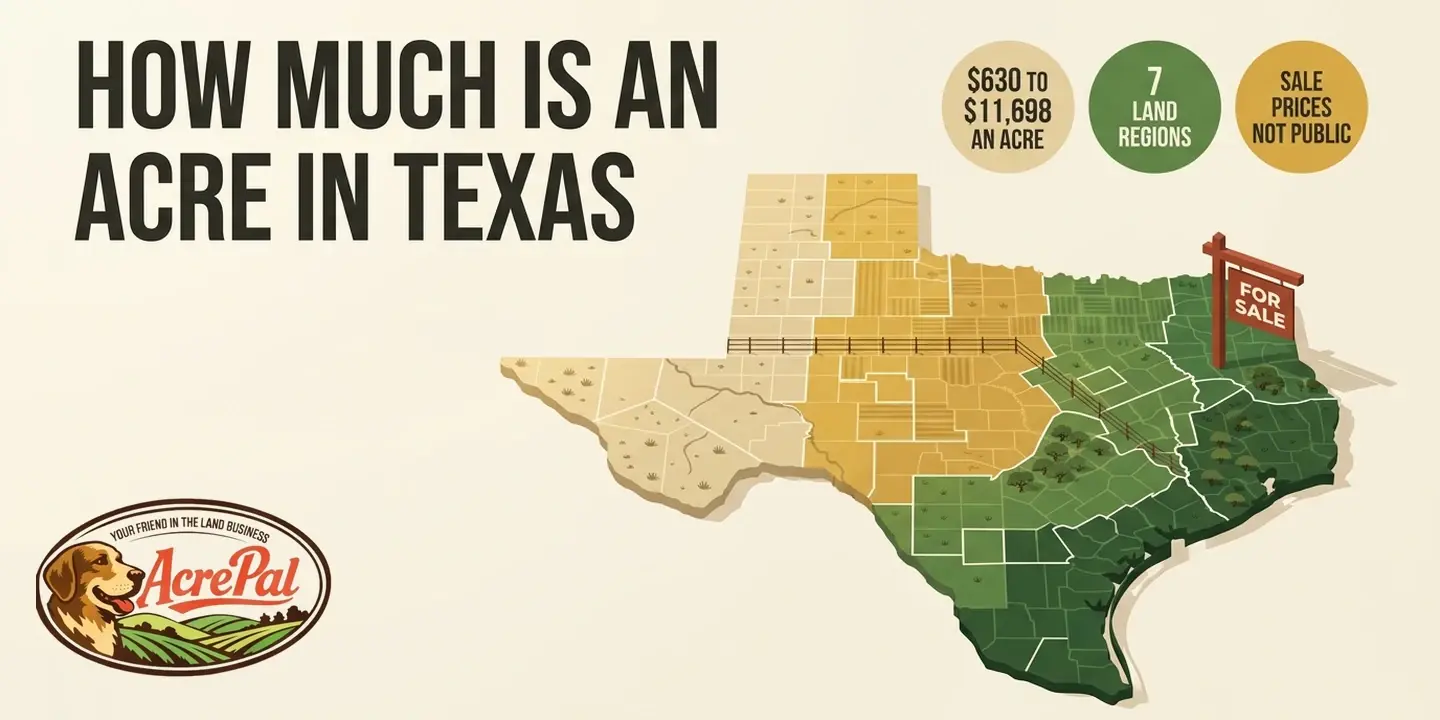
Texas rural land averaged $5,246 per acre in the first quarter of 2026, according to the Texas Real Estate Research Center at Texas A&M University. In that same quarter, an acre ran from $630 in Far West Texas to $11,698 in the Gulf Coast and Brazos Bottom, more than eighteen times the price inside a single state. The honest answer to how much is an acre of land in Texas begins with where you are standing, not with a statewide average.
No two published sources agree on that statewide number, and there is a specific legal reason. Texas is a non-disclosure state, which means what the tract next door sold for is not public record. Every average price per acre in Texas you will find, including the one above, is built from a partial view of the market.
Below are all seven regional numbers with the quarter each came from, what the most-quoted Texas average leaves out on purpose, what an acre costs you every year after you own it, and how to price the parcel in front of you.
Texas Land Prices by Region, From $630 to $11,698 an Acre
The published price per acre in Texas is not one number, it is seven. TRERC prices seven regions separately, and here is where all seven stood in the first quarter of 2026.
- Region 1, Panhandle-South Plains. $1,828 per acre, up 1.67 percent year over year. Price has "remained in the $1,800s since 2Q2024."
- Region 2, Far West Texas. $630 per acre, down 7.89 percent.
- Region 3, West Texas. $2,947 per acre, up 12.87 percent to a new high, which TRERC calls "by far the largest percentage increase" of the seven.
- Region 4, Northeast Texas. $8,960 per acre, up 0.98 percent, and below the $9,159 reported the prior quarter.
- Region 5, Gulf Coast-Brazos Bottom. $11,698 per acre, up 9.83 percent.
- Region 6, South Texas. $6,277 per acre, up 4.76 percent, just short of the $6,324 high set in 1Q2024.
- Region 7, Austin-Waco-Hill Country. $8,028 per acre, up 8.27 percent, another new high for the region.
Statewide, TRERC put the figure at $5,246 per acre for the quarter, up 6.02 percent year over year. Three regions sit below it, Regions 1, 2 and 3, and four sit above, Regions 4, 5, 6 and 7. Only Regions 1 and 2 come in under half the statewide number.
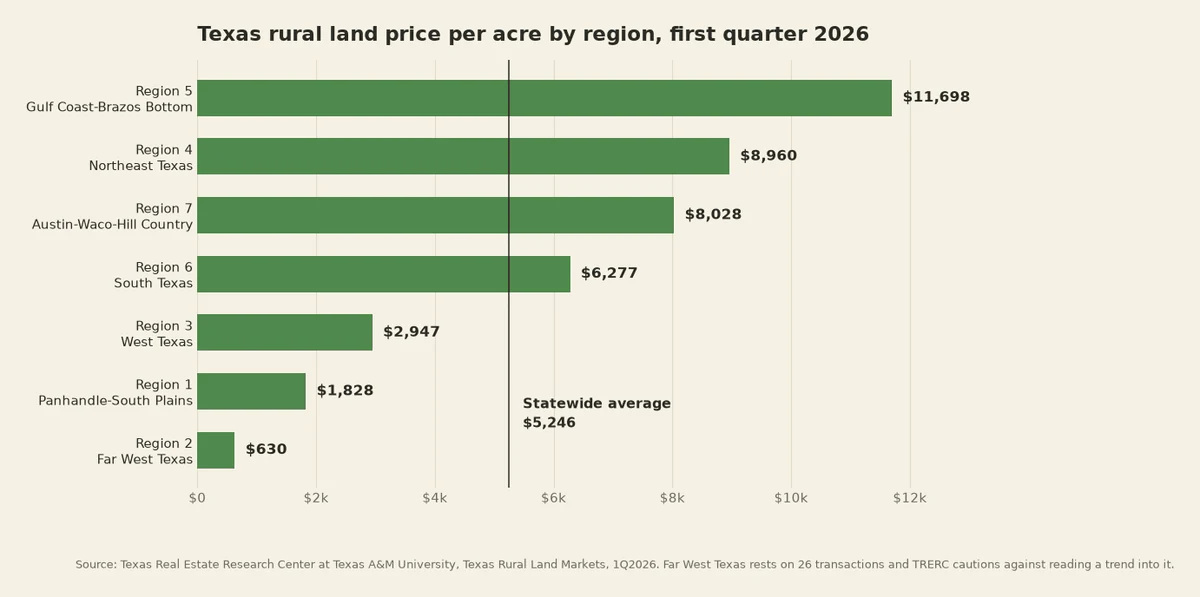
The cheapest figure is also the least reliable, and TRERC says so. On Far West Texas the report warns, "Lack of a sufficient volume of transactions makes it difficult to accurately estimate trends in this region." The region recorded 26 transactions in the quarter. When the publisher tells you not to lean on a number, the warning is worth more than the number.
Region 1 covers the Panhandle and South Plains in the far north, Region 2 the far western corner, Region 3 a broad band through the middle west. Region 4 is the northeast quadrant, Region 5 the coastal southeast, Region 6 the southern wedge running to the Rio Grande, and Region 7 the central corridor. TRERC prints the region map with county boundaries on page 3 of its quarterly report, and its Rural Land Data dashboard has a County to Region reverse lookup.
Of the six competing pages we could retrieve, none cites a TRERC region by its published number, and one Texas county is named across all six combined. Credit where it is owed, landboss is the only one that dates its figures throughout, and its heading "Why one acre in Texas can cost $1,800 or $100,000+" admits the spread.
Why Nobody Can Tell You What the Tract Next Door Sold For
In most states you can look up what a property sold for. In Texas you cannot.
Guadalupe Appraisal District puts it plainly on its own public page. "Texas is a non-disclosure state which means property owners are not required to provide details on their recent acquisition of real property..."
Johnson County's Central Appraisal District said the same in its 2025-2026 reappraisal plan. "Because Texas is a non-disclosure state, there are no publicly available sources of sales information."
Three pieces of law produce that result. No Texas statute compels a buyer or a seller to report what a parcel sold for. Tax Code Section 22.27(a) reaches what is voluntarily disclosed, so prices given to an appraisal office or the comptroller after a promise of confidentiality "are confidential and not open to public inspection." Government Code Section 552.149(a) excepts from the Public Information Act "Information relating to real property sales prices... received from a private entity by the comptroller or the chief appraiser..."
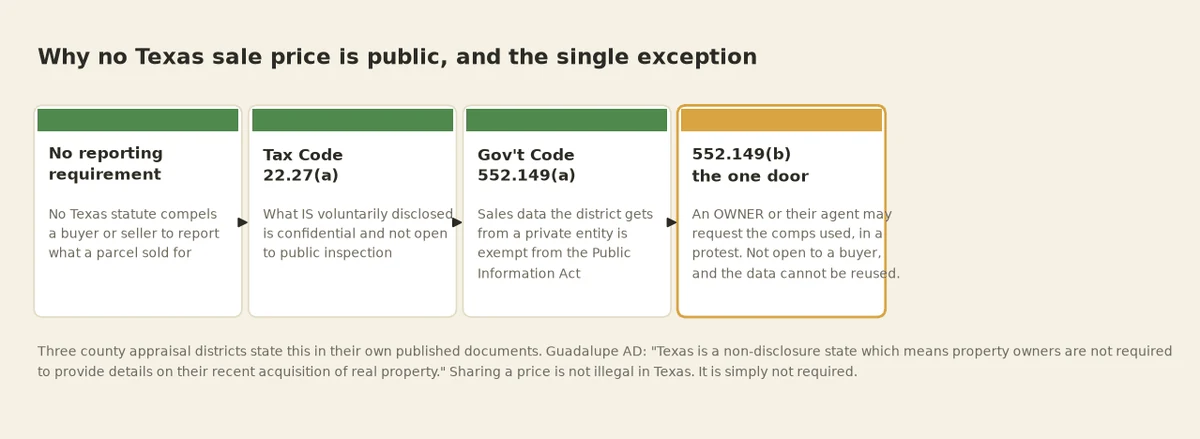
None of that makes it illegal to share a sale price. A buyer and a seller may tell anyone they like what they paid. Texas simply declines to require reporting, and locks up what the appraisal district receives.
So how does anyone know anything? Travis Central Appraisal District answers that in its own reappraisal plan. "Since Texas does not require full sales disclosure of sales transactions, the District will obtain sales prices through deeds, voluntarily disclosed closing statements, fee appraisals... buyer and seller mailed questionnaires, or third-party sources such as real estate agents and market data vendors."
Guadalupe, Johnson and Travis say it independently, each in its own published document, and that patchwork is why published Texas land prices disagree.
One narrow opening exists, and it is not available to you as a buyer. Government Code 552.149(b) provides that "the property owner or the owner's agent may, on request, obtain from the chief appraiser comparable sales data... at the hearing on the property owner's protest." Three limits ride along. It runs to the owner or the owner's agent, it attaches to a protest rather than a general records request, and the data "may not be disclosed or used for any purpose except as evidence or argument at the hearing." Johnson County calls it the sales used to value your own property, "but no other sales information."
Search that same set of six pages, whole, navigation and footer included, and the phrase non-disclosure state appears zero times.
Where the $5,246 Figure Comes From and What It Leaves Out
TRERC or Texas A&M gets named 22 times across those six pages as the source of a Texas land number. None tells you what that dataset is. Here is TRERC's own description.
"Nominal price per acre is the four-quarter, moving median price per acre segmented by size of property sold in each region. Statewide prices are a weighted average of those regional prices. Weights are determined by the amount of land in each region..."
So it is a rolling median by region, weighted into one statewide figure, not a simple average of last quarter's sales.
It also leaves the top of the market out on purpose. TRERC's definitions carry this note. "Note: From 1966 to 2019 the analysis excluded sales with a price per acre above $30,000. The upper limit was raised to $50,000 per acre for sales occurring after 2019."
The most-quoted average price per acre in Texas is trimmed by design. It describes ordinary rural tracts, not the entire market.
TRERC is upfront about the rest, calling the sales in the report "a sample of verified transactions" and stating that "The report does not include all Texas land sales."
USDA's National Agricultural Statistics Service puts Texas farm real estate at $3,100 per acre for 2026, while TRERC puts a Texas rural acre at $5,246 for the first quarter of 2026, which is 69.2 percent higher. Both are authoritative and they are not counting the same land. NASS defines farm real estate value as "The value at which all land and buildings used for agricultural production, including dwellings..." are held, so buildings and dwellings sit inside that number, while TRERC counts rural land transactions and throws out any sale above $50,000 per acre.
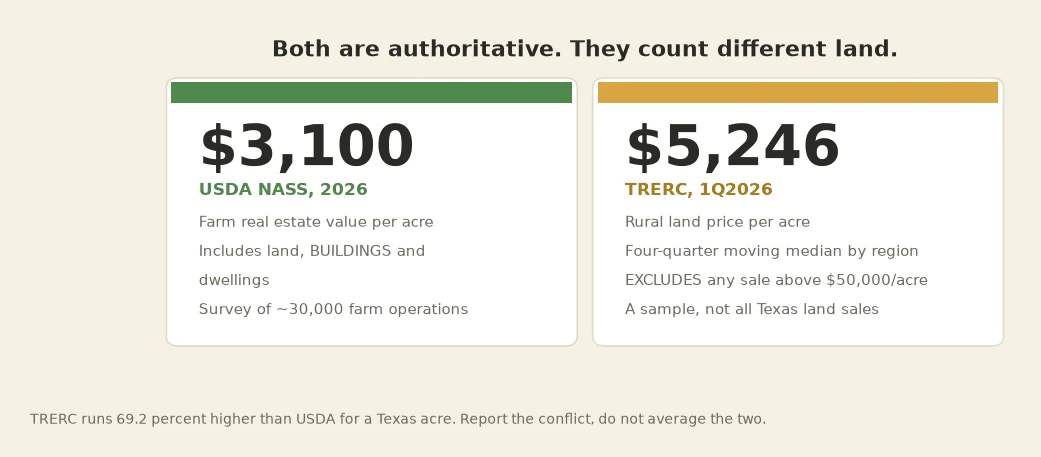
Report a conflict like that, do not split it. Averaging numbers that measure different things gives a number that measures nothing.
Of the six pages we could retrieve, five have a financial stake in what you conclude, and the stakes point opposite ways. Two are cash-offer buyers of land, one is a developer selling owner-financed Texas tracts, and two are brokerages. Not one discloses that on the page.
Which obliges us to disclose ours. AcrePal sells owner-financed rural land in Arizona, Colorado, Nevada, California and Florida. Texas is not one of our markets, so no tract of ours waits at the end of this article.
What Actually Moves the Price of a Texas Acre
Sooner or later you will open two forty-acre listings priced three times apart, with nothing on either page explaining the gap. A short list of factors accounts for most of it, and they do not carry equal weight.
Region comes first and it is not close. The gap between $630 and $11,698 is wider than any feature of an individual tract will produce. Get the region right before you weigh anything else.
Second, demand that has nothing to do with farming. Reviewing full-year 2025, TRERC's Rural Land Spring 2026 article reported that "West Texas price jumped 13.5 percent YoY to a record $2,878 per acre. This result was somewhat influenced by a spike in demand for land with potential for data centers. Additionally, this region still contains some of the most affordable land within relative proximity to urban markets."
Note that TRERC says data centers "somewhat influenced" that full-year 2025 move rather than caused it. The same region came in at $2,947 per acre for the first quarter of 2026, up 12.87 percent.
Third, water, legal access and road frontage. A tract you can reach on a county-maintained road, with water available, prices differently from a landlocked parcel you can only get to across a neighbor's property. If the listing is unimproved land with no well, no septic and no power at the road, then the real cost of land in Texas includes everything it takes to make that parcel usable.
Fourth, whether the tract already carries open-space valuation. That one barely touches the sticker price and changes the annual bill enormously, which brings us to what it costs to hold an acre.
What 2 Acres or 10 Acres of Land in Texas Really Costs
The instinct is to take a statewide average, multiply by your acreage, and call it a budget. Ten acres at the first quarter 2026 statewide average of $5,246 comes to $52,460, and that is precisely the number to distrust. For a small tract the multiplication is wrong in the expensive direction, and TRERC publishes separate series that prove it.
In the fourth quarter of 2025 in Region 3, West Texas, small tracts sold at $8,330 per acre while large tracts sold at $2,878 per acre. Same publisher, same region, same quarter, and small tracts cost nearly three times what large tracts cost per acre.
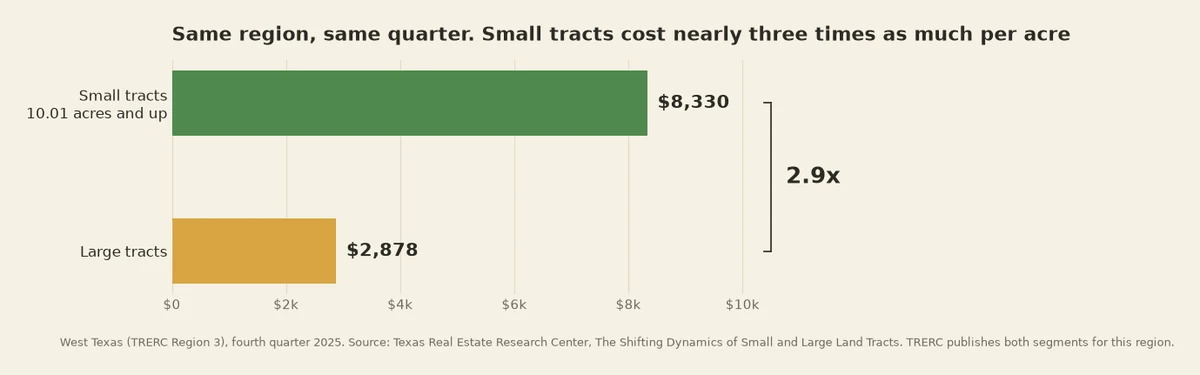
TRERC separates the large land market from the small land market, "which is usually those under 35 to 160 acres depending on the region," and states that "The minimum tract size for each region is 10.01 acres." Over the last ten years, small tracts have made up "more than half of total annual sales (55 to 60 percent) statewide." So most Texas land sales are small-tract sales, while the headline number is dominated by the big ones.
TRERC named small-tract prices for four regions, all fourth quarter 2025.
- Region 1, the Panhandle, $9,460 per acre, up 7.59 percent year over year.
- Region 3, West Texas, $8,330, up 8.5 percent.
- Region 6, South Texas, $14,900, down 11.91 percent.
- Region 7, the Hill Country, $17,529, up 7.7 percent.
South Texas is the one that fell, and TRERC calls it "the primary outlier," a reminder that the small-tract trend is not one way everywhere. Set the Hill Country number against the Region 7 all-tract figure of $8,028 for the first quarter of 2026 and the size effect shows up inside a single region, provided you keep the two quarters and the two segments straight.
Two acres is a harder question, and we would rather say so than guess. TRERC's small-tract cohort starts at 10.01 acres, so a two-acre Texas parcel is not in that series and not in the quarterly report either. No comparable public series covers tracts that small. What we can tell you is the direction, because the price per acre in Texas rises as tracts get smaller, so two acres usually carries a higher per-acre price than ten acres in the same area, and we break down the size curve itself separately.
What an Acre of Texas Land Costs to Hold, Not Just to Buy
The purchase price happens once. The tax bill arrives every year.
TRERC's Lynn D. Krebs, Ph.D. wrote in July 2026 that "since Texas has a moderate sales tax rate and no personal income tax, it has one of the higher property tax levels in the country," and that "by most estimates, Texas ranks in the top 10 in the U.S. for highest overall property tax levels considering all property types." Across those same six pages, property tax rates, 1-d-1 open-space valuation and Tax Code citations all appear zero times.
The same article reports the statewide effective tax rate "declined 22.11 percent from 2019 to 2025." That came primarily from school homestead exemption increases, which apply only to an owner-occupied primary residence. Buy raw vacant land and none of that relief reaches you.
What can reach you is open-space valuation. Tax Code Section 23.51 defines qualified open-space land as "land that is currently devoted principally to agricultural use to the degree of intensity generally accepted in the area and that has been devoted principally to agricultural use... for five of the preceding seven years." That five-of-seven history is not something you switch on after closing.
The Comptroller publishes the mechanism. Districts subtract expenses from the typical owner's income to reach what is "commonly known as net-to-land," then "divide the average net-to-land for a five-year period by the annual cap rate to arrive at the land's productivity value." Tax Code Section 23.53 sets that cap rate at the greater of 10.00 percent or the Farm Credit Bank of Texas rate on the prior December 31 plus 2.50 percent. That bank rate was 6.33 percent, giving 8.83 percent, so 10.00 percent governs for 2026.
Dividing by 10.00 percent is multiplying by ten. An acre carrying open-space valuation is appraised for tax at ten times its five-year average net-to-land, whatever it would sell for.
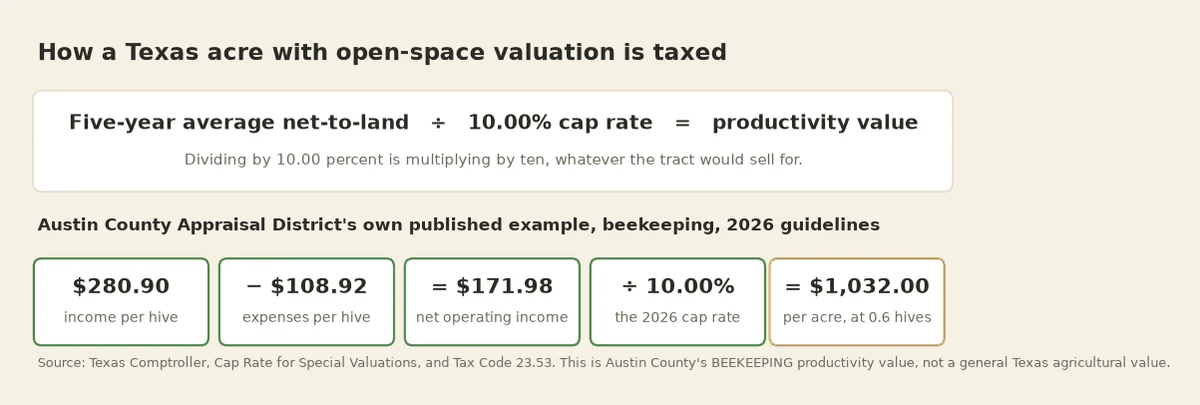
Austin County Appraisal District runs that calculation in its adopted 2026 agricultural use guidelines, for beekeeping. Net operating income of $171.98 per hive divided by the 10.00 percent cap rate gives $1,719.80 per hive, and at 0.6 hives per acre that is $1,032.00 per acre. That figure is Austin County's beekeeping productivity value specifically, not a general Texas agricultural value and not a pasture value.
Changing the use of a tract that carries open-space valuation has tax consequences, covered in our guide to the Texas wildlife exemption.
How to Tell If an Asking Price Is Fair
The state's own land economists have a line about Texas sellers. From TRERC, "Sometimes unrealistic expectations of sellers, who remain anchored to peak 2022-23 pricing, create a psychological barrier that contributes to current market friction."
When the research center that publishes the state's land price series describes seller expectations as unrealistic, an asking price stops being a market reading and becomes an opening position. Three quick tests will tell you most of what you need.
- Is the number inside the published band for that TRERC region? Use the seven regional figures above, not the statewide average.
- Is the source dated to a quarter? An undated Texas land price is close to worthless. Of the six pages competing for this question, one dates its figures throughout, two carry a single dated reference, and one of those references is to the fourth quarter of 2023.
- Does whoever published the number gain from a high answer or a low one? Both directions are represented among the pages ranking for this question.
One correction outweighs all three tests. A county appraisal district's appraised value is not a sale price and should never be treated as one. It is the district's estimate, built from that same patchwork, and it can sit well above or well below what a tract would actually trade for.
If you are on the other side of this and checking what your own acre is worth, that is a different exercise with a different method.
How to Price the Acre You Are Actually Looking At
Nothing above prices your parcel on its own. Here is the sequence we would work through, and most of it fits in an evening.
- Find your region. Use the County to Region reverse lookup on TRERC's Rural Land Data dashboard, or the seven-region map on page 3 of the quarterly report. Price off that region's number rather than the statewide $5,246. Whether your region runs above or below it matters as much as the size of the adjustment.
- Adjust for tract size. TRERC named small-tract prices for four regions in the fourth quarter of 2025, Regions 1, 3, 6 and 7. If yours is one of those, compare against the small-tract number instead of the all-tract one. If it is not, treat this step as a sanity check on whether the regional figure describes transactions anything like the one you are contemplating, not as a formula.
- Pull the county appraisal district record for the parcel and its neighbors. A CAD record shows acreage, appraised value, and whether the tract carries open-space valuation. It does not show the sale price, which Tax Code 22.27 makes confidential, so do not go hunting for one.
- Check the valuation status before anything else about taxes. Ask the seller directly whether the tract currently carries open-space valuation and how long it has carried it. That answer moves the annual bill more than the purchase price does, and the five-of-seven history requirement means you cannot assume you will qualify on your own.
- Budget what it takes to make the tract usable. A raw acre and a usable acre are different products, and access, water, power and septic are where the difference lives. Price utilities and access separately before you decide whether the asking price is reasonable.
- After you own it, and only after, use 552.149(b). A property owner or the owner's agent may request the comparable sales the district used, in connection with a protest before the appraisal review board. The limits ride along, owner or agent only, protest only, and the data cannot be reused or republished.
How Texas Compares With the Other States Buyers Ask About
Most people assume Texas land is expensive. By the one federal source that measures every state the same way in the same year, it is not.
USDA's Land Values 2026 Summary, published in July 2026, puts Texas farm real estate at $3,100 per acre against a United States average of $4,500. Texas sits roughly $1,400 below the national figure, at about 69 percent of it. Here are the 2026 values for the states this question tends to get paired with.
- Oklahoma $2,620
- Texas $3,100
- Missouri $5,200
- Kentucky $5,600
- Tennessee $6,500
- Michigan $7,000
- Florida $9,150
- California $14,100
California runs 4.55 times Texas. Texas is the second cheapest of these eight, and the order is unchanged from 2025, so it is a stable fact rather than a one-year wobble.
The caveat matters as much as the numbers. USDA's farm real estate value is "The value at which all land and buildings used for agricultural production, including dwellings..." are held, so buildings and dwellings sit inside every figure on that list, and NASS reaches them by surveying roughly 30,000 farm operations rather than by recording transactions. It is not a raw land number, and it is not measuring what the TRERC figure at the top of this article measures, which is why the two disagree.
Frequently Asked Questions About Texas Land Prices
Can I look up what my neighbor paid for their land in Texas?
No. Texas is a non-disclosure state, no statute requires a buyer or seller to report a sale price, and Tax Code 22.27 makes prices voluntarily given to an appraisal district confidential and not open to public inspection. Sharing what you paid is not illegal in Texas, it is only not required, so ask the seller directly.
Why do different sources give completely different prices for a Texas acre?
Because they count different land. USDA NASS reports $3,100 per acre for Texas in 2026, a farm real estate figure that includes land, buildings and dwellings. TRERC reports $5,246 per acre for the first quarter of 2026, a rural land transaction figure built as a four-quarter moving median that excludes any sale above $50,000 per acre. Do not average the two.
What part of Texas has the cheapest land?
Region 2, Far West Texas, at $630 per acre in the first quarter of 2026. That number carries TRERC's own warning, since the region recorded 26 transactions and TRERC states that "Lack of a sufficient volume of transactions makes it difficult to accurately estimate trends in this region." Treat it as the least reliable figure in the set rather than a shopping tip, and see our guide to the cheapest places to buy land.
How much is 10 acres of land in Texas?
At the first quarter 2026 statewide average of $5,246 per acre, 10 acres works out to $52,460. The honest answer is the range, roughly $6,300 in thinly traded Region 2 up to $116,980 in Region 5, and small tracts typically carry a higher per-acre price than the all-tract average implies. Use your own region's number, and three acres works differently again.
How does Texas land compare with the national average?
Texas farm real estate averaged $3,100 per acre in 2026 against a United States average of $4,500, according to USDA's Land Values 2026 Summary. Texas sits about $1,400 below the national figure. Those values include land, buildings and dwellings across surveyed farm operations, so they are not raw land prices.
Are Texas land prices expected to keep rising?
In TRERC's words, "Regional variations will remain a defining feature of the market; areas with potential for energy or artificial intelligence-related infrastructure projects, such as West Texas, are seeing localized 'exuberance,' while traditional agricultural regions, like the Panhandle, continue to trade sideways as high prices meet buyer resistance."
What has the biggest impact on the price of a Texas acre?
Region, first and by a wide margin, since the seven published regional figures span more than eighteen times from lowest to highest. Tract size comes next, because per-acre price rises as tracts get smaller. After that, legal access and water, then whether the tract carries open-space valuation, which drives what you pay every year rather than what you pay once.