
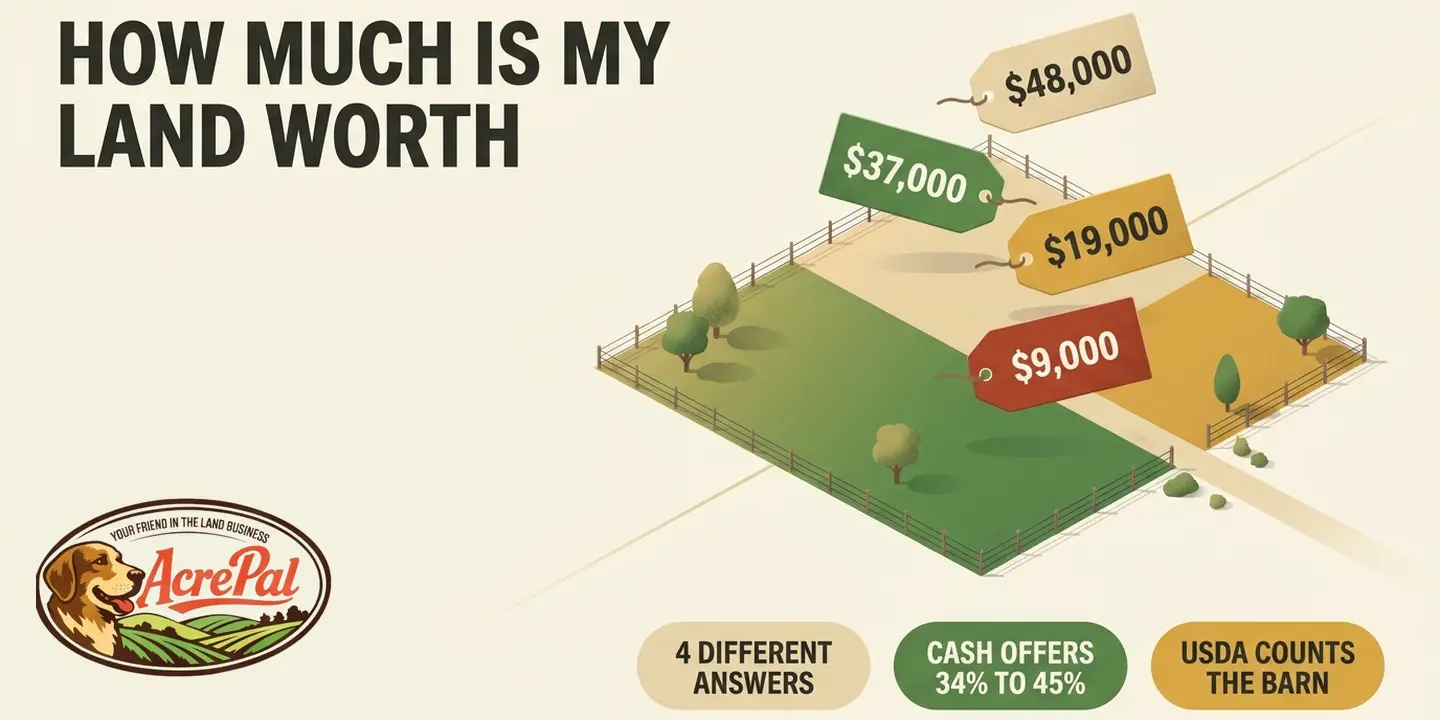
A free land value estimator needs a public dataset underneath it, and for land there is essentially one. By USDA's own published definition, the number that dataset reports includes the farmhouse, the barn, and the equipment sheds. If you own bare ground with nothing standing on it, the figure on your screen is measuring somebody else's property.
That is the first reason how much is my land worth is such a hard question to get a straight answer to. The second one is bigger. Four different numbers all get called what your land is worth, they can differ by a factor of three on the same parcel, and almost every tool hands you one of them without saying which.
Which of the four you need depends on why you are asking. Below we sort that out, then build a real number from recorded sales instead of other people's asking prices, and put dollar figures on the features that actually move a parcel's value. Where a figure is soft, we say so.
Why the First Number You Find Is Measuring Somebody Else's Farm
USDA is unusually clear about what that number measures. The Land Values 2025 Summary defines farm real estate value as "the value at which all land and buildings used for agricultural production, including dwellings, could be sold under current market conditions, if allowed to remain on the market for a reasonable amount of time." Its highlights page says it plainer still, calling the figure "a measurement of the value of all land and buildings on farms." The 2026 national average is $4,500 per acre, and every barn and farmhouse on those operations is inside that figure.
USDA defines a farm as any establishment from which "$1,000 or more of agricultural products were sold or would normally be sold" during the year, and the survey targets farms and ranches meeting that bar on at least one acre. A vacant five-acre desert lot has no agricultural sales, so it was never in the sample.
It is also not a record of sales. Enumerators "collect an estimated value of all land and buildings for the operator's entire farming operation," by mail and phone, from roughly 28,500 operations, with an April 1 reference date. That is opinion, not a sale price.
USDA publishes how precise the result is, and the answer is not very. The coefficient of variation on the 2025 national farm real estate estimate is 37.3 percent, against 5.4 percent for cropland and 6.3 percent for pasture. Nevada runs 78.3 percent, Arizona 43.1, and Rhode Island, the most expensive state in the series, 70.8.
The 2024 figures were far tighter, 1.5 percent nationally, and that gap needs explaining before anyone reads a trend into it. NASS replaced the June Area Survey with a new list-frame survey in 2025. The jump is a change in how the data gets collected, not a signal about the land market.
The state blend hides more than it shows. USDA's own 2025 Arizona figures are $8,150 per acre for cropland and $950 for pasture, an 8.6x spread inside one state, so the blended "Arizona $4,180" describes almost no real parcel. Arizona and Nevada pasture values were withheld as (D), too few reports to publish, from 2021 through 2024.
This cuts both ways, though. Price per acre falls as tract size rises, so a large raw tract usually trades below the state blend while a small subdivided parcel carries a premium above it. Our guide to how much 50 acres of land is worth walks through that curve.
USDA says Arizona is $4,180 an acre. Our own county research puts real raw-land medians closer to $1,091 per acre in Apache County and $2,502 in Mohave County.
The Four Numbers People Call What My Land Is Worth
One landowner described receiving an unsolicited offer on inherited Michigan land that came in seven to eight times below the Zillow estimate for the same property. Neither number was necessarily a lie. They were answers to different questions, and there are four questions in play.
Retail market value is what an end buyer pays after the parcel has been properly marketed for as long as that takes. It is the highest of the four and by far the slowest. This is your number when you have time and can wait for the one buyer who wants exactly what you have.
Cash offer value is what a buyer pays today to take the risk and the waiting off your hands. It is commonly a steep discount to retail, and we put figures on it in the next section. This is your number when speed or certainty beats the last few thousand dollars.
Assessed value is a tax figure, produced by applying your state's assessment ratio to the county's own estimate. It is not an attempt to state market value at all. Use it for a tax bill and nothing else, and we explain why further down.
Appraised value is a licensed opinion, written to a standard that a bank, a court, or the IRS will accept. Reach for it when an institution has to sign off, and skip it when nobody does.
This confusion has real costs. Nearly 40 percent of landowners who inherited rural property reported being unsure of its value or how to proceed with a sale, and heirs often accept below-market offers because carrying costs and family disagreement wear them down, not because the offer was fair.
Start with retail market value whatever your situation, because every other number is either a discount from it or a check against it. Skip the appraisal until you know a third party is going to demand one.
What a Cash Offer Actually Pays, and Why
General web sources put land cash offers at 30 to 70 percent of retail market value, 50 to 70 percent in Florida specifically. The educators who publish their own arithmetic quote steeper discounts than that. One gives a rule of thumb of 35 to 45 percent when he needs to resell inside one to two months.
In a separate walkthrough the same educator prices his resale at about 85 percent of comparable listings, then offers about 40 percent of that already discounted figure, landing nearer 34 percent of true market value. The numbers get lower when they come from the people actually writing the offers.
The discount is a price rather than an insult. A cash buyer absorbs resale risk, holding costs, taxes, and a buyer pool that is thin and slow next to housing.
Compare the offer against what a listing would actually net you, not against the sticker price in your head. One land educator runs a $60,000 listing through the math, starting from his experience that on-market land sells for about 90 percent of list, so $54,000, then subtracting $6,000 in commission and roughly $2,000 in closing costs to leave the seller $46,000, or 77 percent of list.
Check that commission figure before you borrow it. His $6,000 is about 11 percent of the sale price, steep even against the 5 to 10 percent that land commissions generally run, which is already higher than residential. Drop it to 6 percent and the same sale nets $48,760, or 81 percent of list.
His 90 percent of list figure is one practitioner's worked example rather than a published statistic, so treat the whole path as a range. Your choice is roughly 40 percent today against 77 to 81 percent in six to eighteen months, minus what you pay to carry the land meanwhile.
We should say where we sit. AcrePal buys and sells rural land, including owner financed parcels in several western counties, so we have an interest in what you believe that discount should be. That is why we publish the practitioner numbers instead of a comfortable range. Our guide to buying land with no money down covers how owner financing works.
A cash offer buys speed and gets priced for it. Treat it as a different product with a different delivery date, and make sure you know which one you are being sold.
How to Pull Comps That Are Actually Comparable
Asking price is what a seller hoped for. On a parcel that has sat listed for a year, it is evidence of what the market refused. Nearly every guide points you at Zillow, LandWatch, or Realtor.com without saying so, and pricing off other people's unsold listings is how overpricing spreads through a thin market.
Recorded sales are what you actually want. Pull three to five with similar acreage and zoning, within roughly 10 to 20 miles, closed in the last 12 to 24 months, and compute price per acre on each. When comps are scarce, widen the radius or the time window before the parcel type, because a comparable in the wrong land class hurts more than a distant one. Treat the result as a range, not a single number.
Then filter for arm's length transactions, because non-market transfers pollute county sold records. Watch for nominal consideration such as $10 "and other good and valuable consideration," for quitclaim deeds, which strangers rarely use, and for matching surnames on grantor and grantee. Florida treats a deed with nominal or unstated consideration as taxable at fair market value under a rebuttable presumption and tells recorders to check before accepting it. Nevada's Department of Taxation Guidance Letter 09-001 interprets what counts as nominal consideration under NRS 375.010.
Sold data lives in county recorder and assessor portals, with GIS parcel viewers and auction results filling gaps. Paid tools help too. AcreValue covers land prices and sales across 48 states and 2,833 counties. PRYCD aggregates over 2 million comps as a licensed DataTree provider, though it draws partly on listing data alongside sold comps, so it inherits part of the asking-price problem.
One land investing educator says pricing tools "only get you 50 to 75 percent of the way there" and warns against letting them become a crutch. Rural comps are thin, and some counties go months or years without a sale.
If three sold comps land in the same range, that range is your answer. If they scatter badly, the section on appraisals below is for you. All of this assumes sold prices are public where your land sits, and in about a dozen states they are not.
The States Where Sold Prices Are Not Public Record
Try that method in Texas and you hit a wall. In roughly a dozen states, sale prices never become public record, and sources disagree at the edges, so treat that count as approximate. Texas, Montana, Wyoming, New Mexico, and Idaho hold much of the cheap-land map, so the people shopping the cheapest markets can verify the least. These states are not all alike.
In the strictest group, nobody reports a price to anyone. Texas is the clearest case, where Government Code 552.149 shields sales information received by the state comptroller or a chief appraiser, and Alaska, Kansas, Louisiana, Mississippi, Montana, New Mexico, and North Dakota sit alongside it. Idaho belongs here with a wrinkle, since its assessors rely on voluntary sales verification returns that only about 30 to 40 percent of buyers return.
A second group requires the price and then hides it. Wyoming Statute 34-1-142 makes a statement of consideration mandatory with every deed, then keeps it confidential to the county clerk, assessor, and Department of Revenue. Utah joined on May 1, 2024, when Senate Bill 30 began requiring the purchase price be filed with the recorder as a private record, open to assessors, the State Tax Commission, and parties to a tax appeal. Any guide still filing Utah next to Texas has the law two years out of date.
Missouri gets decided county by county. St. Louis City, St. Louis County, and Jackson County require a certificate of value, and jurisdictions that mandate it capture close to 50 percent of sale prices against 15 to 25 percent elsewhere.
Skip the workaround you may have read about. Where a transfer tax runs as a percentage of price, the stamp is public and the price can be reversed out of it, which is how Florida's documentary stamps give the number away. Non-disclosure states almost never levy a statewide transfer tax, so there is no stamp to divide out. The two lists overlap almost exactly.
What remains costs a relationship or money. A licensed agent sees MLS sold data you cannot, and a local land broker's opinion is usually free and tracks the real buyer pool. In Wyoming or Utah, a formal assessment appeal is often the only route that legally opens the confidential number to the owner.
What Each Feature Is Actually Worth in Dollars
Every guide lists the factors that change land value. Almost none says how much any of them is worth.
Legal access
A landlocked parcel with no legal road access can be worth as little as 25 percent of the same land with public frontage, and one cited case put damages above 50 percent. That range comes from appraiser forum matched-pairs analysis, so treat it as practitioner consensus, not a published study. Legal and physical access are separate, and a parcel can have one without the other. Our breakdown of deed vs title covers how both show up on paper.
Septic feasibility
The biggest swing in our research is invisible from a walkthrough. A land analysis channel described a parcel expected to bring $35,000, worth roughly $7,500 to $8,000 once the soil could not support a septic system, a 77 to 79 percent loss from one factor. The same source says land thought to be worth $50,000 might not fetch $10,000 without workable percolation, though that is one deal from one channel, not a rule. See perc test costs and well and septic installation costs.
Utilities
Utilities at the line are worth roughly what a buyer would otherwise spend bringing them in, which makes this a cost lookup, not a percentage. The dollar figures live in what it costs to get utilities on land and the cost of digging a well in 2026.
Slope
Two independent land investing sources put the first breakpoint around 10 percent grade, where construction starts getting materially more expensive. Between 15 and 30 percent, a parcel becomes questionable to build on at all.
Flood zone
Being in a flood zone and being near one are different problems. Land inside a high-risk FEMA zone such as AE or VE can sell at a 20 to 40 percent discount against flood-free land, while sitting adjacent to a floodplain has been associated with about a 7.3 percent reduction. Zone X sees little impact. Vacant land is not insurable under the NFIP, only structures are, so the hit reflects future buildability and buyer perception, not any premium.
Zoning
Zoning sets the buyer pool, and the buyer pool sets the price. A designation that permits a manufactured home reaches a different market than one that does not, and our guide to the R-2 zone has the detail.
Two parcels of identical acreage in the same county can differ by more than half on access and septic alone. That is why a per-acre average only ever gives you somewhere to start.
Why Your Assessed Value Is Not Your Market Value
Your tax bill is not a valuation, and no multiplier turns one into the other. Assessment ratios run from 4 percent of market value in South Carolina up to 100 percent in states including Texas and Florida. The ratio can differ by property class inside a single county, with Cook County, Illinois assessing residential at 10 percent and commercial at 25 percent.
Knowing the ratio only gets you half the answer. The base it gets applied to matters just as much. California is nominally assessed at full value, but under Proposition 13 the base is a factored acquisition value that resets only on transfer or new construction, so a parcel held for decades can sit far below market while the ratio still reads 100 percent. The ratio tells you the formula, not how fresh the number inside it is.
Thirty-seven states reassess at least once every three years and 27 of those annually, so how far your assessed value trails the market depends on where the parcel sits.
Agricultural and greenbelt classification is the trap for this audience. It suppresses assessed value well below market, and losing it triggers a recapture tax. Under Tennessee's Greenbelt Law the rollback period is the current year plus the two preceding years for agricultural and forest land, and the five most current years for open space. Every state sets its own rules, so read Tennessee as one example and check yours before you split a classified parcel, which our guide to subdividing a property walks through.
There is one place the assessed number earns its keep. One land flipper describes never paying above assessed value as a personal discipline, precisely because assessed usually runs below market, which builds in a margin of safety. That makes it a useful floor for sanity-checking an offer, not a valuation.
Assessed value tells you what you owe in tax. It becomes evidence about market value only once you know your state's ratio, what base it applies to, and whether the parcel carries an agricultural classification.
When Paying for an Appraisal Is Worth It
An appraisal earns its cost when somebody else has to accept the number. Vacant and rural land appraisals commonly run $300 to $700 at the low end, with the full range across sources running $300 to $1,500 and climbing past $4,000 for large or hard-to-comp acreage. Turnaround is typically two to four weeks from inspection to written report, though simpler assignments can come back in seven to ten days.
Rural work costs more for the same reason your own comp search is hard. In some rural counties there may be no sales for many months or even years, which forces the appraiser to expand the comparable search radius far beyond normal residential practice. You are paying for the search as much as the opinion.
Get one when a third party has to sign off. Bank financing, estate settlement and date-of-death valuation, divorce, a tax appeal, IRS matters, and litigation all qualify. Inherited land triggers several of these at once, which is why so many people first hear the word appraisal in a probate conversation.
Skip it when you are only pricing a listing or sanity-checking a cash offer. A local land broker's opinion costs nothing and often tracks the actual buyer pool more closely than a report will.
Appraisers work with the cost and income approaches alongside sales comparison. On raw land the income approach only bites where documented income exists, such as a farm lease, a hunting lease, timber, or a cell tower easement, and we cover those in how to make money from your land.
FAQ
How accurate are free online land value estimators?
Directional at best. One land investing educator puts pricing tools at 50 to 75 percent of the way to a real number and warns against leaning on them, and the USDA data most free estimators sit on carries a 37.3 percent coefficient of variation on its 2025 national farm real estate estimate. They also cannot see access, slope, or septic feasibility. Use them to bracket a range, never to set a price.
Is there a land valuation map I can use?
Partly. County GIS and assessor parcel viewers show assessed values and parcel boundaries, and AcreValue maps land prices and sales across 48 states and 2,833 counties. No public map shows true market value for raw land, and in non-disclosure states no map can, because the sale prices behind it were never recorded in the first place.
How much does an acre of land cost on average?
USDA's 2026 national averages are $4,500 per acre for farm real estate, $6,020 for cropland, and $2,000 for pasture. Those figures describe operating farms and include the buildings standing on them, so they are a poor proxy for what a vacant parcel trades at.
Does my land being in an HOA or POA affect its value?
Yes, and in both directions. Recorded restrictions run with the land and bind whoever buys it next, so they shape what the parcel can be used for and therefore what somebody will pay for it. Maintained roads and amenities can add value while use restrictions and dues subtract it, and the specifics live in the recorded documents. Our comparison of POA vs HOA walks through the difference.
Should I get an appraisal before accepting a cash offer?
If the offer sits in the 34 to 45 percent range that land wholesalers describe for their own formulas, a $300 to $700 appraisal is cheap insurance on a decision worth several multiples of that. If you only need a directional read, three sold comps and a local land broker's opinion cost nothing and take an afternoon.
How long does raw land take to sell?
Longer than a house, and that gap is the entire reason cash offers are discounted. US homes ran a median near 58 days on market in July 2025 and 49 days in May 2026, while vacant land in one Southwest Florida market ran 59 to 119 days as of January 2026. Land has no clean national days-on-market series the way homes do, so regional segment data is the best available substitute.