
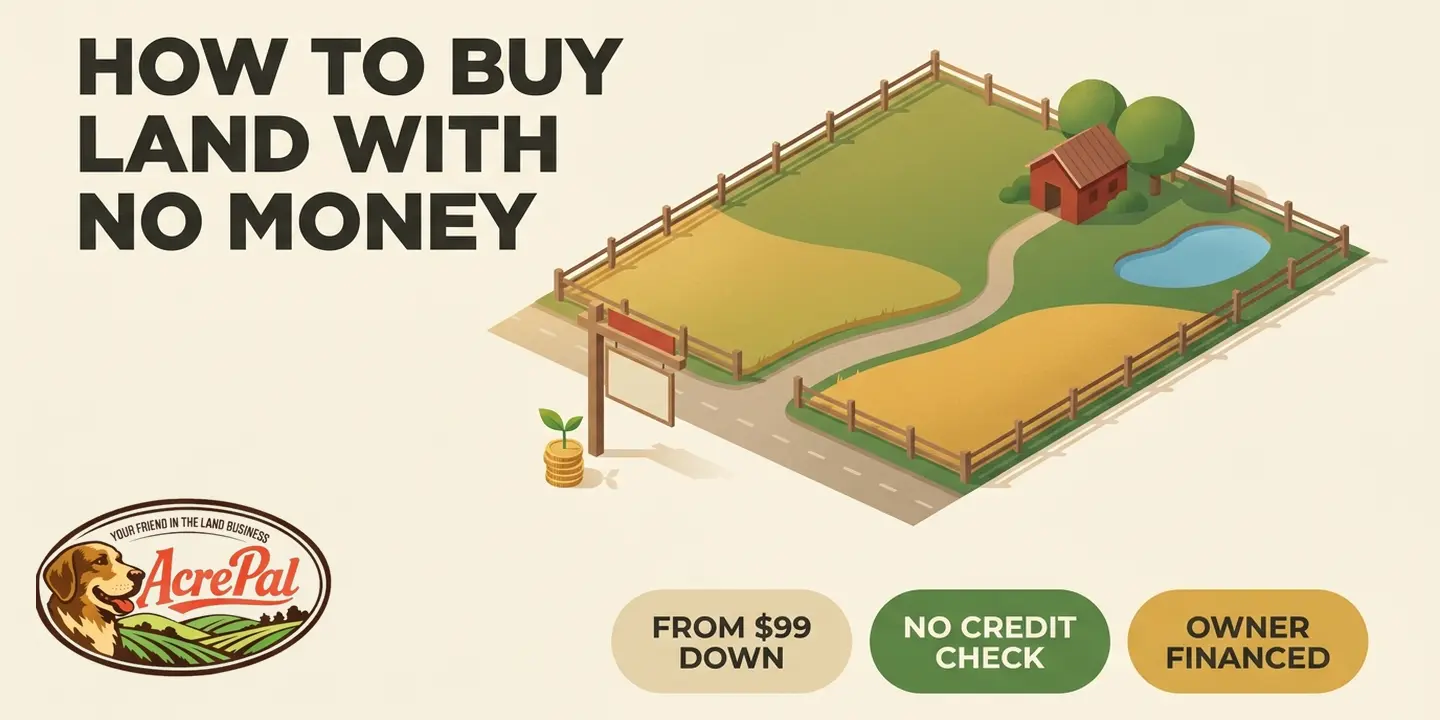
Most guides promise a $0 magic trick, then quietly admit it does not exist. The honest version is less flashy. How to buy land with no money almost never means zero dollars leave your pocket, it means no bank down payment, because a seller carries the note instead of a lender.
You can get onto a rural parcel for roughly $99 to $500 down with no credit check, while a bank would demand 30 to 50 percent down and a 640 to 700 credit score on raw land. That barrier sidelines roughly 8 in 10 would-be buyers. The real cash at the table, doc fee plus recording plus your first payment plus basic verification, lands around $200 to $800, and an owner-financed deal can close in 7 to 10 days instead of the 45 to 60 a bank takes. This guide walks you through the whole path with real 2026 numbers, a seller negotiation script you can copy, an honest look at USDA, and the contract traps that quietly wipe buyers out.
Step 1: Know What No Money Down Really Costs You
The number nobody puts in writing is what you actually hand over on closing day. The other guides skip that math.
No money down means no bank down payment. The seller finances the purchase and holds the note, so there is no lender demanding 20 percent up front. That does not make the deal free. On a $5,000 to $15,000 owner-financed parcel with no bank, your real out-of-pocket usually breaks down like this.
- Title search, roughly $150 to $500.
- Deed preparation, roughly $100 to $300.
- Recording fees, roughly $50 to $250.
- Your first monthly payment, often $99 to $250.
Add it up and most budget buyers spend about $200 to $800 to get onto the land. Because there is no bank, you skip the fees that bloat a conventional deal, origination at 1 to 3 percent of the loan, an appraisal at $300 to $600, and bank attorney charges that can push a bank closing past $1,000.
True zero-dollar deals do exist, where the seller asks nothing at signing. They are a minority of listings, and sellers who offer them usually charge a higher total price, a higher interest rate, or a shorter term to make up for it. So the money is still there, just moved into the payments.
If you are still scouting locations, our guide to the cheapest places to buy land shows where entry prices start lowest. This path fits the buyer who has a few hundred dollars saved but cannot pull together a 20 percent down payment.
Step 2: Use Owner Financing as Your Main Path
Banks reject most budget land buyers before the conversation even starts. Score under 640 and shopping for raw land, and the answer is usually no, no matter how badly you want the parcel.
Owner financing is the way around that wall, and it should be your default. The seller acts as the lender. You sign a land contract, sometimes called a contract for deed, and pay the seller directly in monthly installments.
There is no credit check because the seller is not a bank. Their protection is simple, if you stop paying, they can reclaim the land, so a low credit score does not scare them the way it scares an underwriter. Approval often takes 24 to 48 hours instead of the weeks a bank underwriter needs, because there is no appraisal, no income verification, and no loan committee.
The real 2026 numbers are worth knowing before you ever call a seller. Down payments commonly run 5 to 20 percent, but entry-level deals with $99 to $500 down are out there on cheap parcels. Interest rates sit at 8 to 15 percent APR, higher than a bank land loan at 6 to 9 percent, because the seller absorbs the risk a bank refuses. Terms run 3 to 30 years, and closings happen in 7 to 10 days instead of the 45 to 60 a mortgage takes.
Now the honest tradeoff. Say you buy a $7,000 parcel at $180 a month for 60 months. That is $10,800 total, a 54 percent premium over the cash price. That premium is what you pay for no down payment, no credit check, and no bank. Knowing the number up front keeps the deal honest.
Make owner financing your main path and treat every other route in this guide as a backup.
Step 3: Target the Markets Where Low Down Land Actually Exists
Start with these counties tonight. Cheap owner-financed land clusters in the arid West, where per-acre prices stay low and sellers compete on terms.
- Costilla County, Colorado. Average around $4,347 per acre, with 5 to 40 acre parcels from $5,000 and monthly payments of $149 to $249.
- Mohave and Apache County, Arizona. Desert parcels under $8,000, $99 to $171 a month, and zero to low down.
- Elko County, Nevada. Small parcels from about $3,000, $99 to $129 a month, and Nevada is one of the few states that legally requires the contract to be recorded, which protects you.
- West Texas, in counties like Hudspeth. Around $275 a month for 20-plus acres, and Texas also mandates recording.
Understand what cheap per acre really buys. These are remote parcels, usually with no utilities, so you have to verify road access and a water plan before you fall in love with a price. High-desert land in Costilla sits above 7,500 feet with a short growing season, and the Arizona and Nevada desert parcels bake in summer with no shade for miles. A low price on a listing means little if you cannot legally reach the land or live on it comfortably.
This is our own backyard. AcrePal sells owner-financed, no-credit-check rural land across Arizona, Colorado, Nevada, California, and Florida, so these are the exact markets we work in every day.
For deeper regional numbers, see our guides on cheap land in Colorado, the best states for homesteading, and how much 3 acres of land really costs. Colorado has the cheapest price per acre, while Nevada and Arizona have the lowest entry monthly payments.
Step 4: Find Owner Financed Listings and Motivated Sellers
Start with platforms built for this, not general real estate sites. A few filters put the right parcels in front of you fast.
- Landmodo and BuyVacantLand list owner-financed land only, and they show the down payment, monthly amount, and term right on each listing.
- Aggregators like Land.com, LandWatch, and LandSearch have owner-financing filters but mixed inventory, so you will sort through bank-required listings too.
When you filter, search by fixed dollar down amounts under $500 rather than percentages. A 10 percent down field hides a cheap deal, while a $200 down filter puts it right on top. That small change surfaces the truly low-entry parcels instead of burying them under pricier listings.
For the most flexible sellers, go to Facebook Marketplace and Craigslist. Private owners list their own land there, which means more room to negotiate and no platform fees. It also carries the highest scam risk, which is exactly why Step 5 exists.
Learn to read the signals of a flexible seller. Phrases like easy terms, low down, no credit check, and owner will finance are green flags. So are listings that have sat for 90-plus days, inherited parcels, and out-of-state owners, because those sellers want out.
Skip the broad Zillow-style searches. They bury owner-financed dirt under bank-required listings and waste your evening.
Step 5: Verify the Seller and Parcel Before You Pay Anything
One buyer made six months of payments before learning the parcel was landlocked. By the time the truth surfaced, the seller had stopped answering calls. Cheap prices and gentle sales pressure make people skip the checks that would have caught it. Do not be that buyer.
Start at the county assessor. Enter the parcel ID from the listing and confirm the seller name matches the deed owner. It is free and takes under five minutes, and it is your first line of defense against fraud.
Next, check the county treasurer for unpaid back taxes and liens. These often become your problem the moment you sign. Pew research found 73 percent of land-contract buyers were on the hook for property taxes without even holding legal title, so a hidden tax backlog is a real risk.
Then confirm access and zoning. You want deeded frontage on a public road or a recorded easement, not a neighbor's friendly handshake, which is not legal access. Call the county planning department and ask in writing whether you can camp, park an RV, or build. Get the answer in an email you can keep.
For any parcel over about $3,000, pay for a title search at $150 to $500. It checks for liens, encumbrances, and competing ownership claims before your money is gone. A landlocked parcel with no recorded easement cannot get a building permit and can lose most of its value, so treat access as a deal-breaker, not a detail.
If a seller will not give you a parcel ID, walk away.
Step 6: Negotiate a Low or Zero Down Payment
Most guides say ask for owner financing and stop there. You need the actual words and the term structure to land a low or zero down.
The core lever is trading price for terms. In owner financing you can negotiate four separate dials, purchase price, down payment, interest rate, and term length. A seller who makes money on interest over time can often accept little or nothing up front in exchange for a slightly higher total price or monthly amount.
Have your script ready. Try something like this. I am ready to start payments within seven days of signing, so would you consider zero down at a slightly higher purchase price or a bit more per month. Concrete numbers and a fast start beat vague interest every time.
If you have genuinely no cash on day one, propose a deferred down payment. You pay a higher monthly amount for the first 3 to 6 months, covering what the down payment would have been, then drop to the standard rate. The seller gets their security, and you put zero dollars down at signing.
While you are at it, always request a 30-day cure period after a missed payment. Many contracts only give 10 to 15 days. This is the same protection Step 8 leans on, so lock it in now.
None of this is fantasy. Creators have documented real deals at $400 down and a $999 parcel, both with no bank.
This works best with sellers who have multiple parcels or listings sitting 90-plus days. Skip the hardball on a fresh, in-demand listing where the seller has no reason to bend.
Step 7: Check the Honest Truth About USDA and FSA Loans
The zero-down government land program most people picture does not exist for raw land. That single fact saves you from wasting weeks on the wrong applications.
USDA Section 502 loans, both Direct and Guaranteed, fund a primary residence in an eligible rural zone, or construction tied to the loan. They do not fund standalone vacant land. They also carry tight income limits, roughly 80 percent of area median income for the Direct program. Buy bare dirt with no dwelling attached and you do not qualify.
The FSA Beginning Farmer Down Payment loan is the other one people misread. It is not zero down. It requires a minimum 5 percent cash from you, FSA finances 45 percent up to $300,150, and a commercial lender covers the remaining 50 percent. It is also for active farm operations only, not recreational, off-grid, or hold land.
These programs help in two narrow cases. If you truly plan to farm, or to build a home on the land right away with a construction plan attached to the loan, one of them may fit. There are also acreage caps to watch, the FSA program bars you from owning more than 30 percent of the average farm size in your area. For everyone else buying raw rural land to homestead, camp, or hold, owner financing remains the realistic path.
Do not build your plan around USDA for bare land. Verify your exact scenario with a local Rural Development office before you count on it.
Step 8: Protect Yourself in the Land Contract
Miss enough payments on a land contract and you can lose the property and every dollar you have already paid. Unlike a mortgage, where you build equity you can recover, a standard forfeiture clause lets the seller reclaim the land and keep your payments. In many states that plays out as an eviction weeks after a missed payment. That is the stake, so protect yourself before you sign.
Record the contract, or a memorandum of it, with the county. Only 13 states legally require this, so in the other 37 you have to insist on it yourself. A memorandum needs the names of both parties, their signatures, the property description, and the contract dates. Recording costs $50 to $100 and stops the seller from quietly reselling the land out from under you.
Get title insurance, roughly $200 to $500 even on a cheap parcel, so a hidden lien or a prior owner's claim does not sink you. Then require a warranty deed at payoff, not a quitclaim. A warranty deed guarantees clean title, while a quitclaim only passes whatever murky interest the seller happens to hold. Our deed vs title guide breaks down the difference.
Where your state allows it, ask for a deed of trust instead of a pure land contract. Title transfers to you at closing while the seller holds a lien, so a missed payment triggers a slower foreclosure rather than a fast forfeiture that keeps everything you paid.
Two traps catch buyers most often. Pew found 14 percent of land contracts carry a balloon payment, and sellers often promise you can refinance later, which is rarely possible for raw land. Another 8 percent of buyers never got a written contract at all.
For balance, the same research found 87 percent of buyers rated the experience positive and 88 percent reached full ownership. The path works when you protect yourself.
Never accept a promise to record it later.
Step 9: Budget for the Hidden Costs After You Buy
The bills that arrive after the keys catch cash-strapped buyers off guard. You spend your last dollars getting onto the land, then cannot afford to make it usable.
Name the costs before you sign. A perc test for a septic system, well drilling, a survey, running utilities to the parcel, and any inherited back taxes all land after closing. Competitors list these and never price them, which helps no one. A $5,000 parcel can quietly demand many times that to reach water, power, and a legal septic setup, so the sticker price is only the beginning.
The two biggest surprises are almost always water and power. Rather than guess, see our real 2026 breakdowns on the cost of digging a well and what it costs to get utilities on land. On remote desert parcels with no services, these numbers decide whether the land is livable.
Keep a reserve beyond your down payment and first few installments so the parcel becomes something you can actually use. Price these before you sign, not after.
Frequently Asked Questions About Buying Land With No Money
Can I really buy land with no money at all, zero dollars?
Almost never in the literal sense. No money down means no bank down payment, with the seller carrying the financing. Some deals start at $99 to $500, and closing on a small parcel with no bank can run $200 to $500. Plan for cash toward your first payment, recording, and basic verification.
Do I need a credit score to buy owner-financed land?
Usually not. Private sellers and owner-financing platforms often advertise no credit check, and many accept scores as low as 500 or no credit history. The seller makes a personal lending decision, not a bank underwriting call. Their protection is the right to reclaim the land if you stop paying.
Will USDA loans let me buy raw land with zero down?
No. USDA Section 502 programs fund rural housing, an existing home or construction tied to the loan, not standalone vacant land. Many buyers assume USDA is a broad zero-down land program, and it is not. Contact a local Rural Development office to confirm your situation first.
What happens if I miss a payment on a land contract?
Most contracts give a grace period of 10 to 15 days, then a cure period, often 30 days, to catch up. After that the seller can start forfeiture, reclaiming the property and keeping every payment you made. This can move fast, so negotiate a 30-day cure period before signing.
Is owner-financed land a scam and how do I know the seller owns it?
Legitimate deals are common, but fraud exists, especially on Facebook and Craigslist. Get the parcel ID, confirm the seller name against the county assessor, and check the treasurer for back taxes. For anything over $3,000, pay for a title search before closing. Recording afterward blocks a reseller.
Where is the cheapest owner-financed rural land right now?
As of 2026, the best value sits in Costilla County, Colorado at about $4,347 an acre, Mohave County, Arizona with parcels under $8,000, Elko County, Nevada from around $3,000, and West Texas at roughly $275 a month for 20-plus acres.