
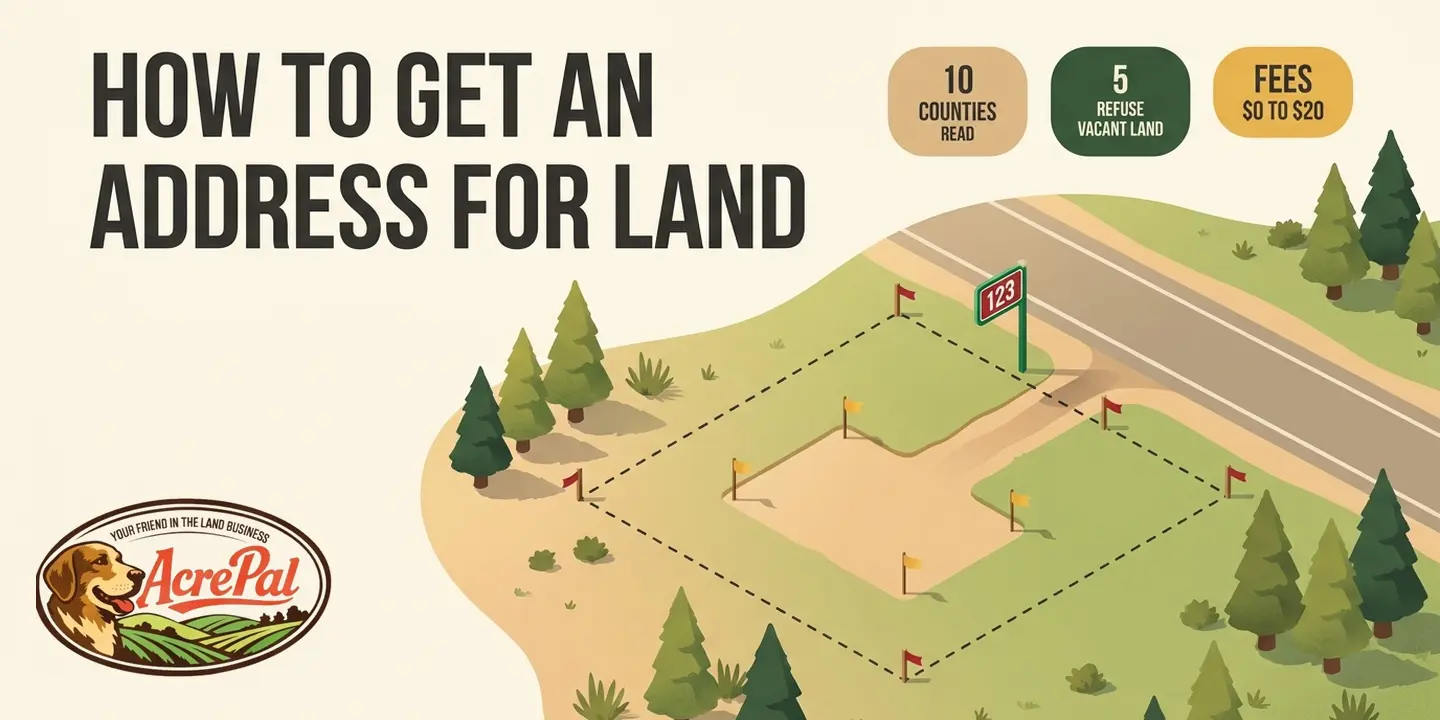
You closed on a parcel, or you are about to, and then somebody asked for a street address. The insurance agent needed one to bind a policy. The utility company wanted one before it would quote service. The listing showed something that looked like an address, and it went nowhere on a map.
Figuring out how to get an address for land is usually not a matter of finding the right form. For most vacant rural parcels the first question is whether the county will assign one at all, and plenty will not. Apache County, Arizona says so in a parenthetical on its own Engineering page, "we do not address vacant land." Six words, and they can undo a whole plan.
The second surprise is which office does the work. Most people call the assessor. Across the ten counties read for this guide, the assessor assigns addresses in none of them.
No national addressing office exists, no national form, and no national fee, which is why general advice on this stays so vague. Anyone who hands you a dollar figure without naming a county is guessing.
What follows is nine steps, built from what ten county addressing offices publish in their own documents, plus the USPS Postal Operations Manual for the mail half. The first move is not calling anyone. It is finding out what your parcel already has.
Step 1: Check Whether Your Parcel Already Has an Address
Some parcels already have a number sitting in a county file and the owner has no idea. That is the cheapest possible outcome, and it costs one phone call.
Be careful what you do with an old number, though. Mohave County, Arizona warns about exactly this on its addressing page.
"There are 'some' addresses that had been assigned years ago that may be on vacant properties. However, without verifying these numbers, they could be incorrect. (ie: lots that have been combined, un-combined, split, etc.)"
Combinations, un-combinations and splits are routine on cheap rural parcels that have been carved up and traded for decades. Treat an old number as a lead and make the county verify it.
A perfectly valid address can still return nothing on your phone. "Mohave County does not populate information to third-party website search engines." A working address and a searchable one are two different things.
Then there is the blunt possibility. Elko County, Nevada states it plainly on its rural living page, "Not all parcels in Elko County have a physical address."
While you sort out which string is which, keep the labels straight. An APN identifies your parcel inside the assessor's tax and mapping records and is not a location anyone can drive to. The situs address, the number attached to a structure standing on the ground, is what permit clerks and utility companies want.
If nothing verified comes back from the county, your parcel has no address and the rest of this guide applies to you.
Step 2: Find the Office That Actually Assigns Addresses
Ten counties, ten addressing offices, and no two states organize it the same way. Guessing is a poor strategy here.
In Mohave County, Arizona the authority is written into an ordinance. Section 43, the county's Addressing and Road Naming Regulations, names the "Addressing Official" and defines that role as "The Mohave County Development Services Director."
Here is where the job actually sits.
- Planning and Zoning. Mohave County, Arizona, Costilla County, Colorado, and Elko County, Nevada.
- Engineering. Apache County, Arizona, which lists "Facilitate the 9-1-1 addressing program countywide" among its duties.
- The Planning Department. Modoc County, California, through an Address Administrator.
- Information Technology. Putnam County, Florida, where a 911 Division sits next to GIS, and Mono County, California.
- The Plan Commission. Noble County, Indiana.
- Building and Planning. Calhoun County, South Carolina.
- Development Services. Orange County, Virginia.
The two Arizona counties on that list share a state and still route the work to different departments. Not one of the ten routes it to the Assessor. Not one routes it to the Recorder.
That matters, because the most widely read guidance on this topic sends people to exactly those two offices. The recorder records documents and the assessor values property for taxation. Neither can issue you a number.
Some states skip county offices altogether. The Texas Landowners Association built a directory covering all 254 Texas counties, and roughly half of them route addressing to a regional Council of Governments instead of any county desk.
Skip your state 911 program. Those agencies and statutes govern emergency call routing and funding, not the assignment of a street address to a parcel.
Work down this list and you will usually land on the right desk inside two calls.
- Planning and Zoning
- Development Services
- Engineering
- GIS or Information Technology
- The Plan Commission or its local equivalent
Faster still, call the county switchboard and ask for addressing or the county addressing coordinator rather than for a department by name.
Step 3: Ask Whether Your County Will Address Undeveloped Land at All
This question decides whether the next six steps apply to you at all. Five of the ten counties answer it in writing, and the answer is no.
- Apache County, Arizona. "we do not address vacant land," in a parenthetical on its Engineering page.
- Costilla County, Colorado. "A Physical Address will NOT be issued to Vacant Land."
- Calhoun County, South Carolina. "We do NOT address vacant property."
- Orange County, Virginia. "Orange County does not issue 911 addresses to vacant land."
- Noble County, Indiana. "addresses cannot be issued before a foundation has been put in place," and "Sheds, barns, and garages are not considered primary structures."
Only two of those five, Apache and Costilla, are counties where we sell land. Calhoun, Noble and Orange are places we have no stake in whatsoever. That is deliberate, because a refusal list drawn entirely from our own markets would be easy to wave off.
Mohave County, Arizona poses the question in the owner's own voice. "I acquired a piece of property and need to know where it is. Why can't I have an address for my vacant land so that I can do a Google search and find it?" The answer is one sentence. "Addresses are assigned and/or verified through the permitting process."
It is not universal. Mono County, California has a Request for Street Address form with a checkbox for a vacant lot, noting only that "address numbers are not generally assigned to vacant parcels." That is a hedge, not a refusal. Putnam County, Florida runs a portal of prerequisites that never names vacant land as a disqualifier.
So most rural counties gate an address on development, several refuse outright, and a few will look at a vacant parcel case by case. That makes it a due diligence question rather than a post-closing errand, because it decides whether an insurer will bind, whether a utility service application can be opened, and whether a permit office will start a file. What your rural zoning allows decides whether that gate is reachable.
AcrePal sells land in six counties, and we read what each one publishes on addressing before writing this. That is why the counties here are named and quoted rather than gestured at.
Call the office you found in Step 2 and ask this. Will you assign a physical address to a parcel with no structure and no building permit on file, and if not, what has to exist first?
Step 4: Find the Trigger That Unlocks an Address on Your Parcel
Six counties, six thresholds, and no two sit at the same height. If Step 3 came back as a no for now, you need the event that flips the switch on your parcel.
- Modoc County, California. A structure, a submitted permit application, or telephone service.
- Apache County, Arizona. An established driveway or a drawing marking where it will go, plus a plan to live there or build.
- Elko County, Nevada. A parcel "that is developed or being developed."
- Mohave County, Arizona. Building permit application.
- Calhoun County, South Carolina. "you must be ready to permit the structure to be addressed with the Building and Planning Office."
- Costilla County, Colorado. The hardest gate anywhere. "Physical addresses will only be assigned after an Occupancy Permit has been obtained, and structures must not be occupied until the Occupancy Permit has been issued."
Modoc's telephone clause is the one worth hunting for in your own county. "Addresses will also be assigned to any location where telephone service exists or is about to be installed for any reason including, but not limited to, normal telephone service, FAX machine, modem, or alarm system." It stands alongside the building trigger rather than hanging off it, so an owner who cannot build yet may still qualify in Modoc. One county's written rule, not a national shortcut.
Mohave's Section 43 explains the pattern. "All recorded lots and parcels of land, subdivided or unsubdivided, and all proposed or built structures shall have an address assigned at the time of application for a Building Permit." It runs the gate in reverse too. "No permit required by the County shall be issued for any structure requiring an address as so defined herein until the owner has procured from the Addressing Official or their designate the proper address(es) assigned to the premises."
You need the permit for the address and the address for the permit, and Mohave breaks the loop by assigning at application. A perc test usually sits earlier in the same sequence.
Section 43 also defines an administrative address, "An address (usually temporary) assigned by the County for management of records, permits, addressing anomalies, construction, and other purposes, such as coordinate addresses, until a permanent situs address can be assigned," and extends it to a parcel with no frontage on a named road. It appears in the ordinance, not on the county's addressing page, which is reason enough to name it out loud when you call.
Step 5: Settle Your Access Before You File
An address tells emergency responders how to reach your land. It does not tell you whether you are allowed to.
Mohave County, Arizona puts that in writing in Section 43. "An address for a lot or parcel fronting on a named road or easement shall be assigned based upon primary physical access from a named road and not documented access, if defined differently." If the two-track everyone drives to reach your parcel is not the route your deed gives you rights to, Mohave numbers you off the one people drive on.
The county then disclaims the obvious inference. "The Department discourages trespass on the property of others, and does not intend that issuance of an address or road name be construed as authorization for trespass." The same passage puts the burden of establishing access rights on the owner and says staff have neither the expertise nor the authority to research them.
Putnam County, Florida takes the opposite posture. Its portal states that "If the property crosses other properties to access, a recorded easement will be required." Two counties, opposite rules, same question, and the number itself carries no information about your legal access either way. Sorting out what your deed actually conveys, and whether a recorded easement exists, is work you do regardless of which posture your county takes.
Apache County, Arizona adds a third wrinkle. Its application warns that a road starting with an N is non-maintained, that the county has "no duty or obligation to maintain such roads," and that some "are deemed impassable, and as such, may prevent emergency vehicles from reaching your property." Sign the application and you waive any claim against the county over it. You can hold a valid 911 address on a road an ambulance cannot use.
Step 6: Gather the Documents the County Will Ask For
Every county asks for a slightly different pile, and the overlap is small enough to gather in an afternoon.
- The parcel number. Apache County's application asks for the "Tax Parcel #" and notes it "(Can be obtained from the Assessor's Office)".
- The legal description and the owner's name as registered. Costilla County, Colorado wants the name exactly as it appears in the assessor's records.
- The recorded deed, if the purchase is recent. Apache requires it when "property has been purchased within the last 6 months." Putnam County, Florida states that "For recently purchased properties, the recorded deed will be required."
- Proof you are the right person to ask. Putnam requires that "The applicant must either be the Property Owner or a Legal Representative."
- A separate application per parcel. Putnam requires one for each lot inside a subdivision.
The trap is the split and combine problem. Putnam will not assign until "The parcels must be complete and visible in the GIS system," and it requires that "The address application must be submitted under the new parcel number." Apache's form warns separately that "Splits or combinations are subject to change address." That is the same event behind the stale numbers in Step 1.
If your parcel has recently been split or combined, confirm the new number is live in the county's mapping system before you file. Filing under a superseded parcel number is the most avoidable rejection here.
Step 7: Do the Ground Work the County Will Come Out and Check
Orange County, Virginia turns this into a physical task list. Apply for your building permit, and then "you will put the driveway in and mark the four (4) corners of the new home," call Development Services, and staff "will come and do GPS coordinates to assign the 911 address."
That sounds arbitrary until you see the arithmetic. Mohave County defines its addressing range as "the application of one unique number approximately every 21 feet from a zero baseline, adding up to 250 odd and 250 even numbers per linear mile." Modoc County says "Addresses are based on driveway location and mileage along the primary access road." Apache's form says "Addresses are calculated by mileage."
Your number is your driveway's position measured along the road, which is why no county issues one before it knows where the driveway goes. What that looks like on the ground varies.
- Apache County, Arizona. "Attach a map of the parcel number & mark driveway location on parcel map."
- Calhoun County, South Carolina. "Please provide a copy of the plat with an 'X' on the location showing where the structure will be located." If staff have to come out, "the driveway to the property must be properly marked with a flag," and "You will be given 48 hours to flag the driveway."
Putnam County, Florida publishes the most specific trigger. "A site plan or sketch may be required if the property exceeds 1.5 acres or has road frontage over 100 feet." Most rural parcels clear 1.5 acres without trying, so most Putnam applicants need one.
Driveway placement also constrains where the well and septic can go, so decide both together.
Skipping the ground work has a price. Calhoun charges nothing to come out and issue an address, but if the crew arrives to an unflagged driveway it collects $25 before scheduling the return trip.
Step 8: File It, Then Plan Around the Real Fee and the Real Calendar
The published guidance on what this costs contradicts itself. Two of the most visible pages print the same dollar range, another says most jurisdictions charge nothing, and none names a county.
Costilla County in southern Colorado publishes a flat number, "There is a $20.00 fee for this process."
Calhoun County, South Carolina publishes the other. "There is no fee to come to your property and issue the address. However, if this trip finds the driveway has not been properly flagged a $25 fee will be charged and paid before coming to revisit the property to give the E9-1-1 address."
That $25 is a penalty for a wasted trip, not a price for an address, so the two real numbers in ten counties are $20 and nothing. Mohave, Elko, Modoc, Apache and Putnam publish no fee at all. Treat any national range as unsourced until somebody attaches a county to it.
Turnaround splits three ways. Calhoun is fastest, telling applicants "Your address will be given immediately from the aerial photography." Apache asks you to "allow 2-3 weeks from receipt of the application for processing." Noble County, Indiana is different in kind, because addresses there "are issued by the Plan Commission each month at their regular meeting," and "address letters will be sent out the following day of the meeting."
Then post it. Putnam requires that "The 911 address numbers must be affixed to the front of the structure, preferably near the main entrance," and, where that display is not visible from the street, "the address number should also be displayed near where the driveway meets the street." Noble requires a green address sign by ordinance. Mohave allows temporary signs during construction and can withhold an inspection until they are up.
A queue and a calendar are not the same wait. Miss a meeting cutoff and you lose a month no matter how clean the paperwork was.
Step 9: Set Up Mail as a Separate Job
The mailbox at the end of your own driveway, the one you have been picturing, is the delivery mode the Postal Service says is generally not available for new delivery points.
The county assigns the address. The Postal Service decides separately whether mail reaches it.
Postal Operations Manual Section 631.1 states that "Centralized delivery is the preferred mode of delivery for all new residential and commercial developments. Curbside, sidewalk delivery, and door modes are generally not available for new delivery points, with very rare exceptions, as determined by the Postal Service in its sole discretion, on a case-by-case basis." Centralized delivery means a cluster box shared with other addresses, usually nowhere near your parcel.
Per 631.24, new customers "must request and receive approval of the delivery location and mode of delivery from the local Postmaster or District designees," and "These deliveries will not receive mail delivery service until the mail receptacles are installed and the units and locations are approved by local postal management." Your decision maker is a local Postmaster, not a website.
The fallback is in 631.53. "Post Office Box or general delivery service may be provided at the nearest postal facility where carrier delivery emanates, or where may be otherwise available to a customer." A PO Box solves correspondence but not a permit office that wants the parcel's own address. Nothing in Section 631 requires a maintained road or a finished house, whatever you may have read elsewhere.
Private carriers are a third system. Elko County warns its residents that "Standard parcel and overnight package delivery can be a problem for those who live in the country. Confirm with the service providers as to your status."
LegalClarity covers what happens after assignment, including the Master Street Address Guide, the database that makes a 911 address usable to a dispatcher, and the separate location VoIP and wireless services register.
Three systems, then. The county, the Postal Service, and whoever brings the packages. Only the first produces the address that the other two, and every permit office, will ask you for.
Frequently Asked Questions
How do I get an address?
If a structure already stands on the land, the county office that handles addressing assigns one on request. If the land is vacant, most rural counties will not assign until a building permit, a driveway or a foundation exists. How to get an address comes down to two local variables, which department owns the function and what event triggers assignment.
Can I get an address for vacant land with no plans to build?
Sometimes. Costilla County, Colorado states that "A Physical Address will NOT be issued to Vacant Land," and four other counties refuse in similar terms. Mono County, California hedges, noting addresses "are not generally assigned to vacant parcels." Modoc County, California will assign where telephone service is being installed. Ask before you close.
Does the assessor assign addresses?
No, not in any of the ten counties read for this guide. The assessor values property for taxation and the recorder records documents. Addressing sat in Planning and Zoning, Engineering, Development Services, a Plan Commission, or an IT or GIS division.
What is a situs address?
It is the address tied to a structure on the ground. Mohave County's ordinance puts it simply, "The structure address is also called the situs (or main) address." A mailing address is wherever correspondence goes, which can be a PO Box. An APN identifies your parcel in the assessor's records rather than a location.
How much does it cost to get a 911 address?
Only two fees were verified across ten counties. Costilla County, Colorado charges $20.00, and Calhoun County, South Carolina charges nothing to issue one, with a $25 penalty if a site visit finds the driveway unflagged. Five counties publish no fee at all. Any national dollar range you see quoted is unsourced.
Will I get mail delivered once the county assigns an address?
Not automatically. The local Postmaster approves both the delivery point and the mode, and per Postal Operations Manual Section 631 centralized delivery is preferred for new delivery points while curbside and door modes are generally not available. A PO Box or general delivery is the usual interim answer.