
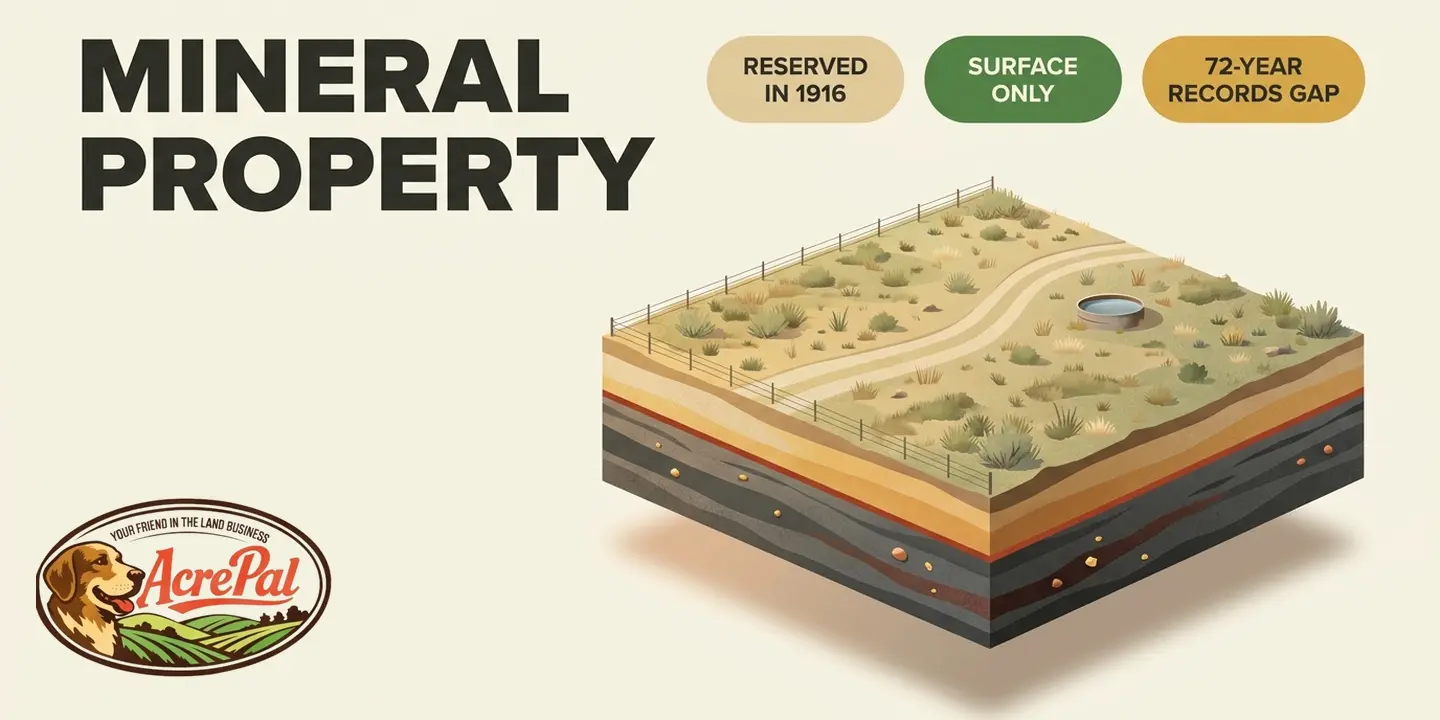
You found five acres in Arizona or Nevada for less than the price of a used truck. Then, in smaller type than the price, you hit one line. Surface rights only. Or mineral rights not included.
That line is about mineral property, and searching the phrase cold will not help you much. Half of what comes back teaches you to identify a rock by its hardness and luster. The other half is a fight over who owns what sits underneath a piece of ground.
The advice on almost every page about the second kind is the same. Go read your deed. The two most authoritative pages on the subject say that usually will not work, and exactly one of them explains why.
Something else worth knowing up front. Almost nobody finds out the hard way because they went looking. They find out because somebody else came looking, with a lease in hand.
So here is what you are getting. A free federal record that reaches back to 1788, the actual years the online records go back to in the six counties we sell land in, what a law Congress passed in 1916 did to parcels like yours, and what a mineral owner is and is not allowed to do on your ground.
What Mineral Property Actually Means
Type the phrase into a search bar and the results split down the middle. One set teaches hardness, luster and streak, the way a geologist identifies a specimen. The other argues about who holds title to the oil, gas, coal or gold under a specific piece of dirt, and only that sense changes what you are buying.
The clearest definition of that second sense comes from Montana State University Extension. Of the ten pages we read, its MontGuide is the only one that treats mineral property as its real subject.
Mineral property is real property that can have several different forms. Mineral property includes hydrocarbons (oil, gas, and coal); hardrock minerals (gold, silver, copper, and other metals); and other types of minerals (talc, bentonite, uranium, and others).
The jargon behind mineral right meaning and mineral rights meaning comes down to five plain terms.
- Surface estate. The ground you walk on, build on and camp on.
- Mineral estate. Everything of value underneath it.
- Mineral rights. The legal right to explore for, extract and sell what is down there.
- Mineral interest. One person's share of that mineral estate, usually a fraction.
- Severance. The moment somebody split the two estates apart.
Even the word mineral is not settled. In Amoco Production Co. v. Southern Ute Indian Tribe, 526 U.S. 865, decided June 7, 1999, the Supreme Court read the Coal Lands Acts of 1909 and 1910 and decided whether a coal reservation also took the coalbed methane gas inside the seam.
The term "coal" as used in the 1909 and 1910 Acts does not encompass CBM gas.
If the Supreme Court needed a full opinion to decide whether coal includes the gas inside it, you can forgive yourself for not knowing what your deed reserved.
The Three Shapes Mineral Ownership Takes
MSU Extension describes a single 640 acre mineral tract sitting underneath 28 different surface owners, and a 920 acre ranch carrying four separate mineral ownerships. Mineral boundaries have no obligation to match fence lines. Most pages treat this as a yes or no question, and it is closer to a map.
| Shape | What it means | What you actually own |
|---|---|---|
| Unified estate | Nobody ever split it | The surface and everything under it |
| Severed or split estate | Someone carved the minerals out and kept or sold them | The surface only, unless the record says otherwise |
| Fractional interest | The minerals were divided among several owners | A percentage of the whole mineral estate, not a corner of it |
A unified estate is the simple case, and it is still common on ground that never went through a federal patent carrying a reservation. Severance is the interesting one, because it happens once and then travels forever. The next section explains how that happened to most of the cheap land in the West.
Fractional interests are what heirs create. A man who owned all the minerals under 160 acres leaves them to four children, each of whom leaves a quarter share to three more, and now twelve people own a twelfth of everything under that ground rather than thirteen acres apiece. Nobody owns a corner. Everybody owns a slice of the whole.
Those slices are measured in net mineral acres. Multiply the surface acres by your fraction of the mineral estate, so a quarter interest in the minerals under 160 acres is 40 net mineral acres, not 160. Own an eighth of the same tract and you hold 20.
Water rights run on a completely separate set of rules, and we cover those in their own guide.
The useful question is not whether this parcel has mineral rights. It is which acres, what fraction, and who holds the rest.
Why So Much Cheap Western Land Has No Minerals Attached
Five acres for less than a used truck, and the minerals are not included. That has almost nothing to do with the seller. It has everything to do with a law Congress passed in 1916.
The Stock Raising Homestead Act let settlers claim large tracts of dry western ground for grazing, and kept the minerals for the United States in every patent it handed out. The codified text, at 43 U.S.C. 299(a), is short and blunt.
All entries made and patents issued under the provisions of this subchapter shall be subject to and contain a reservation to the United States of all the coal and other minerals in the lands so entered and patented, together with the right to prospect for, mine, and remove the same.
A patent here is not an invention patent. It is the original deed from the United States to the first private owner, and every chain of title in the West starts with one. The word appears in zero of the ten competitor pages we read.
BLM says it plainly on its own split estate page.
These "split estate" situations are the legacy of the Stock Raising Homestead Act (SRHA) of 1916.
The law allowed a settler to claim 640 acres of non-irrigable land that had been designated by the Secretary of the Interior as "stock raising" land.
The Act is old and it is not dead. Most of the surrounding subchapter, sections 291 through 298 plus 300 and 302, was repealed by FLPMA in 1976, so nobody files a new stock raising homestead entry today. Section 299 survived, and the reservation written into every patent already issued is still live in 2026.
All six counties we sell in sit in public land states, which is exactly why surface only mineral property keeps turning up on cheap western parcels. Wyoming has its own version of this story, and we cover that one separately.
Why Your Deed Probably Will Not Tell You
The most repeated instruction on this subject is to check your deed. It is also the instruction the two best sources on the subject say will not work.
We read ten pages. Four tell you to check the deed with no caveat at all. Two warn that the deed, or even a standard title search, is not enough. Nobody reconciles the split for you.
Nolo, written by a J.D. and updated in June 2026, gives the mechanism.
Since sellers of land can convey only property that they own, each sale of the land after the minerals are separated automatically includes only the land. Deeds to the land made after the first separation of the minerals will not refer to the fact that the mineral rights are not included.
CNBC Select tells you the opposite, that "the deed is the first place to look to see how mineral rights are divided". MSU Extension lands in between. "A standard title search will not always turn up the ownership of minerals, additional research may be needed."
So if the minerals were carved out in 1954, every deed after it quietly conveys the surface alone. Seventy years later your deed is silent, and silence is not proof of anything. The deed is a reasonable place to start and a terrible place to stop, and one page in ten explains why.
Matt Onest, an oil and gas attorney in Ohio, described the call he gets over and over. Somebody rings up because a great-great-grandfather owned property in the county, and a company has just told them they hold mineral rights and wants to lease. Their reaction is always the same. They had no idea.
So when you ask who owns the mineral rights to my property, your deed answers one narrow version of that question. If the severance happened in the deed you are holding, the language is right there, usually in the paragraph after the legal description. A reservation means the seller kept something back, and an exception means something is carved out of what is being conveyed.
Start With the Free Federal Record Nobody Mentions
Before you pay anybody a dollar, go look at the free federal database that holds the document that started your parcel's chain of title. Neither General Land Office nor patent appears anywhere in the ten competitor pages we read.
It is the BLM General Land Office Records site, glorecords.blm.gov. In BLM's own words, "The website offers access to images of more than five million federal land title records issued since 1788." No signup either, because "Account creation is not necessary for general use of the General Land Office Records system." It also carries survey plats and field notes back to 1810, covering "federal land conveyance records for the Public Land States, which are states that were created out of the public domain."
If your parcel was patented under the Stock Raising Homestead Act, that patent created the split, and this is where you can read it for free tonight. Search by state and county, then by patentee name or legal description, meaning township, range and section, and look for reservation language on the face of the patent.
Two limits, both real. BLM says up front that "while the collection is extensive, this site does not contain every federal title record issued." And a patent tells you what the United States reserved back then, not what happened to that mineral property in the hundred years since.
What County Records Can and Cannot Show You
Everybody tells you to search the county records. Nobody tells you what you are looking at when you get there, or that on the oldest severances the online record cannot reach the document that matters.
Six terms get you through the first five minutes.
- Grantor. The person giving the property away.
- Grantee. The person receiving it.
- Grantor-grantee index. A name-based index, so you trace ownership person by person and check both names at every link.
- Tract index. A land-based index organized by the parcel itself, faster where it exists, and it catches documents recorded outside the expected name chain. Most counties still use grantor-grantee, because a tract index is expensive to keep current.
- Book and page. The filing address of a recorded document.
- Reservation and exception. The two words from the last section, and the ones you are hunting for.
The method is simple and slow. Start with your current deed, find the grantor, look that name up as a grantee to get the deed before it, and keep walking backward. Read the paragraph after the legal description every single time, hunting for the first deed that stops passing the minerals along. Counties also bill severed mineral interests separately from the surface, so an owner-name search at the county assessor is a second place a severance shows itself, sometimes still under a long-dead prior owner's name.
This is what we find when we pull chains of title in the counties we sell in.
| County | Recorder portal | Online index covers | What sits behind that |
|---|---|---|---|
| Mohave County, AZ | eaglerss.mohave.gov/web/ | 1988 to present | Pre-1988 is index books and microfilm, in person |
| Apache County, AZ | eaglerecorder.co.apache.az.us/web/ | Not published | We have seen a case where nothing before 1991 was indexed |
| Costilla County, CO | icounty.org | 1997 to present, paid day pass | Pre-1997 in person at 400 Gasper Street, San Luis, Monday to Thursday |
| Elko County, NV | records.elkocountynv.net/Landmark | March 5, 1869 forward | The outlier, deep coverage online |
| Modoc County, CA | rwindex.co.modoc.ca.us/recorderworksinternet/ | 1984 to present, plus scanned index books back to 1972 | Pre-1972 in person |
| Putnam County, FL | apps.putnam-fl.com/peas/ | Not published | Multiple portals, login required |
A severance created by a 1916 Stock Raising Homestead Act patent sits 72 years before Mohave's online index begins and 81 years before Costilla's. The standard internet advice, search your county records online, cannot reach the document that matters on exactly the kind of parcel where it matters most. You are not doing it wrong. The records are not there.
Elko breaks the pattern. Its index runs from March 5, 1869, the homestead era itself, so a Nevada buyer can often do online what an Arizona buyer cannot. Portals change, so confirm current coverage with the recorder.
We do not have a verified price range for hiring this out, so we are not going to print one. But if the parcel is expensive, if there is active production or mining nearby, or if the online index stops short of your chain's era, a professional title search earns its fee.
What a Mineral Owner Can and Cannot Do to Your Land
The same 1916 sentence that handed the minerals to the United States also fenced in whoever ends up holding them, and that half almost never gets published. You will read that mineral rights trump surface rights and that extraction happens without the surface owner's permission. Both claims are directionally true and materially incomplete.
Start with 1916. Reentry to actually mine is capped at what is "reasonably incident to the mining or removal of the coal or other minerals". Beforehand the developer has to do one of three things. Get the surface owner's written consent, pay agreed damages to crops and improvements, or post a bond for the landowner's benefit.
Congress went further in 1993. Public Law 103-23 added 43 U.S.C. 299(b) through (f), which require 30 days advance notice to the surface owner by registered or certified mail, a reclamation bond covering crop and grazing losses, and a plan of operations carrying a surface use fee. On consent the statute is direct.
No person may engage in the conduct of mineral activities (other than those relating to exploration) on a mining claim located on lands subject to this subchapter without the written consent of the surface owner thereof
Read the scope carefully. Those subsections are written in terms of mining claims and locatable minerals, the hardrock system running back to the 1872 Mining Act, not a general rule for oil and gas leasing. That puts them on point in hardrock country like Elko County, Nevada, and off point in a drilling scenario.
Courts have also developed an accommodation doctrine. Where a mineral owner has a reasonable alternative route to the minerals, its surface use has to leave room for how the surface owner is already using the land. Texas recognized it in Getty Oil Co. v. Jones, 470 S.W.2d 618 (Tex. 1971). That is Texas law about an oil and gas lessee, so treat it as a general principle and let the federal statute carry the weight.
What Your Title Paperwork Is Supposed to Tell You
You would assume your title policy either covers a mineral surprise or flatly excludes it. In the 2021 ALTA Owner's Policy, the form a raw land buyer receives, the word mineral appears zero times, so there is no standing mineral exclusion.
Whether your minerals are excepted is decided by the Schedule B exceptions the title company writes for your parcel, so read Schedule B and make them walk you through it.
One ALTA form does the opposite of excluding mineral damage. Covered Risk 25 of the Homeowner's Policy covers improvements "damaged because of the future exercise of the right to use the surface of the Land for the extraction or development of oil, gas, minerals, groundwater, or any other subsurface substance". The catch is in its own title, a "Homeowner's Policy of Title Insurance for a one-to-four family residence". Vacant land does not qualify, and it protects existing improvements, which bare ground does not have.
Colorado goes further than any state we sell in. C.R.S. 10-11-123 makes the title insurance agent or company put a written statement in the title commitment once a mineral estate is found to be severed. One required line says the mineral estate "may include the right to enter and use the property without the surface owner's permission." It reaches a buyer before closing, because "Surface owner" means "the owner of the surface estate and any purchaser with rights under a contract to purchase all or part of the surface estate." That covers Costilla County.
Two limits keep it honest. The duty runs to the title company, not the seller, and fires only when a commitment for an owner's policy is issued, so a cash buyer who skips owner's title insurance is owed this disclosure by nobody. Subsection (3) lets the company rely on the recorded documents and disclaims liability for errors in them, and (5) caps liability at the policy amount. In Colorado, buy the owner's policy and the disclosure becomes mandatory.
What You Can Do If the Minerals Are Already Gone
Every page we read stops at how to find out. Not one of the ten mentions that in some states an old, abandoned mineral right can be cleared off your title entirely, and one of those states is California.
If a private party holds the minerals, that interest is property like any other. Find the holder in the county records, make an offer, and record a proper mineral deed. Where the United States reserved the minerals in the original patent, this route is closed.
Then there is California. Civil Code sections 883.210 through 883.270, headed "Termination of Dormant Mineral Right", let a court terminate a mineral right that has gone quiet. It counts as dormant only if all three of these held true for the 20 years immediately preceding the start of the action.
- "There is no production of the minerals and no exploration, drilling, mining, development, or other operations that affect the minerals"
- "No separate property tax assessment is made of the mineral right or, if made, no taxes are paid on the assessment"
- "No instrument creating, reserving, transferring, or otherwise evidencing the mineral right is recorded"
Modoc County, California is one of the counties we sell in, which is the only reason we went looking for this in the first place.
Three hedges ship with it. It takes a court action, not a form. All three conditions have to hold for the full 20 years, and one recorded instrument or one paid assessment resets the analysis. We read the definition and not the procedure, so a California attorney is the right next call.
A law firm survey says "Today, roughly half of the states have enacted one or another form of a dormant mineral statute", with published lapse periods in the states it names running 20 to 30 years. These statutes are unevenly distributed. California has one and we verified it ourselves. Anywhere else, check your own state rather than assuming either way.
How Much This Should Actually Change Your Decision
You did not come here to become a title examiner. You came to find out whether this should stop you buying. Usually it should not, and here is how to tell.
Nolo takes a position against its own interest. "It is typically a costly process to find out whether someone other than the landowner owns the mineral rights. And perhaps you don't really need to find out." Here are four checks you can run in an evening.
- Any active oil, gas or hardrock production in the county?
- A lease offer, a royalty check, or an old mineral deed in the family paperwork?
- Is the parcel in live gold country, like Elko?
- Is this a state where the title commitment has to tell you?
Four noes and the odds of anyone showing up with a rig are small. Note it and move on.
On value, two land brokerages publish flatly opposite claims. One says severed rights drag a parcel's price down. The other quotes its own agent saying severance makes no difference to price in his market. Neither shows any data. On bare recreational ground in a county with no production history, most buyers are not paying extra for minerals.
Most of our buyers want somewhere to camp, park an RV, hunt, or pan a wash. Picking up pretty rocks is a different activity from locating a mining claim. Where the minerals are severed, ask before you dig, and check with BLM and a local attorney before anything resembling extraction. The 1993 notice rules bind people other than the surface owner, a procedural carve-out and not a grant of the minerals to you.
We list what we know about every parcel, including what conveys and what does not. If a listing says surface rights only, ask us what we found in the record. Start at acrepal.com.
Common Questions About Mineral Property and Mineral Rights
How do I know if I own mineral rights?
You check the record, not your deed. Three moves in order. Look up the original federal patent free at glorecords.blm.gov, then walk your county's grantor-grantee index backward hunting for the deed that stopped passing the minerals along, then hire a professional if those turn something up or the stakes justify it. In most counties the online index does not reach the oldest severances.
Who owns the mineral rights to my property?
Usually a previous owner or their heirs, the United States if the ground was patented under the 1916 Stock Raising Homestead Act, an energy or mining company that bought them, or an investment fund. You find out by locating the instrument that severed the minerals and tracing forward, owner by owner. Guessing from the current deed will not get you there.
Where do I find mineral interests for sale?
Mineral brokerages, online auction platforms, private sellers who inherited an interest they do not want, and occasionally county tax sales. Nearly every site listing a mineral interest for sale is run by the sell side and earns a commission on the answer it gives you, so do your own title work first.
How do mineral rights auctions work?
Lots are usually offered and bid by the net mineral acre, the unit defined earlier, with a buyer's premium added on top of the hammer price, so read the terms before you bid. Winning an auction guarantees nothing about production or income. Do the title work first. There is no inspection period after the gavel falls.
Can I buy the mineral rights under land I already own?
Sometimes. If a private party holds them, find them in the county records and make an offer like you would on any other property, then record a proper mineral deed. If the United States reserved them in the original patent, they are generally not available to buy that way. Some states also have dormant mineral statutes, covered above.
Do you pay property taxes on mineral rights?
It depends on the state and on whether the minerals are producing. Some counties assess a severed mineral interest separately from the surface and send it its own bill, sometimes still addressed to an owner who died decades ago. Unpaid mineral taxes can end up in a lien sale like unpaid land taxes. Check the county assessor by owner name.