
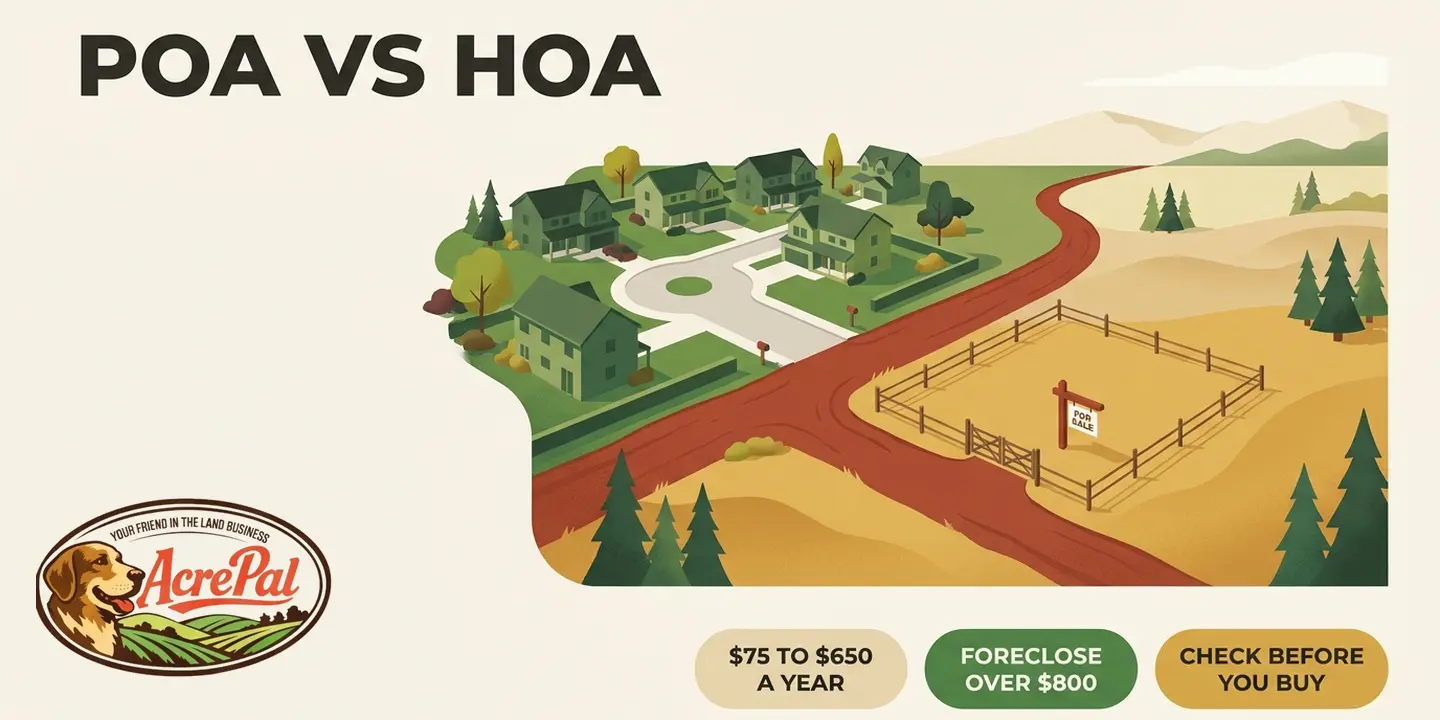
You found a cheap rural lot, the listing says POA, or maybe it proudly says no HOA, and now you need to know what you are signing up for. The POA vs HOA question feels like it should have a clean answer, but a $10,000 vacant lot can carry mandatory annual dues, a recorded lien, and even foreclosure risk you never saw coming. The acronym matters far less than what is recorded against the deed.
Almost nobody says this part plainly. POA and HOA are two labels people treat as opposites, but they are often the same thing wearing a different name. What binds you is the recorded declaration and whether membership is mandatory, not the acronym on the sign. That one shift in focus changes how you read every rural listing.
We will answer the standard comparison accurately, scope, membership, rules, fees, and governance. Then we cover what the suburban articles skip, dues and liens on unbuilt lots, private road agreements, how to check before you buy, and whether unrestricted really means unrestricted.
POA vs HOA, The Accurate Definition Most Articles Get Wrong
Read three articles on this topic and you get three different answers, and that contradiction is the whole tell. If the experts cannot agree on what a POA even is, there is no universal legal difference to agree on. One source calls a POA the broader mixed-use body beside an HOA, another calls it the umbrella over both HOAs and condo associations. They are all guessing at a line the law mostly does not draw.
The accurate core truth is simpler. In Texas, Property Code Section 202.001 uses property owners association as the statutory umbrella for every residential community association, and homeowners association is not even a separate legal category there. Wikipedia notes the same thing from the other direction, that HOAs may also be called POAs or common interest developments. So what matters is the recorded CC&Rs, whether membership is mandatory and recorded against the deed, and what property the documents cover.
Georgia is the rare real exception. Its Property Owners Association Act gives communities that opt in stronger liens and perpetual covenants, which proves the point rather than breaks it. The label only means something when a specific statute or document makes it mean something. The five terms you will actually run into sort out like this.
- HOA, a single residential community with mandatory membership and detailed use and appearance rules.
- POA, a broader, mixed-use, or rural body that often includes vacant land and leans toward infrastructure over aesthetics.
- COA, a condominium association governing shared building components like roofs and hallways.
- PUD, a zoning designation rather than an association, which always comes with a mandatory HOA attached.
- Master association, an umbrella over sub-associations where you can owe two sets of dues at once.
The difference between a deed and the CC&Rs recorded against it trips up plenty of first-time buyers, so understand it before you sign. From here we compare the two criterion by criterion, through a land buyer's eyes.
1. Scope, What Each One Actually Covers on Rural Land
The association type built for raw land is not the HOA, it is the POA, and it is everywhere in the cheap-lot market. That surprises buyers who assume associations are strictly a suburban thing.
HOAs typically govern single-use residential neighborhoods, homes and townhomes, and they lean hard into appearance. POAs govern broader, mixed-use, and rural or recreational areas that routinely include vacant and undeveloped lots. So if you are shopping remote parcels, you are shopping POA territory more often than not.
Rural recreational subdivisions, the Costilla County Colorado and Putnam County Florida types, are where POAs live. A buyer grabs a cheap lot advertised as no HOA and then discovers a recorded POA with mandatory dues and private-road obligations filed into the plat decades ago. In Colorado's mountain and rural counties, POAs are common in any subdivision with private roads. If you are weighing affordable rural lots in Colorado, this is exactly where a quiet POA hides in the plat.
What a rural POA actually governs tends to be practical, not cosmetic.
- Private road grading, snow removal, and erosion repair.
- Gated or shared entry and basic security.
- Common areas, lake or pond access, and open space.
- Shared wells or water systems.
- Signage and fire mitigation in wildfire country.
Best for the rural recreational buyer, a POA is what you will usually meet on remote land. A strict lifestyle association is far more common in built-out suburban subdivisions, so skip the assumption that one is coming for you.
2. Membership, Mandatory or Voluntary and Why It Is the Real Dividing Line
Voluntary POA is one of the most expensive phrases in land buying, because buyers hear it and assume they can simply decline the dues. Sometimes that is true. Often it is a costly misread.
The one distinction that carries legal weight is whether membership and dues are mandatory and recorded against the deed, or genuinely voluntary. That is the real line, and it has nothing to do with which acronym the sign uses. Sources contradict each other constantly on whether POA membership is optional, because both versions exist in the wild.
Some rural POAs really are voluntary, funded by donations, loosely organized, with minimal enforcement. Others are fully mandatory, and a mandatory POA has the exact same lien and foreclosure power as any HOA. The friendly-sounding label does not soften the teeth.
How do you tell which one you have? It is written in the recorded Declaration and CC&Rs and tied to the deed, not decided by the name on the entrance sign. We will walk through exactly how to pull those documents later. For now, remember that the obligation begins the moment the deed transfers into your name, which is what makes the next two sections matter.
The verdict, mandatory beats the label every time. If the recorded declaration makes membership and dues mandatory, calling the body a POA does not make a single dollar of it optional.
3. Rules and Restrictions, Plus What Unrestricted Land Really Means
Land can be legally restricted even when there is no HOA collecting a dime. That fact undoes most assumptions people carry into a raw-land purchase.
Start with the honest comparison. HOAs tend to enforce detailed aesthetic rules, paint colors, fences, parking, lawns. Rural POAs restrict less and focus on infrastructure. But rural does not mean loose. Double OTT Ranch in Texas bans manufactured homes, forbids subdividing below 15 acres, sets a 12-month build deadline, and prohibits commercial use. The rules live in the document.
The part that catches people comes next. CC&Rs and deed restrictions run with the land and bind every future owner, and they stay enforceable even if the association is dormant or was never created. Once recorded, the document becomes constructive notice to everyone, so I did not know is not a defense. Any owner bound by the same covenants may enforce them through a private lawsuit. No HOA does not equal no restrictions.
Truly unrestricted rural land is the real prize for off-grid living, homesteading, RVs, livestock, and manufactured homes, and sellers market that freedom hard. The honest caveat is that unrestricted almost always refers to deed restrictions only. County zoning, health-department septic and well rules, easements, and a road POA can all still apply. If your plan is off-grid, the best states for homesteading are a smart place to start.
We will be straight about our own inventory. Our western parcels across Arizona, Colorado, Nevada, California, and Florida are typically either unrestricted or sit in light-touch rural POAs focused on road access rather than lifestyle rules. We are not a law firm, so verify the recorded documents on any lot, and AcrePal will point you to them rather than around them.
Quick comparison, an HOA restricts how your place looks, a rural POA restricts how the shared road works, and unrestricted answers to the county.
4. Fees and Dues, Rural POA Dollars vs Suburban HOA Dollars
The number to plug into your holding-cost math is refreshingly small. Rural recreational POA dues typically run $75 to $650 per year. Suburban HOA fees average $200 to $300 per month, which is $2,400 to $3,600 a year. That gap is why rural ownership stays cheap to carry.
Real examples fill in the range.
- Colorado rural POAs, roughly $75 to $250 per year for road maintenance.
- Cacapon South POA in West Virginia, $500 per year for 2026, split $400 operations and $100 into a road-repair reserve.
- Village at Nags Head in North Carolina, a $650 per year master association plus separate sub-association dues.
- Undeveloped lots at that same community, from $132 per quarter to $440 per year, unbuilt and still billed.
That last line does the damage. Dues accrue from the moment the deed transfers, whether or not you build, because most CC&Rs do not exempt vacant lots. A reduced vacant-lot rate exists only if the document spells one out, and regular buyers rarely get the deferred terms a developer might.
Watch the extras too. Many associations charge a working-capital or transfer fee at each sale, sometimes a full year's dues, and a special assessment for a major road washout can land as a large one-time charge on top of the regular bill. If you are running the math on holding a lot as an investment, our guide to making money from vacant land folds these carrying costs into the bigger picture.
Direct recommendation, get the exact annual dues in writing before you buy and add them to your carrying cost, even for a lot you never plan to build on.
5. Liens and Foreclosure, You Can Lose a Vacant Lot Over Small Dues
The scariest sentence in land buying is that a $300,000 paid-off home was foreclosed for $800 in unpaid dues. That 2008 case was real, and the same mechanism reaches an empty lot just as easily.
The mechanism is straightforward. Unpaid dues become a recorded lien, and most states let the association foreclose to force a sale and collect. Some states, Texas among them, allow non-judicial foreclosure with no court order. Florida requires a slower judicial process that still ends the same way. None of this needs a house on the parcel to work.
Then there are the dues you never ran up. Under joint and several liability, the clean example being Georgia's POA Act, both buyer and seller are on the hook for unpaid assessments, and an automatic statutory lien can survive the closing if nobody pays it off. Because recorded covenants are constructive notice, you are treated as having known. This is why the estoppel letter we cover in the next section is not optional homework.
Super-lien states raise the stakes further. Roughly 28 states put a set number of months of assessments ahead of even the first mortgage. Colorado gives the association 6 months of priority, Nevada 9 months, Maryland 4 months or $1,200 whichever is less. Two of the states we sell in, Colorado and Nevada, are super-lien states. When a lien makes conventional financing messy, some buyers pivot to owner financing instead of a bank loan to sidestep the friction.
The verdict, small dues are not small if you ignore them. Pay on time even on an empty lot, and clear any prior balance at closing so it never becomes yours.
6. Governance and Roads, the Private Road Maintenance Agreement Nobody Warns You About
The real reason most rural POAs exist is not rules, it is the road. Strip away the aesthetic policing of a suburban board and what is left is owners keeping a shared dirt road passable.
Suburban HOAs run boards, elections, and appearance enforcement. Rural POAs mostly exist to fund private-road maintenance, grading, snow, erosion, and shared infrastructure. Without an agreement, owners split road upkeep informally, which falls apart the first winter someone refuses to pay.
The financing trap is where this gets serious. Lenders treat private-road access differently by program. Fannie Mae conventional loans typically require a recorded Private Road Maintenance Agreement, a PRMA, signed by every road-sharing owner. Freddie Mac wants a recorded permanent easement but not a formal PRMA. FHA and USDA need a recorded easement and all-weather access. VA loans, since November 2022, need only a recorded easement.
The workaround matters when the paperwork is missing. If your neighbors will not sign a PRMA and you need conventional financing, you may be pushed toward cash or owner financing. Drafting a PRMA runs about $500 to $2,000 in attorney fees, cheap next to a dead deal. Since a POA may or may not cover road upkeep, understand the real costs of utilities and access on rural land before assuming the dues cover it.
Best for the buyer who values a maintained access road, a road-focused POA is a genuine feature. Skip the parcel, or pay cash, if it sits on a private road with no agreement and you wanted financing.
7. How to Check for a POA, HOA, or Deed Restrictions Before You Buy
You can uncover nearly every recorded restriction on a parcel before you sign, usually for the cost of a title commitment. This is the step-by-step check that turns everything above into something you can act on.
Work the list in order.
1. Order the title commitment, read the Schedule B exceptions, then request copies of every document it references, the Declaration of CC&Rs, any POA declaration, and easements.
2. Read the recorded CC&Rs directly for use restrictions, membership terms, assessment authority, and lien rights.
3. Pull the recorded plat or subdivision map for setbacks, easements, and any POA references baked into the plat notes.
4. Search the county recorder by legal description or subdivision name for Declaration, Covenants, Restrictions, and Easements. Many counties have free online portals.
5. Request an estoppel or dues-status letter from the association to confirm current dues, unpaid balances, violations, and transfer fees. Florida caps it at $299 for a non-delinquent account, plus $179 if delinquent.
6. Confirm whether the access road is public or private, and whether a recorded PRMA exists.
7. Check whether the association is active or dormant, remembering that the CC&Rs bind you either way.
Do all of this before you sign the purchase contract, not after the money is committed. If the deed and title side still feels murky, our breakdown of the difference between a deed and a title makes the recorded-document trail easier to follow.
Direct recommendation, order a title commitment and pull the recorded declaration on any lot before you sign. Ten dollars of county records beats a surprise lien every time.
So Which Matters More for a Land Buyer, the POA, the HOA, or the Documents
Carry one decision rule into every listing you open. POA vs HOA is the wrong question. The right questions are what the recorded CC&Rs actually restrict, whether membership is mandatory and recorded against the deed, what the exact dues are, and whether a lien or a private-road agreement is in play. The acronym is a label, the documents are the contract.
For a land buyer, the practical frame shakes out cleanly.
- A light-touch rural POA that maintains the road for $75 to $250 a year can be genuinely worth the money.
- A mandatory association with steep dues, aggressive liens, or restrictive CC&Rs may simply not fit an off-grid or investment plan.
- Truly unrestricted land gives the most freedom, but nobody maintains the shared road and nothing shields you from a neighbor's use.
Buyers who want minimal restrictions tend to gravitate toward western rural parcels that are unrestricted or lightly governed, and that instinct is sound. Every parcel still earns its own document check, no exceptions. Then take the concrete next step, order a title commitment and read the recorded declaration before you sign. The FAQ below answers the specific worries buyers type into search most often.
POA vs HOA on Land, Frequently Asked Questions
Is a POA the same as an HOA?
Often, yes. The two are frequently used interchangeably, and many states draw no legal distinction. Texas law uses property owners association as the statutory umbrella, and Wikipedia lists POA and CID as alternate names for an HOA. The recorded documents matter, not the name.
Do I have to pay POA or HOA dues on a vacant lot if I never build?
Yes, in most cases. Dues typically begin the day the deed transfers, and most CC&Rs do not exempt unbuilt lots. A reduced rate exists only if the documents provide one, and unpaid dues can become a lien against the empty parcel.
Can a POA or HOA foreclose on my land for unpaid dues?
Yes. Once a lien is recorded, most states allow foreclosure, and some, like Texas, permit it with no court order. Florida requires a judicial process. A 2008 case saw a $300,000 paid-off home foreclosed for just $800 in dues, and it reaches vacant lots.
Can a listing say no HOA but still have deed restrictions or a POA?
Yes. No HOA usually means no active association collecting dues, but recorded CC&Rs and dormant POAs still bind the land. Unrestricted refers to deed restrictions only, not county zoning. Review the title commitment Schedule B and the county recorder before assuming a parcel is free.
Do I need a private road maintenance agreement to get a mortgage on rural land?
It depends on the loan type. Fannie Mae conventional loans usually require a recorded PRMA signed by all road-sharing owners. VA loans since November 2022 need only a recorded easement, and FHA and USDA need one with all-weather access. Without a required PRMA, expect cash or owner financing.
What is the difference between HOA, POA, COA, PUD, and master association?
An HOA governs a single residential community with mandatory membership. A POA covers broader or rural areas including vacant land and leans toward infrastructure. A COA governs shared condo components. A PUD is a zoning designation that carries a mandatory HOA. A master association is an umbrella where you may owe two sets of dues.
What is an estoppel or dues-status letter and do I need one?
Yes, request one before closing. An estoppel letter, also called a status letter or resale certificate, is a binding document confirming current dues, unpaid balances, violations, special assessments, and transfer fees. It stops you inheriting the prior owner's back dues under joint and several liability. Florida caps it at $299, plus $179 if delinquent.