
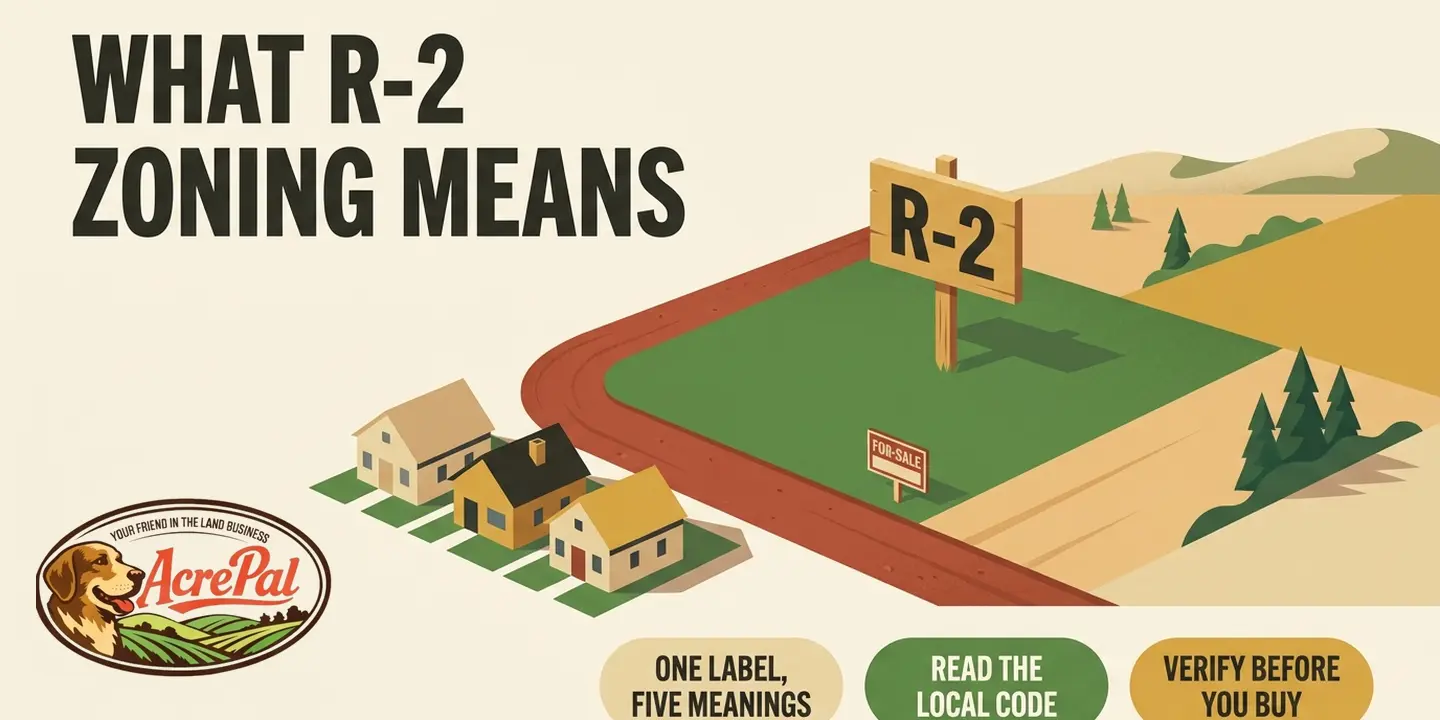
You spotted R-2 on a listing or on the county parcel viewer, so you typed "what does R-2 zoning mean" into a search bar and got five different answers. The sources are not contradicting each other by accident. An R-2 zone is a local label with no single national meaning, and assuming it means one fixed thing is how land buyers get burned. The same three characters can mean single-family only in one city and apartments in another.
We wrote this guide to give you the real answer instead of a guess. You will learn what R-2 usually allows, the dimensional numbers that decide what actually fits on a parcel, the manufactured-home trap that catches cheap-land buyers, why most affordable rural acreage is not R-2 at all, how private deed restrictions can override the zoning entirely, and the exact steps to confirm the rules for your specific parcel before you sign anything. Read the section that matches your plan, then run the checklist near the end.
What R-2 Zoning Actually Means (There Is No Single Answer)
The same three-character label can mean opposite things depending on which city or county wrote the code. That is the one fact every thin article gets wrong.
One thing does hold up everywhere. The "R" stands for residential, and the number is a density tier that generally climbs from R-1 at the low end toward R-4 or R-5 at the high end. What the "2" actually permits, though, is written into a specific municipal or county ordinance. It is not fixed nationally.
The same label lands in five very different places.
- In New York City, an R2 district allows single-family detached homes only. Duplexes are not permitted, the minimum lot area is 3,800 square feet, and the maximum floor area ratio is 0.5. It is one of the lowest-density R-2 designations in any major U.S. city.
- In the City of Los Angeles, R2 is a two-family zone. It permits any R1 use plus a duplex or two houses on one lot, with a 5,000 square foot minimum lot and 2,500 square feet per unit.
- In Salt Lake City, the R-2 district is a single- and two-family hybrid, so both a single house and a duplex are allowed. It sits squarely between the NYC and LA models.
- In Taylor, Arizona, R-2 is multifamily residential, meaning medium to high density apartments are the primary use, not just a duplex.
- In Grace, Idaho, a small town, R-2 is also a multiple-family district.
Same label, five different density tiers. The abbreviation is only an index into a document, and you have to read the document to know what it says. Just knowing the name of the designation is never enough, you have to find the exact uses it allows.
A quick word on the ladder, since people rely on it. A higher number usually signals higher density, so R-3 typically sits above R-2. That ordering is a rule of thumb, not a law, and some codes flip the numbers or skip them entirely. Never act on the letters alone. Pull the ordinance text for your parcel's exact district and read the actual rules.
What You Can Actually Build on R-2 Land
Buyers pay for a parcel picturing a duplex or a rental unit out back, then learn their R-2 only allows one house. The fix is knowing which uses are safe assumptions and which ones you have to verify.
Walk the typical R-2 use menu with three labels in mind, usually yes, depends, and usually no.
Usually permitted by right:
- A single-family detached home, the one near-universal R-2 use
- Accessory structures like a garage or a shed
- Often an accessory dwelling unit (ADU), which is increasingly allowed
Depends entirely on the local code:
- A duplex or two-family dwelling, allowed in LA R2 but not in NYC R2
- Townhouses and small multi-family, only in medium or high-density R-2 like Taylor, Arizona
- A manufactured home, which many R-2 zones restrict or exclude (more on that below)
Usually needs a conditional permit and a hearing:
- Daycare homes, churches, schools, and elderly housing
Usually not allowed at all:
- Commercial and industrial uses
- Mobile-home parks, which belong in a separate manufactured-home district
The "depends" bucket is where money gets lost. In LA City R2 a duplex is the primary permitted use, while in NYC R2 the exact same label bans it and allows one detached house only. Even inside a single county the answer shifts by sub-district, so in Cochise County, Arizona the SM district allows manufactured homes while the MR-1 district right next to it excludes them. You cannot read the outcome off the letters.
The real skill is reading the use list itself. Every ordinance splits uses into three buckets, permitted (allowed by right), conditional (allowed only with a special permit and a hearing), and prohibited (not allowed at all). A conditional use is not a guaranteed yes, it means you have to apply, accept conditions, and can still be turned down. That list, for your exact zone, is the only reliable answer to "what can I build."
R-2 is best if your plan is a house, and maybe one extra unit where the code allows it. Hold your assumptions if your plan is apartments, a manufactured home, or any kind of business, until you confirm the use in writing.
R-2 Lot Size, Setbacks and Height: The Numbers That Decide What Fits
A parcel can be zoned R-2 and still be unbuildable. The use list tells you what is allowed, but the dimensional standards decide whether your specific lot can hold it.
These standards vary by jurisdiction, so treat the following as typical ranges, not fixed numbers.
- Minimum lot size 2,500 to 20,000 square feet, most commonly 5,000 to 8,000
- Lot width 40 to 60 feet
- Front setback 15 to 35 feet
- Side setback 3 to 15 feet
- Rear setback 10 to 50 feet
- Maximum height 25 to 35 feet, roughly 2 to 2.5 stories
- Lot coverage 30 to 55 percent
- Parking 1 to 2 spaces per unit
For a concrete anchor, unincorporated LA County R-2 requires 5,000 square feet per lot and 2,500 per unit, caps height at 35 feet, and sets a 20 foot front yard, a 15 foot rear yard, and 5 foot interior side yards.
For raw land, minimum lot size is the number with teeth. It works like a gate. If a vacant parcel sits below the minimum, the county generally will not issue a building permit (that is an undersized nonconforming lot) unless you win a variance. The same gate applies if you want to split a bigger R-2 parcel into sellable lots, because each new lot has to meet the minimum on its own. Dividing into 2 to 4 lots is usually a minor subdivision with simplified approval, while 5 or more lots typically triggers a major subdivision with full engineering, environmental review, and public hearings, which is one path some owners use to make money from their land.
Before you assume you can build or subdivide, measure the parcel's actual dimensions against the code minimums. The use list tells you what is allowed, the numbers tell you what is possible, and you need both to line up.
Can You Put a Manufactured or Mobile Home on R-2 Land?
The cheapest path to living on your own land is often a manufactured home, and R-2 is exactly where that plan can quietly die. Do not assume that an R-2 zone, or any zone labeled "residential," allows a manufactured home.
The real examples are blunt.
- The City of Bainbridge, Georgia excluded manufactured homes from its R-2 district and sued a resident who placed one there anyway.
- Huntsville, Texas banned manufactured homes outright, even on private property.
- Central Point, Oregon allows a manufactured home in R-2 only if it is multi-sectional and encloses at least 1,000 square feet, so a single-wide does not qualify.
- Willis, Texas allows one in R-2 only when the planning commission finds an economic hardship that rules out a site-built home, which is conditional rather than by right.
Several mechanisms trip buyers up. A zone may exclude manufactured homes entirely, or relegate them to parks and a separate R-MH district. Others impose a minimum width (24 feet is a common, court-upheld threshold) or a minimum square footage, plus appearance rules covering roof pitch, siding, skirting, and a permanent foundation. A growing trend in western states like Arizona and Kansas is an age cap, barring any home older than 5 or 10 years.
The legal frame explains why these rules survive. Federal HUD code preempts local construction standards for manufactured homes, but it does not preempt appearance, dimension, or location rules. So a county cannot rewrite how the home is built, yet it can regulate how the home looks and where it can sit. Age-only bans have been struck down in some states, while appearance and dimension standards are generally upheld.
One distinction saves a lot of headaches. A modular home is built to the state building code and is usually treated like a site-built house, so it dodges most of these limits. A HUD-code manufactured home does not get that treatment. Because a manufactured home is often the most affordable way to live on land without a big cash outlay, it is worth confirming first. Before you buy R-2 land for one, get the ordinance text and ask the planning department in writing whether your home's type, width, and age qualify.
Why Most Cheap Rural Land Is Not Zoned R-2
R-2 barely exists out where land is cheap. It is a town-and-suburb designation that clusters at the edges of incorporated cities, not in open desert or range.
The rural districts you will actually run into look nothing like R-2.
- In Cochise County, Arizona, about 90 percent of unincorporated land is zoned RU (Rural), not R-2, with tiers like RU-36, RU-18, RU-10, RU-4, and RU-2 set by minimum acreage.
- Costilla County, Colorado has no R-2 district at all. It uses Agricultural (A) and Estate Residential (ER), where ER covers sub-35-acre lots, allows single-family and manufactured homes, and sets a 600 square foot minimum dwelling.
- Elko County, Nevada uses agricultural-residential districts like AR (1-acre-plus parcels) and AR-CRD-2 (5-acre-plus parcels), not R-2.
- Texas counties generally have no county-level zoning over unincorporated land at all, which is why so much Texas acreage is marketed as "unrestricted."
Contrary to a common belief, rural Arizona is zoned, according to the Arizona Cooperative Extension. It is just zoned RU rather than R-2. So if you do see R-2 on a rural listing, it usually means a town annexed the area or the parcel sits inside a municipal boundary, which is worth confirming.
This is where we fit in honestly. We sell rural and recreational parcels across Arizona, Colorado, Nevada, California, and Florida, and those are typically rural-residential, agricultural, or in unzoned areas rather than urban R-2. Instead of leaning on a one-size label, we point buyers to the county's actual code and GIS map. You can see how that looks across our markets at AcrePal, and if you are still comparing regions, our guides to the cheapest places to buy land and the best states for homesteading go deeper.
R-2 answers a suburban question. For raw acreage, the district you usually need to decode is AG, RU, AR, or ER, and the verification steps below apply to those just the same.
Zoning Is Only Half the Rulebook: Deed Restrictions and CC&Rs
Your R-2 zoning can say yes while a document you never read says no. A parcel is governed by two independent layers, and the stricter one wins.
Zoning is public law from the planning department. CC&Rs, also called deed restrictions, are private covenants recorded in county property records. They can be enforced by an HOA or a POA, or directly by neighboring owners, and they exist even on land with no HOA at all. This catches buyers of "unrestricted" rural land off guard, because a parcel with no zoning can still carry recorded covenants from the original subdivision. The difference between a mandatory HOA and a voluntary POA matters here, which we break down in POA vs HOA.
Both layers bind the same parcel, and the stricter rule governs. Your R-2 zone might allow a duplex while the recorded covenants cap the lot at one single-family home, forbid metal roofs, or set a minimum house size. Zoning permission does not override a private restriction, and a private restriction cannot loosen the zoning either.
One trait makes covenants sticky. CC&Rs "run with the land," so they bind every future owner. Unlike zoning, which changes through a public process, they often stay fixed for decades unless the governing document spells out a way to amend them. You find them through a title search or the county recorder, frequently buried in the original subdivision plat, and understanding what rides on your deed versus your title helps you read them.
Check both the zoning code and the recorded restrictions before you assume anything is allowed.
How to Verify R-2 Zoning Before You Buy
You can pin down exactly what an R-2 parcel allows in an afternoon, and most of it is free. Run these steps in order.
1. Get the APN (assessor parcel number) from the listing or the county assessor's website. If it is not listed, cross-reference the address on Google Maps with the county GIS map.
2. Pull the parcel on the county GIS or parcel viewer to see the actual mapped district. Do not trust the listing's label, since agents and sellers get zoning wrong all the time.
3. Read the ordinance text for that district, both the permitted, conditional, and prohibited use list and the dimensional standards. Do not guess from the letters.
4. Toggle the overlays and cross-check FEMA flood maps at msc.fema.gov, where Zone A or Zone AE signals high flood risk that can block permitting. Also look for historic, conservation, wildfire, and airport or highway setback overlays, since these quietly affect what you can build and what it costs to get utilities onto the land.
5. Search the county recorder for CC&Rs and deed restrictions, tying back to the two-layer point above.
6. For a paper record, request a zoning verification letter from the planning department. These run roughly $30 (Lexington, KY) to $155 (Chattanooga, TN), commonly $30 to $200 or more, with turnaround from 3 to 30 days. The letter confirms current zoning and permitted uses, but it does not verify existing structures are legal or predict future changes.
7. Call the planning department, which is free and takes about ten minutes. Ask whether your intended use is permitted, conditional, or prohibited, whether manufactured homes are allowed, whether there is a minimum lot size for a dwelling permit, and whether any zoning changes are pending.
Watch the nonconforming-use trap on vacant parcels. If you are buying an abandoned or long-empty lot counting on a "grandfathered" use, confirm it survives. Most ordinances treat 6 to 12 months of non-use as abandonment, and a lot sitting vacant 2 or more years usually loses its prior nonconforming right entirely, which means you inherit today's rules, not the old ones.
Make your offer contingent on the exact zoning and use you need being confirmed in writing. That single condition turns a guess into a protected purchase.
When R-2 Does Not Fit: Variance, Conditional Use Permit, or Rezone
"I'll just get it rezoned" is the assumption that sinks land deals, because roughly 25 to 40 percent of rezoning requests are denied. If the R-2 rules block your plan, three tools can fix it, and picking the right one matters.
Use a variance when you need to bend a dimensional rule and the use itself is already allowed.
- Fits a setback, height, or coverage problem
- Filed with the Board of Zoning Adjustment
- Requires proving an unnecessary hardship from unusual physical features of the property, not just cost
- Roughly 4 to 12 weeks, about $500 to $3,000
Use a conditional use permit (CUP) when your use is listed as "conditional" in the ordinance.
- Runs from staff to the planning commission to the council
- You accept conditions attached to the approval
- Roughly 2 to 6 months, about $1,000 to $10,000
- Generally 30 to 50 percent cheaper and faster than a rezone
Use a rezoning when your use is outright prohibited and you have to change the parcel's classification.
- Runs from staff to the planning commission (advisory) to the city council (final vote)
- Must match the comprehensive plan, the county's long-term land use blueprint
- Roughly 4 to 8 months, about $1,000 to $50,000 or more
- Around 25 to 40 percent are denied
Attend the free pre-application meeting and read the comprehensive plan before you file, or better yet before you buy, so the price reflects the real odds. Treat any deal that depends on a rezone as high-risk, and never pay a build-ready price for land that still needs one.
R-2 Zoning FAQ
What does R-2 zoning mean?
There is no single answer. The "R" means residential and the "2" is a local density tier, so the meaning changes by jurisdiction. It is single-family only in NYC, two-family in Los Angeles, and multifamily in Taylor, Arizona. Always read your specific county or city ordinance rather than trusting the label.
What can you build on R-2 land?
Almost always a single-family home plus accessory structures, and often an ADU. A duplex is frequently allowed but not everywhere, since NYC R2 bans it. Apartments show up only in high-density R-2 zones. Check the permitted, conditional, and prohibited use list for your exact district before you commit.
Does R-2 zoning allow manufactured or mobile homes?
Not reliably. Many R-2 zones exclude manufactured homes or allow them only with conditions like multi-sectional construction, a minimum width or square footage, or an age cap. Modular homes, built to the state building code, are usually treated like site-built houses. Confirm your home type in the ordinance text first.
Is rural land in Arizona, Colorado, or Nevada zoned R-2?
Rarely. Cheap rural parcels typically use RU, AR, AG, or Estate Residential designations, and R-2 sits at the edges of towns. In Cochise County, Arizona about 90 percent of unincorporated land is RU. Many Texas counties have no county-level zoning over rural land at all.
How is R-2 different from R-1, R-3, and R-4?
The number is a density tier, with R-1 lowest (single-family) and climbing toward R-4 (larger multi-family). R-2 usually sits just above single-family. That mapping is local, though, and some codes flip it, so read the actual ordinance instead of relying on the ladder.
How much does a zoning verification letter cost?
Commonly $30 to $200 or more, such as $30 in Lexington, KY and $155 in Chattanooga, TN, with turnaround around 3 to 30 days. It confirms current zoning and permitted uses. It does not verify whether existing structures are legal or predict future zoning changes.