
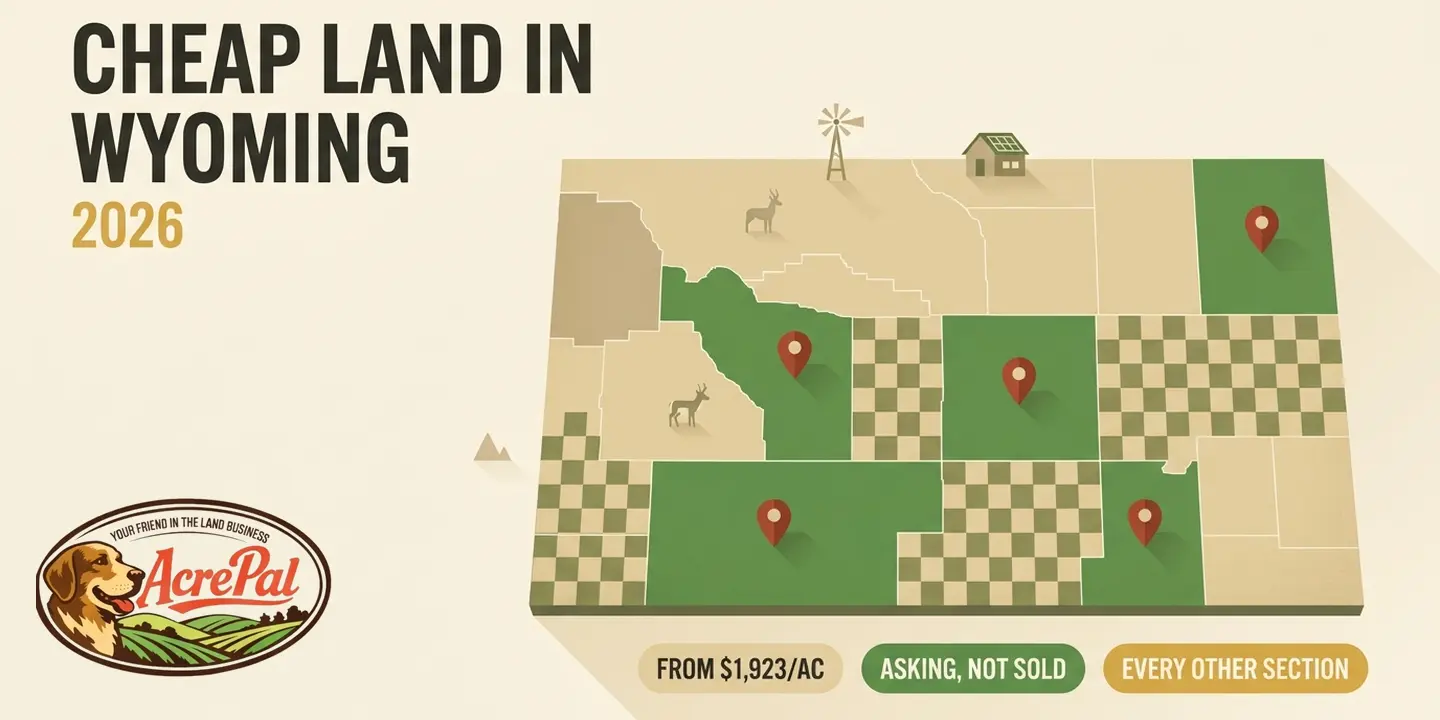
Search for wyoming cheap land and you will get guides that name almost no counties and quote per-acre figures running anywhere from about $6,116 to $135,800 for the same state. Wyoming cannot be all of those numbers at once.
Here is the answer those guides skip. Carbon County is the cheapest verified county at about $1,923 an acre, with Niobrara around $1,969 to $2,550 and Albany near $3,000, while Teton County runs about $263,473 an acre. Every one of those is an asking price rather than a recorded sale, and that distinction turns out to be the whole story. The cheap counties are also cheap for reasons that were drawn on a map in 1864, which is where the second half of this guide goes.
We rank the cheapest counties first with real numbers, then work through what is actually wrong with them. If you want the national picture before narrowing to a single state, our guide to the cheapest places to buy land covers the whole country.
1. Carbon County: The Cheapest Verified Land in the State
If you want the lowest verified per-acre figure in Wyoming, it is in Carbon County, and almost none of the guides ranking for this search will print it.
The median runs about $1,923 an acre, and a separate pull on the same county returns about $1,321 as an average. Both are listed figures, taken from what sellers are asking on a marketplace aggregator, not from recorded sales. That label holds for every county figure here, so rank counties with them rather than budget from them. Carbon shows between 16 and 38 active listings depending on the filter, a small enough pool for one parcel to move the median.

Carbon sits in south-central Wyoming on the Union Pacific corridor, inside the alternating public and private sections that run the length of southern Wyoming. That pattern is the main reason the price is this low, and item 7 explains how it got there. Elk Mountain is here too, where the corner-crossing case in item 8 started.
None of that makes it a no-rules county. Building in unincorporated areas requires a permit and a zoning certificate from the county Planning and Development Department. The BLM's Rawlins Field Office manages roughly 3.5 million acres of surface across Carbon, Albany, Laramie, and Sweetwater combined, with no county-level breakdown published.
Best for the buyer who wants the lowest per-acre number in the state and will do the checkerboard access homework first. Skip it if you need certainty that you can drive to your own parcel on day one.
2. Niobrara County: Second Cheapest, and Three Listings Deep
Wyoming's second cheapest county has two different published medians and roughly three active listings to build them from.
One pull returns about $2,550 an acre. Another pull of the same marketplace data returns about $1,969, and that second figure is stated as resting on the listing price of 36 acres, effectively one parcel. Both are listed prices. We are not going to average them, because splitting the difference between two numbers that disagree by 30 percent invents a third with no basis at all.
Niobrara had about three active listings when we researched this, and it is Wyoming's least populous county, tucked into the northeast corner near Lusk. Services and amenities out there are genuinely thin, and the price reflects it.
We found no zoning ordinance, building permit requirement, well cost, or access detail specific to Niobrara anywhere. The gap is worth naming rather than papering over.
Treat the Niobrara median as a signal that land there is cheap, not as a price you can plan around, and get a real quote on a specific parcel before you decide anything.
3. Albany County: The Cheap County the Guides Skip Entirely
The third cheapest county in Wyoming has a university in it, which is not how cheap land usually works.
Albany County's listed median is about $3,000 an acre, from the same market-insights data behind the rest of this ranking. The likely mechanism is a mix effect, since the county holds Laramie and the University of Wyoming along with long rural stretches toward Medicine Bow that pull the median down.
For a sense of what actually trades out there, roughly 105 contiguous acres north of Laramie toward Medicine Bow has been marketed by a wholesale land seller offering financing. Treat it as a listed example, not a comp.
The catch is the one Carbon carries. The Union Pacific corridor runs through Albany along with Laramie, Carbon, Sweetwater, and Uinta counties, so checkerboard exposure has to be checked parcel by parcel against item 7. We also turned up no Albany-specific zoning or permit detail, so confirm both with the county planning office.
If you want cheap Wyoming acreage without being two hours from a hospital, start in Albany and pull the section numbers before you get attached to a parcel.
4. Sweetwater County: One County, Three Different Prices

Three different per-acre prices are published for Sweetwater County right now, and the top and bottom sit nearly 11 times apart. Once you see why, the rest of the state's pricing makes far more sense.
The listed median is about $8,126 an acre. A sold median of about $4,336 also circulates, resting on 12 records, which makes it low confidence. And a real 40-acre parcel lists at $29,990 with an owner-finance seller, roughly $750 an acre. None is the Sweetwater price, and item 6 explains why spreads like this happen.
Sweetwater is the heart of the Union Pacific checkerboard corridor, and high desert in the hardest sense, at 6,500 to 8,500 feet with only 7 to 10 inches of precipitation a year. Sandy Creek near Farson averages just 42 frost-free days annually, per University of Wyoming climate data. Forty-two days is your growing season if the plan involves growing anything.

The county requires an approved zoning permit for all residential, commercial, industrial, and mineral construction in unincorporated areas, and allows tiny homes at a 220 square foot minimum living space plus 100 square feet per additional occupant. RV occupancy rules could not be confirmed, so call the land use office.
One seller offers 40-acre Sweetwater parcels from $29,990 with $249 down and a 20 percent cash discount, and never mentions the checkerboard they sit inside. That $249 is a down payment, and it says nothing about price per acre.
Best for the buyer who wants the most owner-financed cheap inventory in Wyoming and will verify access and water on the parcel. Skip it if 7 to 10 inches of rain and a 42-day growing season kill your plan.
5. Fremont County: More Per Acre, Almost No Rules
Fremont County's own planning department page says the county "does not have any County-wide Zoning or County specific Building Codes," and states in capital letters that it does not issue certificates of occupancy.
Fremont's listed median is about $17,663 an acre, the highest of any county sold as cheap Wyoming land and roughly nine times Carbon's. Irrigated parcels near Riverton and Lander mixed with high desert are the likely cause. Fremont is marketed as a price play and is really a regulatory play, and the seller running $249-down Sweetwater offers markets it alongside them.

A permit is still required for small wastewater systems under 2,000 gallons per day, and separate zoning and building codes apply inside FEMA flood hazard zones around Lander, Riverton, Dubois, and Hudson and inside incorporated city limits. Our breakdown of rural zoning codes goes deeper on district classifications.
The Wind River Reservation sits inside Fremont County, zoned Residential/Agricultural and administered by the Intertribal Business Council, so tribal jurisdiction and the fee-versus-trust distinction are live questions here.
Carbon and Sweetwater both require permits to build in unincorporated areas, and both are cheaper per acre than the county with almost no rules.
Pay Fremont's premium if answering to almost nobody is the point. If you are optimizing purely for price per acre, Carbon, Niobrara, and Albany all beat it.
6. Why No Honest Source Can Hand You a Wyoming Price Table
Nobody can give you an honest table of Wyoming per-acre prices by county, including us, and the reason is worth more than the table would be.
Wyoming's per-acre figure is published as a $10,673 median, a $54,000 average, a $6,116 listing average across 437,852 acres, and $135,800 in one recurring claim. Big Horn shows $7,237 to $11,333 depending on the page, Washakie shows $4,529 against adjacent Hot Springs at $15,734, and Teton shows $263,473, roughly 137 times Carbon. All listed.

The reasons are structural. No sold comps exist, because Wyoming is a non-disclosure state. W.S. 34-1-142 requires a Statement of Consideration when a transfer is recorded, then keeps it confidential from the public.
Owners may review comparable sales during the 30-day appeal window and may not re-disclose them. So every marketplace median is built from asking prices, which our guide to how much your land is worth covers.
The samples are also tiny, with Niobrara's figure resting on 36 acres of listings and Sweetwater's sold median on 12 records.
Mix distortion does the rest. Take a 1-acre town lot at $40,000 and a 640-acre ranch at $500 an acre. Averaging the two per-acre figures gives $20,250 an acre, while the true blended price across all 641 acres is $561.62, an overstatement of about 36 times.
That is how a county with a few town lots posts a five-figure median while its 40-acre parcels list in the hundreds, and it explains Sweetwater's 11x spread. Per-acre price also falls as tract size rises.

The $135,800 an acre number traces to a LinkedIn Pulse post, a content mill, and is a parcel price mislabeled as per-acre. No verifiable $199 an acre Wyoming listing exists either, and the closest real patterns are $99 down marketing, a $249 down offer, and a $199,000 total on 40 acres near Buffalo, about $4,975 an acre.
The guide ranking first here anchors its advice to $8,299 an acre from a multi-state Farm Credit district average and $6,452 from a territory excluding Wyoming, three to six times real cheap ground, in an article naming no county. Its top research tip, comparing county sale comparables off assessor sites, is foreclosed by state law.
Treat every published Wyoming median as an asking-price artifact on a small sample, use it only to rank counties, and price the parcel off its own listing.
7. The Checkerboard and the Company That Owns Every Other Section
The property lines under the cheapest land in Wyoming were drawn in 1864 to finance a railroad, and every other square mile across from your parcel belongs to one corporate owner.
The Pacific Railway Act of 1862 created the grant at 10 sections per mile of track, and the 1864 act doubled it to 20, producing odd-numbered sections that extend roughly 20 miles on each side of the line. Odd sections went to Union Pacific, the government kept the even ones, and each is one square mile, 640 acres. The corridor runs Cheyenne to Evanston through Laramie, Albany, Carbon, Sweetwater, and Uinta counties, exactly where the cheapest parcels get marketed, and the original grant came to 4,582,520 acres in Wyoming Territory.

Anadarko Petroleum bought Union Pacific Resources Group in 2000, taking the land grant with it. Occidental acquired Anadarko in August 2019 in a $55 billion cash and stock deal, and Orion Mine Finance then bought the package for US$1.33 billion, holding it through two entities named Aggie Grazing and Sweetwater Surface. Holdings today run roughly 1 million acres of checkerboard surface plus about 4 million acres of minerals. The section across from a cheap Carbon or Sweetwater parcel was an oil company's, and now it is a mining-finance vehicle's.
BLM Wyoming publishes approximately 18.4 million acres of public land surface and 42.9 million acres of federal mineral estate. BLM does not draw the conclusion, but subtract one from the other and roughly 24.5 million acres of federal minerals sit under surface somebody else owns. Wyoming's split estate statute, W.S. 30-5-401 through 30-5-410, effective July 1, 2005, makes an operator post a bond of at least $10,000 per well site, give 5 days notice before entry for surveying and 30 to 180 days before operations begin, and negotiate a surface use agreement before disturbance.
The limit on that protection rarely gets quoted. The BLM Director determined that Wyoming's statute cannot be applied to federal minerals, so the 2005 protection reaches state and private mineral estate only. Our deed versus title breakdown shows how severed rights appear against a deed, and alternating ownership also leaves some parcels touching public land at a single corner.
Pull the section numbers and the mineral ownership before you offer, and assume the minerals are severed until a title search proves otherwise.
8. Access, Corner Crossing, and the Fallback That Fails Here
The costliest mistake on cheap Wyoming land is buying a parcel you can see from the road and cannot legally reach, and the 2025 ruling everyone cites does less than the headlines suggest.
Iron Bar Holdings v. Cape, Tenth Circuit No. 23-8043, was decided March 18, 2025, and the Supreme Court denied certiorari on October 20, 2025, so it is final. Four hunters used a ladder to step corner to corner in Carbon County, reaching public land bordered on two sides by Elk Mountain Ranch, 50 square miles enclosing about 11,000 acres of public land.
Corner crossing remains a civil trespass under Wyoming state law, and what changes the outcome is the federal Unlawful Inclosures Act of 1885, which bars all inclosures of public lands and any obstruction of free passage or transit over or through them. Federal law supersedes the conflicting state rule, so a landowner cannot stop you or collect damages. That is a different sentence than corner crossing being legal in Wyoming.
The ruling covers a limited intrusion on foot with no contact and no damage, and the court declined to extend Leo Sheep to driving, vehicles, or road building. It binds only the six Tenth Circuit states, Wyoming, Colorado, Utah, New Mexico, Kansas, and Oklahoma, leaving Montana uncovered and the question open there. Advocacy groups put the acreage affected nationally in the millions.

With no corner to cross, W.S. 24-9-101 sets the test, where access is necessary if land has no outlet to nor connection with a public road. You petition the county commissioners for a private road across intervening land, a contested proceeding with survey, legal, and damages costs rather than a form you file.
The reflex answer fails on exactly these parcels. Easement by necessity depends on a common grantor who conveyed part of their land and left the conveyed piece no way out. Checkerboard parcels were severed by federal patent in the 1860s and 1870s, and Leo Sheep Co. v. United States, 440 U.S. 668 (1979), held the United States reserved no implied easement across the railroad's odd sections.
A two-track on a map is not a right to drive it. A BLM road number can mean BLM holds a crossing easement, though some cross private ground where travel is barred, and RS 2477, a repealed mining-era law whose grants persist, can make a route a county road only commissioners can vacate. Verify with the BLM field office and the county.
Corner crossing on foot is protected by federal law, driving in is not, and a parcel with no recorded outlet to a public road is a county proceeding waiting to happen. Confirm recorded legal access before you sign.
9. Water: The Permit Comes Before the Drill Bit
Drilling a water well on your own Wyoming land requires the state's permission first, and that has been true even for a plain domestic well since 1969.
W.S. 41-3-930 requires a permit from the State Engineer before drilling begins for any beneficial use of underground water, and since May 24, 1969 that covers all wells, including the stock and domestic ones that used to be exempt. The form is the U.W. 5, Application for Permit to Appropriate Ground Water, filed with the State Engineer's Office Ground Water Division. An existing unpermitted well needs a U.W. 5 and U.W. 6 together.
The same office puts domestic and stock permits at 1 to 2 weeks and complex permits at several months, with Statement of Completion review carrying a 6-month to 1-year backlog. Those wells hold a preferred right over other purposes, and a U.W. 5 for either is generally granted as a matter of course.
A complete private well system in Wyoming runs roughly $10,000 to $25,000, with drilling around $30 to $35 a foot to about 400 feet and more past that as casing requirements grow. No source breaks depth or cost out for Sweetwater, Carbon, or Fremont, so research permitted wells near your parcel. See digging a well in 2026 and perc test costs for the numbers.
A widely shared off-grid pitch offers a $20 ram pump on a creek instead of a $15,000 well. Wyoming is a prior appropriation state, so diverting surface water requires an appropriation, and a buyer who follows that advice may be taking water they have no right to.
Pull the permitted wells nearby to see what depth neighbors hit, and file the U.W. 5 before anyone brings a rig onto the land.
10. The Property Tax Story Every Guide Stops Halfway Through
Every Wyoming land guide says the property taxes are among the lowest in the nation. None mentions that the low number belongs to the ranch next door, not the parcel you are buying.
Wyoming assesses agricultural, commercial, and residential property at 9.5 percent of fair market value. A mill levy then applies, running roughly 65 to 80 mills statewide and averaging 71 in Sweetwater County. A 40-acre parcel bought for $30,000 that does not qualify as agricultural assesses at $2,850, and at 71 mills that is about $202 a year, or 0.67 percent of market value. Statewide that parcel runs $185 to $228, modest in absolute dollars and nowhere near zero.
Qualifying as agricultural is where cheap parcels lose, because all three tests must hold. The land is used for agriculture, meaning crops, timber, forage, or grazing livestock. The owner nets at least $500 of annual gross revenue from marketing agricultural products, or the lessee nets $1,000 if it is leased. And the land is not in a platted subdivision, unless the parcel runs 35 acres or more.
Cheap out-of-state offerings are frequently platted, under 35 acres, and running no livestock, so they fail all three and pay 9.5 percent of market value while the ranch next door pays it on productivity value.

Wyoming appraises rangeland by Animal Unit Month, the forage that sustains a 1,000-pound cow for a month, averaged over five years less a 10 percent expense deduction. Productivity value is a small fraction of market value.
Run that math on your parcel, and if it is under 35 acres inside a platted subdivision, budget the market-value bill rather than the ag number you read about.
11. What $5,000 Actually Buys in Wyoming and Who Sells It
A genuinely sub-$5,000 Wyoming purchase is real. It is just smaller than the 40-acre parcels in the ads.
One marketplace's cheap-Wyoming page shows 32 properties averaging $67,041 listed, about $1,401 an acre across that subset. At that rate a sub-$5,000 total buys roughly 3 to 4 acres, not the 40 acres marketed at $249 down. That is a listed average on a small self-selected set, not a sold benchmark. A $99 or $249 down payment is a financing structure that says nothing about price per acre, which is most likely where the $199 an acre claim came from.
The cheapest parcels are usually off the retail listing sites, at county tax-delinquency auctions, state surplus and land-commission sales, and by word of mouth. Confirm whether the prior owner retains redemption rights, and walk the parcel first if you can.
Banks are hard on raw land, with general land-lending benchmarks at 20 to 50 percent down, Farm Credit Services of America financing up to roughly 65 percent of value, and USDA reaching 100 percent only if you build a primary residence. So most cheap Wyoming parcels sell with owner financing instead, $99 down and $99 a month from one seller, 40 acres from $29,990 with $249 down from another. Our playbook on buying land with no money down walks the mechanics.
One note on who we are, since honesty is the point of this guide. This no-bank owner-finance model is how AcrePal sells rural land, but in the West, in Arizona, Colorado, Nevada, California, and Florida, and not in Wyoming, so Wyoming buyers work with Wyoming sellers. We did the same breakdown for Arizona.
Decide whether you want acreage or a low monthly payment, because at this budget you rarely get both, and price per acre before you look at the down payment.
Frequently Asked Questions
What is the cheapest county to buy land in Wyoming?
Carbon County, at about $1,923 an acre. Niobrara follows at roughly $1,969 to $2,550 and Albany at about $3,000. All three are listed medians from asking prices, not recorded sales, so use them to rank counties rather than set a budget. Teton County's listed median runs about $263,473 an acre, roughly 137 times Carbon.
Is Wyoming land really $135,800 an acre?
No. That figure traces to a LinkedIn Pulse post and is a parcel-level price mislabeled as per-acre, then laundered into search snippets. Wyoming county medians mostly fall between about $1,900 and $21,000 an acre, with Teton as the outlier, and every one is derived from asking prices rather than sales.
Can you buy land in Wyoming for under $5,000?
Yes, but expect roughly 3 to 4 acres rather than 40. The cheap-Wyoming set on one marketplace averages about $1,401 an acre across 32 listed properties, a listed-price average on a small self-selected group. The $99 and $249 down payment offers in the ads are financing structures, not per-acre prices.
Is corner crossing legal in Wyoming?
On foot, with no contact with private property and no damage, a landowner cannot stop you or collect damages. Corner crossing is still a civil trespass under Wyoming state law, but the federal Unlawful Inclosures Act of 1885 supersedes it, per Iron Bar Holdings v. Cape, decided March 18, 2025, with certiorari denied October 20, 2025. It does not cover driving or road building, and binds only the six Tenth Circuit states.
Do you need a permit to drill a well on Wyoming land?
Yes, before drilling begins. File Form U.W. 5, the Application for Permit to Appropriate Ground Water, with the Wyoming State Engineer's Office Ground Water Division. Domestic and stock permits typically take 1 to 2 weeks and are generally granted as a matter of course, holding a preferred right over other purposes. Since May 24, 1969 this has applied to all wells.
Why is land in southern Wyoming so cheap?
Alternating public and private sections from the 1864 railroad land grant leave some parcels touching public land only at a corner, so access is genuinely hard and minerals are frequently severed. The high desert there takes only 7 to 10 inches of rain a year, and Sandy Creek near Farson averages 42 frost-free days. Cheap prices are the market pricing those defects.