
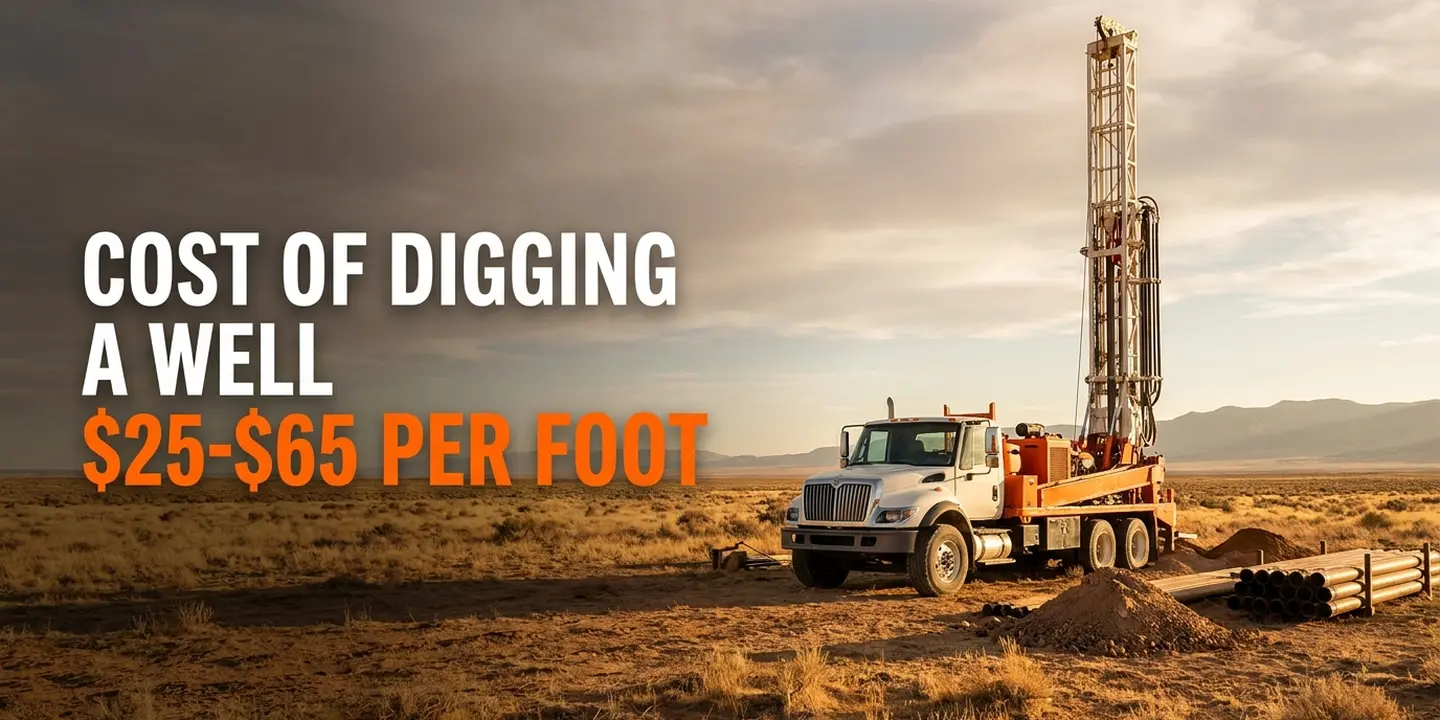
The cost of digging a well in 2026 runs about $15,750 for a complete residential system, with drilling alone averaging $9,750. Most people pay $3,000 to $15,000 all-in, at $25 to $65 per foot, on an average well depth of 150 feet.
Here is the part nobody tells a land buyer. That cheap off-grid parcel is not actually cheap once you add water. Eighteen percent of well projects run over $25,000, and on remote land the well can cost more than the dirt you bought. The price tag on a listing is the start of the math, not the end of it.
So we will go further than a national average. Ahead you will find cost by depth and geology, where the money really goes, how to estimate the cost for a specific parcel before you make an offer, the dry-hole risk, cheaper water alternatives, and the real total budget for putting water on raw land.
How Much Does It Cost to Drill a Well? Cost by Depth and Geology
Well cost mostly comes down to two numbers you can research before you buy: how deep the drillers go, and how hard the rock is on the way down. Get a rough read on both and you can ballpark the bill.
Depth is the first driver. The national average residential well is 150 feet, but the range runs from 25 feet to over 1,000. Arid and mountain states sit deep, with Arizona averaging 350 feet and Nevada and New Hampshire around 300. Here is what a complete system tends to cost as you go deeper.
100 ft: $5,000 to $8,000
200 ft: $7,500 to $13,000
300 ft: $10,000 to $18,000
400 ft: $13,000 to $23,000
500+ ft: $16,000 to $35,000+
Each additional 100 feet adds roughly $4,000 to $8,000. The second driver is geology, which is the rock the drill has to chew through, and it can swing the per-foot rate more than depth does.
Sand and gravel: $20 to $35/ft
Limestone and sedimentary: $35 to $55/ft
Hard granite and basalt: $55 to $85/ft
The comparison that matters: the same 200-foot well costs about $5,000 in soft sand and $13,000 or more in granite. Same hole, two and a half times the price, just from what is underground.
One more number to respect. Well drilling costs are up 28.4% since 2020, and a real driller shortage is still pushing them higher. Do not trust a quote from a neighbor who drilled five years ago. The cheapest raw land in rocky or arid terrain is often the most expensive to put water on.
Where the Money Goes in a Complete Well System
A per-foot quote is the headline, not the total. Buyers see "$40 a foot," do the math on 200 feet, and budget $8,000. Then the real invoice arrives with a pump, a tank, wiring, and a water line stacked on top, and the gap stings.
A drilled well is a system, not just a hole. Here is where the money actually goes on a typical residential setup.
Drilling: 45 to 55% of the total
Casing: PVC ~$10/ft, steel ~$22/ft
Submersible pump (installed): $1,500 to $3,000
Pressure tank: $300 to $1,500
Pitless adapter: $150 to $300
Electrical hookup: $500 to $1,500
Water line, well to house: $500 to $3,000
Water testing: $100 to $500
Permit: $50 to $500
Now the line item that quietly wrecks cheap-parcel math: mobilization. That is the fee to get the rig to your land and set up. Standard remote access runs $500 to $2,000, but steep hillsides, narrow roads, or sites that need specialized equipment can push it to $5,000 to $12,000 or more.
Picture a $3,000 parcel that needs $8,000 just to get a rig on-site. The land was the cheap part. One honest detail people miss: you pay per foot for every foot drilled, even the extra footage below where water is found. That bottom section is "sump" that gives the pump room to work, and it shows up on the bill.
When you call drillers, ask for an itemized quote covering per-foot rate, casing, pump, tank, electrical, permit, and mobilization. Skip any quote that gives you only a per-foot number, because it is hiding most of the price.
Dug, Drilled, Driven, and Artesian Wells and What Each Costs
Why does one neighbor pay $2,000 for a well and another pays $25,000 on the same road? They bought different products. There are four well types, and the cost gap between them is enormous.
A dug well is the cheapest at $1,000 to $4,000, reaching only 10 to 30 feet. It needs a high water table, it is prone to surface contamination, and most modern counties will not permit one for a full-time home.
A driven well, also called a sand point, runs $500 to $3,000 as a DIY job or $2,000 to $8,000 with a pro. It reaches 15 to 50 feet in soft soil only and cannot punch through rock, so it is reliable in few places.
A drilled well is the residential standard at $5,000 to $50,000 or more. It reaches 100 to 1,000-plus feet, works in any geology, delivers the best water quality, and lasts 30 to 50 years. This is the one most rural parcels actually need.
An artesian well costs about the same as a drilled well, $5,000 to $15,000, but natural underground pressure pushes water up the bore, which can cut pump costs. You cannot choose it, though. The confined aquifer either sits under your land or it does not.
Dug: $1,000 to $4,000 | 10 to 30 ft | High water table, contamination tolerated
Driven: $500 to $8,000 | 15 to 50 ft | Soft soil, no rock, light use
Drilled: $5,000 to $50,000+ | 100 to 1,000+ ft | Any geology, permanent home
Artesian: $5,000 to $15,000 | 100 to 800+ ft | Where a confined aquifer exists
For a full-time home on most rural land, assume a drilled well and budget for it. Treat a cheap dug or driven well as a bonus only if the water table and the county both allow it. A neighbor getting lucky with a shallow well does not mean your parcel can do the same.
How to Estimate Well Cost Before You Buy the Land
You can ballpark a parcel's well cost from your couch, before you ever make an offer. The data is mostly free, and a few phone calls fill in the rest. This is the step that separates buyers who get blindsided from buyers who walk in with eyes open.
Here is the playbook:
Start with DrillerDB.com. Enter the property address or ZIP into the free interactive map and see neighboring wells with their recorded depth, drill date, and yield. The free Geology Estimator analyzes nearby logs and predicts your likely drilling depth.
Check your state's well database, and expect inconsistency. Colorado has a public API with depth, yield, and aquifer data. Some New England and Pennsylvania areas have no statewide repository at all. As the Loam.land research team put it, a question as basic as how deep wells are in this county might be answerable in seconds in Colorado and unanswerable in Pennsylvania.
For Texas, use the Texas Well Water Map. It shows drilling success rates by micro-area, which range from 22% to 85%, plus the average depth nearby.
Call the county health or environmental department. They permit wells and usually hold local depth and yield records.
Call two or three local licensed drillers. Ask the typical depth in that area, the per-foot rate, the geology they drill through, and whether they charge for dry holes.
Ask neighbors with wells. Depth, yield, and any problems they have had tell you more than any map.
For high-stakes or arid parcels, buy a pre-purchase groundwater survey. Services like Well Water Finders run around $1,000 per acre with a two-acre minimum and pinpoint where water sits.
Once you have a likely depth, run the budget formula. Estimated depth times the local per-foot rate, plus pump ($1,500 to $3,000), tank ($300 to $1,500), electrical ($500 to $1,500), permit ($50 to $500), mobilization ($500 to $2,000-plus), and a 20% contingency.
Do this before you sign, not after. A seller is not required to tell you that water will cost $20,000 on the parcel they are trying to sell you.
The Dry-Hole Risk and What Happens If They Miss Water
Drillers do not sell water. They sell a hole in the ground, and you pay for it whether or not water comes out. As one experienced driller put it on a Fine Homebuilding forum, "all they're selling is a hole in the ground." No driller guarantees water.
That means you owe the per-foot rate for every foot drilled, even on a dry hole. In water-scarce and arid areas, success rates can sit at just 30 to 40%. The odds are real, and the bills can be brutal.
The examples make it concrete. One forum poster paid $8,800 for four holes, and three came up dry. Arizona and New Mexico farmers have each spent close to $500,000 chasing water through dry holes. A widely shared video documents a homeowner who blew $32,000 on a single well that ran far past budget.
Here is how to de-risk it before you commit:
Research neighbor success rates first. 85% or higher means low risk. 22% to 40% means you talk contingencies before you sign anything.
Get the dry-hole policy in writing. Some drillers offer a second location at a reduced rate. You want that spelled out in the contract, not promised on a handshake.
Know that geology moves. Shifting the rig 50 to 100 feet can hit completely different ground and produce water where the first spot failed.
Budget a contingency. If you expect a $10,000 well, set aside another $5,000 to $10,000 for the chance the first hole misses.
If local success rates are high and well logs are plentiful, drill with confidence. If you are looking at arid land with sparse or failed nearby wells, treat water as unproven, get a survey, or keep an alternative in your back pocket.
Alternatives to Drilling a Well on Raw Land
No water on the parcel does not have to mean an immediate $20,000 well. For recreational or part-time land, drilling is often not the smartest first move at all. Here is the full menu, cheapest to most permanent.
Hauled water and a cistern get you water on day one. A 5,000-gallon poly tank runs $2,000 to $4,000, and delivery can drop to about $0.009 per gallon, which works out to roughly $35 to $80 a month for a family of four. A Montana family runs their place this way, hauling about 4,000 gallons a month. It is great for a cabin or recreational use, and unsustainable for full-time living. If you want a buried tank instead, an underground cistern runs $6,500 to $24,000.
Rainwater harvesting is legal in all 50 states for non-potable outdoor use, but the limits vary hard. Colorado caps collection at 110 gallons, Utah at 2,500, and Oregon and Washington require permits above 1,000 gallons. A 2,000-gallon tank can carry a frugal family of four for several months, though most states will not let you use rainwater as drinking water without treatment and approval. Check your state before you count on it.
An atmospheric water generator pulls moisture straight out of the air and condenses it into drinking water, so it needs no well, no rainfall catchment, and no delivery truck. Compact home units run $1,800 to $4,650 and make 2 to 12 gallons a day, while solar hydropanels cost around $2,500 to $3,000 each and produce close to a gallon a day per panel. Whole-home systems exist but jump to $22,000 and up. The honest catch is that output lives and dies on humidity and power. These machines sip electricity every day and slow to a trickle in dry or cold air, which describes most of the cheap high-desert land buyers look at. Treat one as a supplement or a humid-climate backup, not a primary water source on an arid parcel.
A shared well agreement lets you split drilling cost with a neighbor or tap an existing well. It has to be a recorded, attorney-drafted easement that runs with the land. Watch the yield, you want at least 5 GPM per household, and know that some future buyers balk at shared water.
A rural water district hookup costs $1,000 to $6,000 if a line sits right at the road. Otherwise it is $25 to $200 per linear foot of trench, and tap and meter fees alone can hit $3,000 to $5,000 before any digging. At a 1,000-foot setback, that is up to $200,000 in line alone, which is exactly why a private well is the only realistic option on most remote parcels.
The quick read: haul water for weekend land, harvest rainwater for outdoor use where it is legal, pull water from the air with a generator only in a humid climate, share a well if a willing neighbor exists, and take the district hookup only if a line is already at the road. Everywhere else, you drill.
What a Well Really Costs to Own Each Year
After the big drilling bill, a well is shockingly cheap to run. The scary number is upfront. The yearly number is the part that makes a well pay for itself.
Here is the annual carrying cost, broken into four pieces:
Electricity for a 1 HP pump, $180 to $720 a year ($25 to $60 a month).
Comprehensive water testing, $150 to $250 a year.
Maintenance reserve, $200 to $400 a year for the small repairs that come up.
Pump-replacement reserve, roughly $200 to $550 a year, since pumps cost $2,500 to $5,500 and last 8 to 15 years.
Add it up and a working well runs about $730 to $1,920 a year, or $60 to $160 a month. That is the whole cost of having water, after the borehole is paid for.
Now the comparison that answers the real question for a land buyer. Over the long haul a well averages around $800 a year, while municipal water runs $1,800 a year at a bare minimum. Across a 30-year hold, that is $25,000 to $40,000 in avoided bills. The well does not just save money either. It raises rural property value and makes a parcel far easier to sell, because appraisers and buyers both factor water access into what land is worth. A parcel with a proven, good-yield well is a different asset than one with no water at all.
Plan for one big recurring item over a long hold. You will likely replace the pump once across 30 years, and a pump pulled and reset on a deep well is not a cheap afternoon. Budget roughly $1,000 to $2,000 a year to own a well, keep a separate pump-replacement fund topped up, and the math still beats city water while adding real resale value to your land.
Permits, Financing, and the Real Raw-Land Water Budget
You have the cost picture. Now comes the part that trips up new landowners: actually getting permitted, paying for it, and seeing the true total before you buy.
Permits. Rules vary by state and county. In Texas, counties inside a Groundwater Conservation District require a drilling permit ($50 to $500, usually two to four weeks to process), while non-GCD counties only need a state Well Report that the driller files at no direct cost to you. Most districts exempt a domestic well on 10 or more acres from a production permit, but you still pull the drilling permit. Setbacks apply everywhere: a well sits at least 50 feet from a septic system or drain field and 150 feet from petroleum tanks, with property-line setbacks of 0 to 100 feet depending on the county. A licensed driller is required in every state. Call your state groundwater agency, often the DEQ, DNR, or State Engineer's office, and your county to confirm the specifics before you buy.
Financing. The USDA Rural Decentralized Water Systems Grant funds revolving loans for private wells at 1% fixed interest, a 20-year term, and up to $15,000 per household in rural areas under 10,000 people. In most states outside the arid Southwest, that $15,000 covers the bulk of a well. Personal loans and a HELOC against property you already own are common fallbacks. And one structural move helps a lot: owner-financing the land itself keeps your down payment small and your cash free to drill the well later, instead of needing the full land price and $10,000 to $20,000 of infrastructure in one shot.
The real budget. Here is the number buyers almost never see before they sign. Full raw-land infrastructure runs $28,000 to $62,000: well $8,000 to $15,000, septic $8,000 to $12,000, power $5,000 to $15,000, road $5,000 to $15,000, and permits $2,000 to $5,000, plus a 10 to 20% contingency on top. A $15,000 parcel can need $40,000 to $60,000 before anyone lives on it.
Price the water, and the rest of the infrastructure, into the land before you buy. Then use your financing structure to your advantage so a cheap parcel stays actually affordable.
Cost of Digging a Well, Frequently Asked Questions
What is the average cost to drill a well in 2026?
The national average for a complete residential well system is about $15,750 in 2026, with drilling alone averaging $9,750. Most people pay $3,000 to $15,000 total, though 18% pay over $25,000 in deep or hard-rock areas. Per-foot drilling rates run $25 to $65 nationally, set mostly by depth and geology.
What happens if the driller hits a dry hole, do I still pay?
Yes, in almost every case. Drillers charge per foot drilled regardless of whether they find water, because no driller guarantees water. You typically owe the per-foot rate for all footage drilled on a failed hole. Get the dry-hole policy in writing before work starts, and ask whether a second location comes at a reduced rate.
How can I find out how deep a well needs to be before I buy?
Use DrillerDB.com, a free map showing neighboring wells' depth and yield, plus a Geology Estimator that predicts your likely depth. Check your state's well database, call two or three local drillers about typical depth, and for Texas use the Texas Well Water Map. The Virginia Tech USGWD database holds 14.26 million records back to 1763.
What is the cheapest way to get water on raw land?
From cheapest upfront: rainwater harvesting with a cistern, hauled water with a storage tank ($2,000 to $4,000 plus $35 to $80 a month), a shared well agreement with a neighbor, then a driven or dug well where geology allows ($500 to $8,000). A drilled well is the priciest. A municipal hookup can win only if a line sits right at the road.
Do I need a permit to drill a well on rural land?
It depends on your state and county. In Texas, counties inside a Groundwater Conservation District require a drilling permit ($50 to $500), while non-GCD counties only need a state Well Report the driller files. A licensed driller is required everywhere, and setbacks apply, typically 50 feet from septic. Contact your state groundwater agency for the exact rules.
Is there financing to drill a well?
Yes. The USDA Rural Decentralized Water Systems Grant funds loans at 1% fixed interest, a 20-year term, and up to $15,000 per household in rural areas under 10,000 people. Personal loans and HELOCs are also common. Owner-financing the land itself frees up cash to drill the well later instead of paying for everything at once.
How much does it cost to run a well each month?
A standard 1 HP submersible pump costs about $25 to $35 a month in electricity, and larger pumps for deep wells run $40 to $60. Add testing and maintenance reserves and total monthly operating cost lands around $30 to $75. That beats a typical municipal water bill of $30 to $100 or more.