
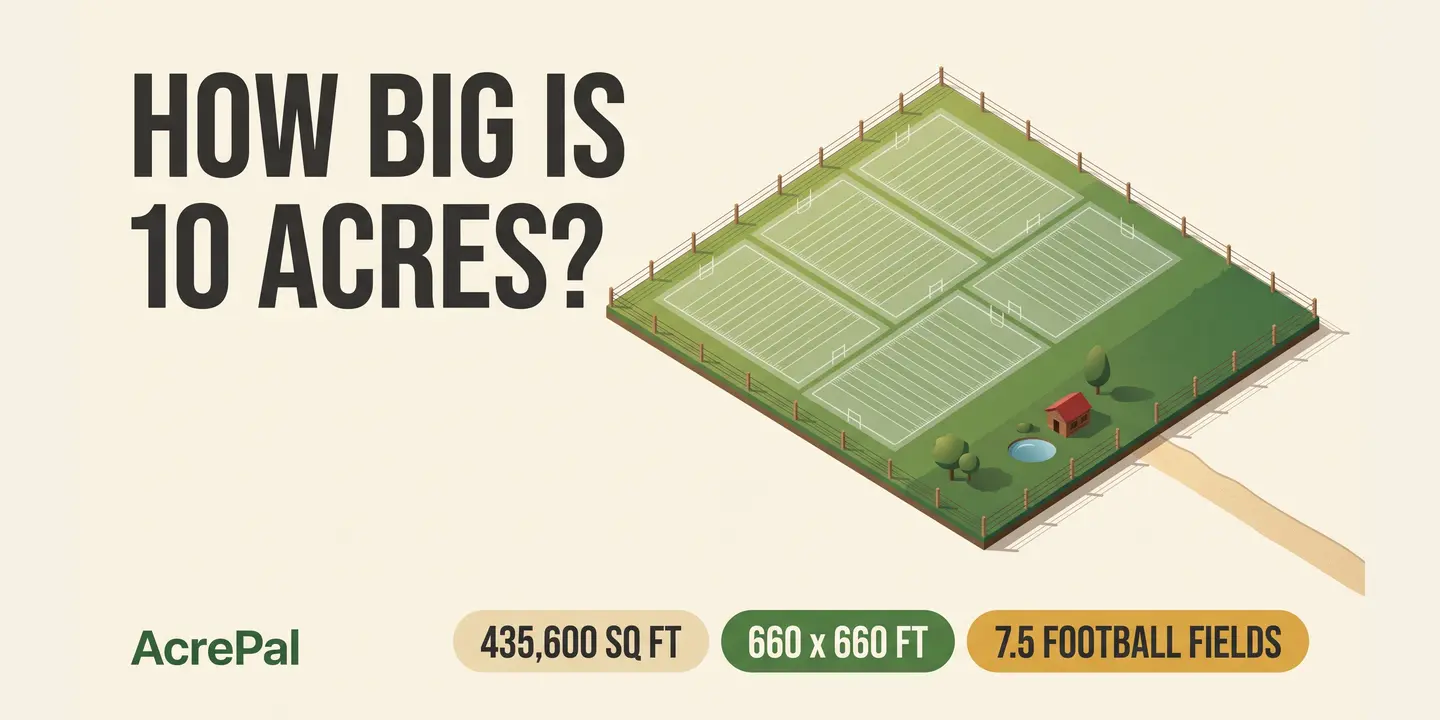
Most people picture 10 acres far smaller than it really is, right up until they stand on it. So how big is 10 acres? It is 435,600 square feet, a square measuring 660 feet on every side, and roughly 7.5 football fields laid end to end.
That last comparison is where a lot of articles leave you, and it still does not help you feel the size or know what to do with it. We walk land for a living, so we will give you the parts those football-field explainers skip. You will get a clean conversion table, the exact dimensions and perimeter, vivid real-world comparisons that actually land, real 2026 prices with named listings, how to buy and own a parcel, and what 10 acres truly supports. By the end you will be able to picture it, price it, and judge whether it fits your plans.
How Big Is 10 Acres in Square Feet and Other Units
Ten acres is 435,600 square feet, the same footprint as a square that runs 660 feet on each side. The math is simple and worth seeing once, because it is what builds trust in every other number on this page. One acre equals exactly 43,560 square feet, so 43,560 multiplied by 10 gives you 435,600. If a site shows you something like 46,560 square feet, that is a typo, and it tells you to double-check the rest of their figures.
Here is how big is 10 acres across every unit people search for, each one verified.
435,600 square feet
About 40,469 square meters
4.047 hectares
0.015625 square miles (640 acres make one square mile)
660 feet on each side as a perfect square (about 201 meters)
2,640 feet around the perimeter, which is exactly half a mile

A couple of these are worth a note. There are exactly 640 acres in one square mile, which is why 10 acres works out to 0.015625 of one. If you are reading an overseas or surveyor's listing, the metric figures rule, so 4.047 hectares is the number to keep handy. The 660-foot side is not random either, it traces back to the old furlong, and we cover that story in the next section on shape and perimeter.
What 10 Acres Looks Like in Real-World Comparisons
One site says 10 acres is 7.5 football fields, another says 8, and neither explains the gap. The answer depends on whether you count the end zones, and once you see the math the confusion disappears. A full field with both end zones is 360 feet by 160 feet, which is 57,600 square feet, or 1.32 acres. Divide 435,600 by 57,600 and you get 7.56 fields, the number most people mean when they round to 7.5 or 8.
Strip the end zones and you measure only the 300-by-160-foot playing area, which is 48,000 square feet, or 1.10 acres. That works out to 9.08 fields. Both answers are correct, they just measure different things, and none of the top results bother to say so.

If football does nothing for you, try these. Ten acres is about 2.3 Walmart Supercenters, since the average store covers roughly 187,000 square feet. It is also around 1,560 standard parking spaces, or close to 40 quarter-acre suburban lots stitched together.
On a map it reads as roughly two city blocks by two city blocks, since a typical urban block runs about 250 to 350 feet. That is a useful anchor when you are scrolling a satellite view and the parcel outline looks deceptively small.
Walking helps too, as long as you are clear on what you are walking. Crossing one 660-foot side of a square parcel takes about 2.5 minutes at a normal 3 mph pace. Walking the full perimeter, all 2,640 feet of it, takes about 10 minutes because that loop is exactly half a mile. People muddle those two numbers constantly, so keep the distinction in mind when a site quotes a single walking time.
Dimensions, Shape, and Perimeter of a 10-Acre Lot
The shape of your 10 acres quietly decides your fencing bill before you build a single thing. A perfect square runs 660 feet by 660 feet, because the square root of 435,600 is exactly 660. That 660-foot figure is the old furlong, the distance a team of oxen would plow before resting, which is how the acre got its proportions in the first place.
Real parcels are rarely perfect squares. Common rectangular shapes include 330 by 1,320 feet (a quarter-mile deep and very common), 220 by 1,980 feet, and 440 by 990 feet. A real listing near Clermont, Florida described its 10 acres as roughly 330 feet of frontage and nearly 1,300 feet deep, which is that classic deep-rectangle pattern. Shape varies with surveying, road frontage, and the public land survey system, where a 10-acre tract is a quarter of a quarter of a quarter of a 160-acre block, which is exactly why 10-acre parcels show up so often.

Watch out for bad shape math online. One competitor lists 10 acres as 210 by 1,080 feet, but that is only 226,800 square feet, about 52 percent of the real size.
Perimeter is where shape hits your wallet. A square is 2,640 feet around, a 330-by-1,320 rectangle is 3,300 feet, and a skinny 220-by-1,980 lot is 4,400 feet. Run the fencing numbers and the difference is real. High-tensile electric runs about $1.21 to $2.00 per foot, barbed three-strand about $1.50 to $3.00, and woven wire about $3.00 to $6.00, so a fully installed perimeter lands anywhere from roughly $10,100 to $50,000 depending on the fence and the shape.
How Much Does 10 Acres of Land Cost in 2026
The same 10 acres can run from about $11,500 to $1.8 million, and most of what moves that number is checkable before you buy. In raw, remote markets like parts of New Mexico, Nevada, and Wyoming, total prices often fall between $1,500 and $7,000. Mid-tier states such as Texas, Missouri, and West Virginia tend to land between $20,000 and $80,000. Premium states like Florida, California, and New Jersey climb to $100,000 and well past $550,000.
Real listings make that range concrete. We have seen 10 acres in Nevada at $11,499 cash (or $297 a month), a 10-acre West Virginia homestead at $160,000, and 10 acres in Michigan's Upper Peninsula at $49,000. On the high end, a 10-acre cherry orchard in Gilroy, California listed at $1.8 million, and rural Southeast Tennessee tracts of 10 to 20 acres run $200,000 to $500,000. For context, USDA 2026 data put average farmland at $4,500 per acre, cropland at $6,020, and pasture at $2,000, while truly raw undeveloped ground often sits at $1,500 to $2,500 per acre.

Price drivers are predictable once you know them. Legal road access matters most, since paved frontage can cost two to five times more than a dirt approach. Utilities versus off-grid, a drilled well versus no water, zoning, and topography fill in the rest.
One trap to avoid is mistaking the sticker price for the total. A well can run $5,000 to $15,000, a septic system $8,000 to $25,000, and extending electric service can top $50,000 per mile in remote spots.
How to Buy 10 Acres and What It Costs to Own
The listing price is the easy part, and the costly mistakes hide in financing and due diligence. You have a few ways to pay. Cash is simplest and realistic on many rural parcels. A bank land loan usually wants 20 to 50 percent down at higher rates than a mortgage, with loan-to-value often capped around 50 to 65 percent, and Farm Credit lenders are friendlier than big banks. If the land is for farming, a USDA Farm Service Agency loan can offer lower rates and longer terms.
Owner financing means you buy directly from the seller and pay monthly, no bank approval required. Expect 10 to 20 percent down, 8 to 12 percent interest, and a 25-to-30-year payoff that sometimes carries a balloon in 5 to 10 years, with some promos starting as low as $97 down. It makes affordable rural acreage reachable for buyers a bank would turn away, and AcrePal is one source of owner-financed parcels in markets like Mohave and Apache in Arizona, Costilla in Colorado, Elko in Nevada, Modoc in California, and Putnam in Florida.
Before you close, work a checklist. Confirm legal road access or a recorded easement, run a perc test for septic ($500 to $1,500), check zoning, verify a water source, measure utility distance, get a boundary survey ($500 to $2,000), pull a title search ($300 to $800), and check FEMA flood and wetland maps. Visit the land in person, do not just trust the GIS map, because that is where the expensive surprises live.
Holding 10 acres is usually cheap. Property taxes run from $50 to $500 a year in low-tax rural areas, up past $2,000 in premium states, with liability insurance around $200 to $500 and maintenance from $0 to $2,000. An agricultural classification can cut that tax bill 50 to 90 percent, even with light farming.
What You Can Do With 10 Acres
A fast readout of what 10 acres realistically supports, by goal.
Horses depend heavily on region. In the eastern US with rotation, 10 acres carries 5 to 7 horses at 1.5 to 2 acres each, or a conservative 4 to 5. In the dry West without irrigation, native pasture can need 10 to 38 acres per horse, so the same 10 acres may only hold 1 or 2. A barn, storage, manure bin, riding ring, and parking all eat into that pasture.
For a homestead, 10 acres is the widely cited sweet spot. A worked permaculture layout fits a 0.25-acre garden, a 1-acre orchard or food forest, a 1-acre pond, 6.5 acres of pasture, a 1-acre woodlot, and 0.25 acre of buildings, enough for real self-sufficiency. Off-grid buyers, like the Arizona desert couple who built from a bare dog fence, learn fast that water is the number one priority.

Hunting and recreation work well too. A Michigan tract at $49,000 paired a dry front for a cabin with a wet back for wildlife, and a small tract beside huge neighboring tracts can feel like you own it all. For income, a solar lease at $800 to $1,200 per acre per year can pay $8,000 to $12,000 annually with no work.
Against its neighbors, 10 acres sits in a clear spot. A 10,000 square foot lot gives you a house and a small yard, one acre fits a house and a small garden, 2 acres suits a hobby homestead, 5 acres strains a full off-grid plan, 10 acres handles a serious homestead or gentleman ranch, 20 acres opens a small commercial farm, and 40 to 100 acres is ranch territory.
The Bottom Line on 10 Acres
Ten acres is 435,600 square feet, a 660-by-660-foot square, about 7.5 football fields, and half a mile to walk around. That size is the reason so many buyers call it the sweet spot. It is private and rural, still affordable in plenty of states, and big enough for a real homestead, livestock, or recreation without becoming a job you cannot manage. The two decisions that matter most are what you will actually use it for and what it truly costs to buy and hold, not just the price tag. If those line up for you, affordable owner-financed acreage is out there when you are ready to look.
Frequently Asked Questions About 10 Acres
How many football fields is 10 acres
About 7.56 fields counting both end zones, since a full field is 57,600 square feet, or 1.32 acres. Measure only the 300-by-160-foot playing area and you get 9.08 fields. Sites that quote 7.5 or 8 round the with-end-zones number without explaining it.
How big is 10 acres in hectares
Ten acres equals 4.047 hectares, since one acre is 0.404686 hectares. In square meters that is about 40,469, roughly a square 201 meters on each side.
How many square miles is 10 acres
Ten acres is 0.015625 square miles. One square mile holds exactly 640 acres, so you divide 10 by 640 to get that figure. Put another way, you would need 64 separate 10-acre parcels to cover a single square mile.
How long does it take to walk 10 acres
Walking across the 660-foot face of a square 10-acre parcel takes about 2.5 minutes at a normal 3 mph pace. Walking the full square perimeter, 2,640 feet or half a mile, takes about 10 minutes on flat ground. A narrow 220-by-1,980-foot lot has a 4,400-foot perimeter, closer to a 17-minute walk.
How many horses can you keep on 10 acres
In the eastern US with good grass and rotational grazing, 10 acres supports about 5 to 7 horses, or 4 to 5 with conservative management. In the dry West without irrigation it may only carry 1 to 2, because native dryland pasture can need 10 to 38 acres per horse. Barns, arenas, and storage shrink the grazing area further.
Is 10 acres enough for a homestead
Yes, 10 acres is the homestead sweet spot for a family. It fits a house, a large garden, an orchard or food forest, a pond, a woodlot, and 6-plus acres of pasture for chickens, goats, pigs, and a cow or two. It is enough for real self-sufficiency without being too much to manage on your own.
How is 10 acres different from 20 or 100 acres
Ten acres is half the size of 20 acres and a tenth of 100. At 20 acres you have room for a small commercial farm and multiple structures. At 100 acres you enter small ranch territory. Ten acres sits in the serious-homestead and small-farm range, large enough for real agriculture, small enough to handle solo.
Can you buy 10 acres with owner financing
Yes, and it is the dominant way small rural parcels under $100,000 change hands. Terms commonly run 10 to 20 percent down, 8 to 12 percent interest, and a balloon in 5 to 10 years, with some promotions starting as low as $97 down (one Nevada parcel listed at $11,499 cash or $297 a month). No bank approval is required and closings are fast.