
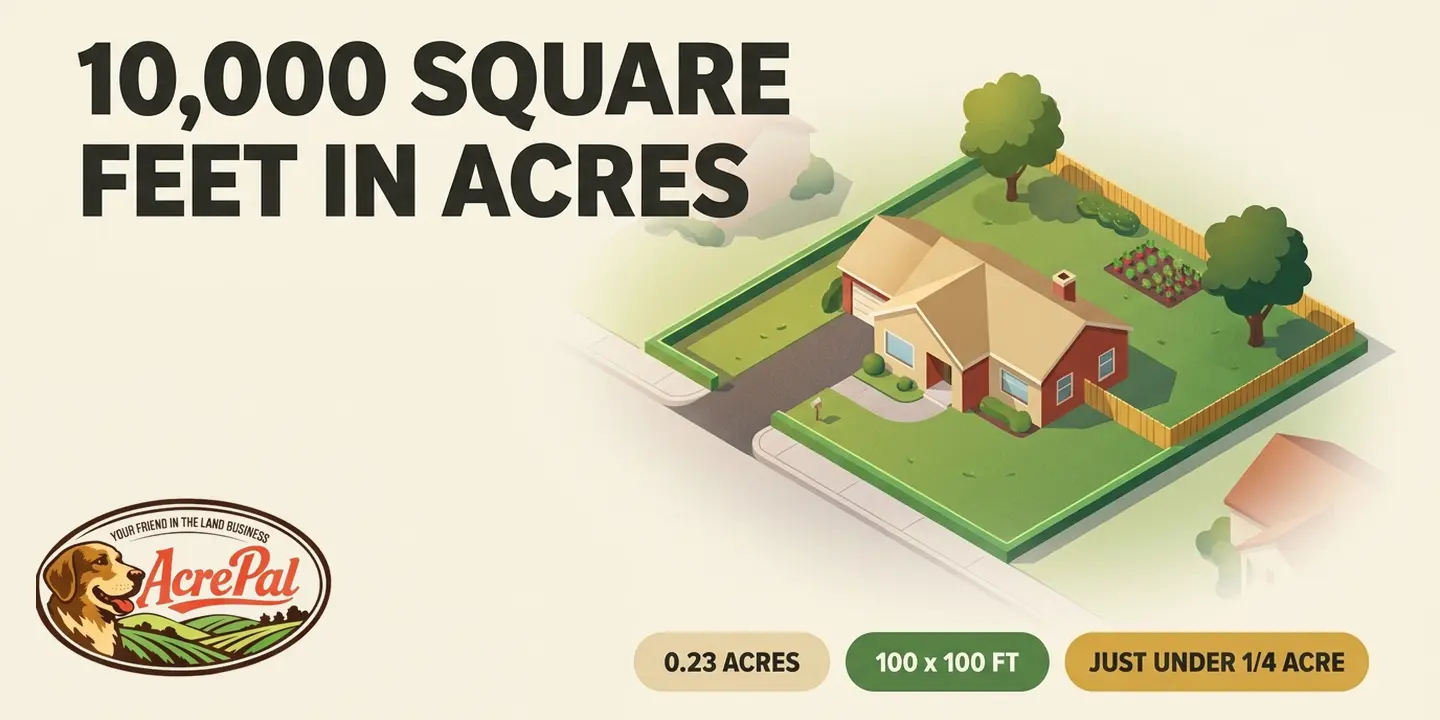
10,000 square feet in acres equals 0.2296 acres, commonly rounded to 0.23 acres, or about 929 square meters for metric readers. Picture a 100 by 100 foot square, just under a quarter acre. Most people typing this are sizing up a lot, not a building, and 0.23 acres lands right around the national median suburban lot of 10,871 square feet. So the short answer is that it is a normal, comfortable suburban parcel, not a big piece of land.
The calculators stop at that number. We keep going, into what 0.23 acres can and cannot actually do, what it looks like on the ground, and how it stacks up against the 1, 2, 5, 10 and 40-acre parcels rural buyers shop. The lot comfortably holds a home and a serious garden, but not a private well and septic, which is the limit that surprises most buyers.
The Exact Conversion Math
The number you can take to a deed office is one clean division. One acre equals 43,560 square feet, the US statutory acre, so 10,000 divided by 43,560 gives you 0.229568 acres. That is the whole calculation, no tricks. The factor never changes, since the statutory acre is fixed at 43,560 square feet regardless of state or county.
Rounding honestly depends on what you need it for.
0.2296 acres, the precise figure for paperwork or a survey
0.23 acres, the everyday number you will see on most listings
0.2 acres, a loose ballpark only
For readers raised on the metric system or working in square yards, the same lot converts cleanly.
About 929 square meters (10,000 multiplied by 0.0929)
About 1,111 square yards (10,000 divided by 9)
One detail trips people up. A true quarter acre is 10,890 square feet, so a 10,000 square foot lot falls 890 square feet short of an honest quarter acre. When a listing calls it a "quarter-acre lot," it is rounding up by almost 900 square feet.
If you are also converting larger parcels, our breakdown of 5 acres in square feet runs the same math at scale. The number is settled, so the better question is what that 0.23 acres actually looks like.
Is 10,000 Square Feet a Big Lot
It feels generous, but the data says it is merely average. A 10,000 sq ft lot sits just below the national median single-family lot of roughly 10,871 square feet, which is almost exactly a quarter acre. So nationally, you are buying a hair under the middle of the pack, not above it.
Lot norms vary a lot by setting, and this helps place 10,000 sq ft on the map.
Standard suburban lots run 7,500 to 10,000 square feet, putting 10,000 at the top of that band
Urban lots run far smaller, often 3,000 to 5,000 square feet
Rural land gets measured in acres, usually 1 acre and up
Zoning reality reframes the picture. Many municipalities use 10,000 square feet not as a generous lot but as the residential minimum, which yields 3 to 4 buildable lots per gross acre. One Washington State RI zoning district allows about 4.3 homes per acre at that 10,000 sq ft minimum. In other words, your "big" lot is often the legal floor, the smallest parcel a builder is allowed to carve out.
There is a reason 10,000 sq ft reads as culturally normal. The quarter acre has anchored US suburban zoning since the post-WWII housing boom, and most setbacks, coverage limits and accessory-structure rules were calibrated around it.
The verdict is plain. It is plenty for a comfortable suburban home, and not big by land or agricultural standards. To make that real, picture it on the ground.
What a 10,000 Square Foot Lot Actually Looks Like
Start with the cleanest mental image, a 100 by 100 foot square. From there, sports fields give you a feel for the scale, and the honest comparisons are smaller than most people guess.
About 17% of a full football field, since a field with end zones covers 57,600 square feet (1.32 acres)
Roughly 2 NBA basketball courts, each one 4,700 square feet
About 3.6 doubles tennis courts, each one 2,808 square feet
That first one surprises people. A 10,000 sq ft lot is less than one-fifth of a football field, noticeably smaller than the instinct suggests. The mansion tours that flood YouTube for this search are measuring 10,000 sq ft of living space, not lot size, which is a different thing entirely.
The square is also misleading, because the same 10,000 square feet comes in very different shapes. A lot can be 100x100, 80x125, 50x200, or a long 40x250 foot strip. Shape drives buildability more than people expect, and a narrow 40x250 ribbon brings frontage and side-setback headaches that a tidy square never has.
Picture a home on it to feel the proportion. A 1,600 sq ft house covers only about 16% of the lot, leaving roughly 84% as open ground, which one agent literally marketed as a "massive 10,000 sq ft backyard." Even a larger 2,500 sq ft footprint still leaves three-quarters of the lot open. That house-to-yard ratio is exactly what decides what you can actually do here.
What You Can and Cannot Do on 0.23 Acres
This is where the glossy listings oversell and the real limits bite. Some uses fit comfortably on 0.23 acres, and a few hard ones simply do not, no matter how the listing is worded.
What a 10,000 sq ft lot handles well.
A standard single-family home with real yard left over, since a 2,500 sq ft house uses about 25% and leaves 7,500 sq ft for driveway, landscaping and play space
A serious year-round food garden, because a proven 1/8-acre plot of 5,445 square feet, under half this lot, has fed a family of six all year
Patios, a shed, a small orchard, and the usual suburban outdoor living
What it generally cannot support.
A private well plus conventional septic, since most jurisdictions require 0.5 to 0.75 acres and the mandatory 100-foot well-to-drainfield setback alone spans the full width of a 100x100 lot
Livestock or grazing, because meaningful agricultural use starts around 1 acre and climbs fast from there
Real privacy, since standard 5-foot side setbacks can put a neighbor's wall as close as 10 to 20 feet away
The septic limit stings most. Real owners on a .39-acre lot, well above 10,000 sq ft, were told it was "too small for a septic tank," which is why a 100x100 lot almost always needs public water and sewer. The binding constraint is usually the leach field rather than the tank, and aerobic or chamber systems can shrink the footprint, though a variance is never guaranteed and you should never assume one before buying.
This utility ceiling is the exact reason buyers who want a well, septic, livestock or privacy stop shopping lots and start shopping acreage, which runs on a completely different pricing unit.
Why Rural Land Is Sold Per Acre and Not Per Square Foot
Once a parcel passes about half an acre, square footage gets clumsy fast. Nobody walks into a deal asking for a "217,800 square foot parcel," they ask for 5 acres. Per-acre pricing standardizes comparison across wildly variable rural sizes, the same reason we price gasoline per gallon and not per ounce.
The bigger reason is how the land market is built. Below roughly $50,000, banks will not write a mortgage and agents will not chase a $600 commission on a $10,000 listing. So a per-acre, owner-financed market grew up to fill that gap, and it is where most affordable cheap rural land actually trades. Zero to $99 down with $39 to $99 monthly payments became the standard structure, less a gimmick than a direct answer to that financing hole.
Converting between the two units is simple. To compare a rural per-acre price against a 10,000 sq ft lot, multiply the per-acre price by 0.23 to get the equivalent slice. Going the other way, divide a suburban lot price by 0.23 to get its implied per-acre rate. Run that second calculation once and the per-acre lens makes suburban land look shockingly expensive, which is exactly where the numbers land next.
How 0.23 Acres Stacks Up Against Real Land Parcels
The whole acreage ladder lines up cleanly when you show each rung in square feet and as a multiple of your 10,000 sq ft lot.
0.23 acres equals 10,000 sq ft, the baseline
0.5 acres equals 21,780 sq ft
1 acre equals 43,560 sq ft, 4.36x your lot
2 acres equals 87,120 sq ft
5 acres equals 217,800 sq ft, 21.8x your lot
10 acres equals 435,600 sq ft
40 acres equals 1,742,400 sq ft, 174x your lot
Price is where the comparison flips. Suburban land runs $20,000 to $100,000 per acre, while raw rural land in Arizona, Nevada and New Mexico runs $2,000 to $5,000 per acre. That is not a small gap, it is an inversion.
Take one example. A suburban 0.23-acre lot priced at a $50,000-per-acre land rate is about $11,500 of dirt, and you get 10,000 square feet for it. A 5-acre rural parcel at $2,000 to $5,000 per acre runs $10,000 to $25,000 total for 21.8x more ground, and a 40-acre parcel can land near the cost of a single suburban lot's land value. A quarter-acre lot in a New Jersey suburb can genuinely cost what a 20-acre New Mexico ranch costs.
That gap is the business we are in. AcrePal sells owner-financed raw rural land from 1 to 40-plus acres across AZ, CO, NV, FL, CA and NM, the exact parcel sizes this ladder points to. Because most of these parcels sit under the bank-mortgage floor, owner financing with a low down payment and monthly installments is simply how they trade, no bank required.
If you want to see the next rungs up, we break down how big 10 acres is and what 2 acres really gets you.
A 10,000 sq ft lot is a fine place to live. But per dollar, it is the most expensive land you will ever buy.
Frequently Asked Questions
How many square feet are in an acre?
One acre equals 43,560 square feet, the US statutory acre. That is the figure behind every square feet to acres conversion. Divide 10,000 by 43,560 and you get 0.229568 acres, which rounds to 0.23 acres for everyday use.
Is 10,000 square feet a lot of land?
For a suburban lot, 10,000 square feet sits at or just below the national median of about 10,871 square feet, so it is normal rather than large. It is not big by rural or agricultural standards. A full acre is 4.36 times larger, and a 5-acre parcel is nearly 22 times bigger.
Can a 10,000 sq ft lot have a septic system?
Rarely. Most US jurisdictions require 0.5 to 0.75 acres for a private well plus conventional septic, and the mandatory 100-foot setback between well and drainfield exceeds the width of a 100x100 lot. Alternative aerobic or chamber systems can shrink the footprint, but variances are not guaranteed, so most 10,000 sq ft lots rely on public sewer.
Can you build a house on a 10,000 sq ft lot?
Yes, in most suburban zoning districts. A 2,000 to 2,500 square foot home fits comfortably and still leaves yard and driveway space. The main catch is utilities, since the lot usually has to connect to public water and sewer rather than a private well and septic.
How does 10,000 sq ft compare to 1 acre?
It is 22.96% of an acre, less than a quarter. A full acre is 43,560 square feet, which is 4.36 times larger than a 10,000 sq ft lot. Step up to 5 acres and you are looking at 21.8 times the ground.
What lot dimensions equal 10,000 square feet?
A 100 by 100 foot square is the most common, but 80x125, 50x200, and 40x250 feet all equal 10,000 square feet too. Shape matters as much as size. A narrow strip can lose buildable area to frontage and setback rules even though the total square footage is identical.
How many square meters is 10,000 square feet?
About 929 square meters. The conversion is 10,000 multiplied by 0.0929, which gives 929 m2. In square yards that same area is roughly 1,111 yd2.
Why is rural land priced per acre but suburban lots in square feet?
Square footage is intuitive for small suburban lots under half an acre, while per-acre pricing standardizes comparison across large, variable rural parcels. There is also a market reason. Below about $50,000, banks will not mortgage land and agents will not chase tiny commissions, so owner-financed, per-acre sales fill that gap.
What can you do with 0.23 acres of rural land?
A rural 0.23-acre parcel can hold a tiny home or cabin where zoning allows, support RV or camping use, grow a large garden, or simply be held for appreciation. What it usually cannot do is carry a private well plus septic without a variance, which limits full-time off-grid living. One New Mexico listing, for example, permits RV use up to 180 days a year.