
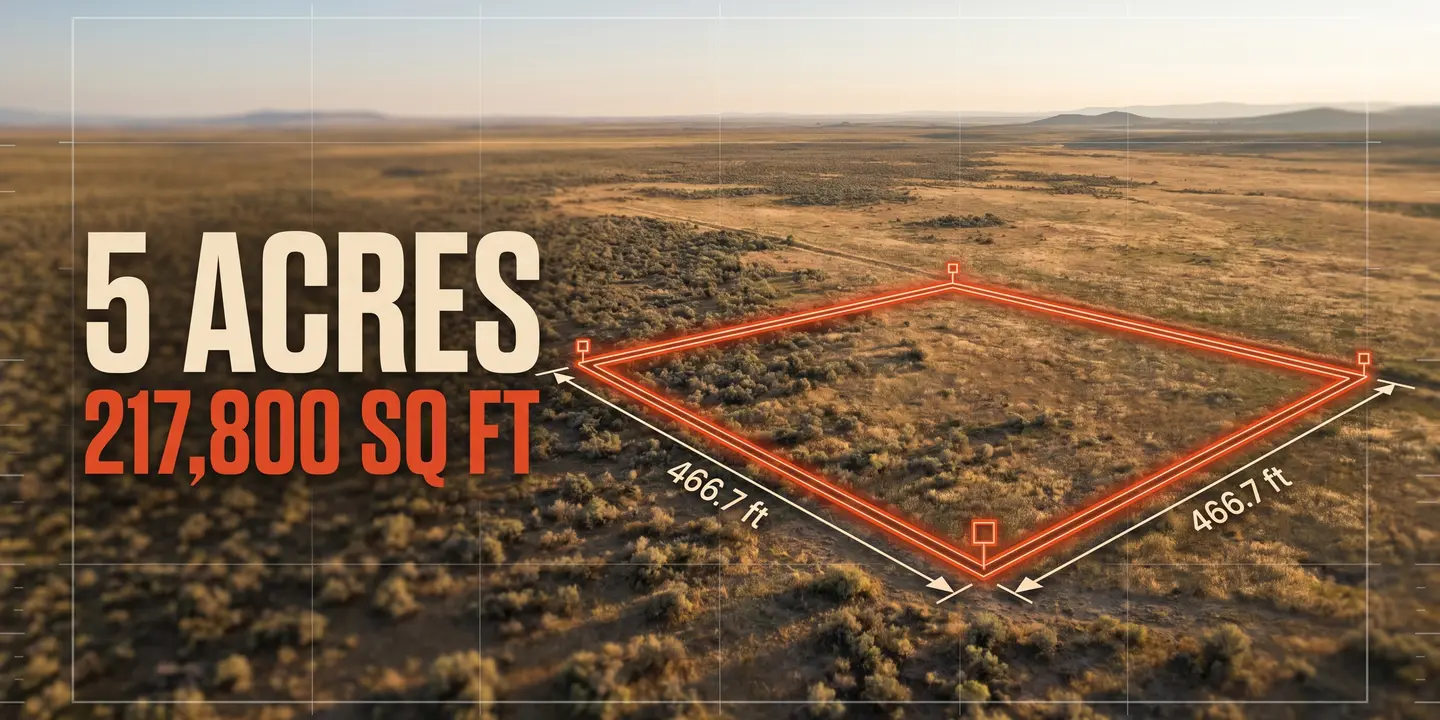
5 acres in square feet is 217,800 square feet exactly. The math is simple: one acre equals 43,560 square feet, so 5 acres is just 43,560 multiplied by 5.
That number alone does not tell you much. A raw square-foot count cannot show you what 5 acres looks like, what shape it takes, or whether you can actually build on it. Most buyers struggle to picture acreage before they buy, and almost everyone underestimates it until they stand on it. A figure on a listing feels abstract until you walk the boundary.
So we will go further. Ahead you will find conversions to other units, real visual comparisons that hold up, exact lot dimensions, how to measure 5 acres yourself, what you can realistically do with it, what it costs, and what to check before you put money down.
How to Convert 5 Acres to Square Feet and Other Units
Here is the formula you can reuse for any parcel: square feet = acres x 43,560. Run it for 5 acres and you get 5 x 43,560 = 217,800 square feet. Plug in any acreage and the same formula works, so a 10-acre lot is 435,600 square feet, a 2.5-acre lot is 108,900, and a 2-acre lot is 87,120, while a 10,000 square foot lot works out to just 0.23 acres.
Why 43,560? The acre comes from old survey units. One acre is 1 furlong long (660 feet) by 1 chain wide (66 feet), and 660 x 66 lands on 43,560. We will save the full backstory for the FAQ.
Once you have square feet, the other units follow. Here is 5 acres across the measurements you are most likely to run into.
Square feet = 217,800 sq ft
Square yards = 24,200 sq yds
Square meters = about 20,234 sq m
Hectares = about 2.023 ha
Square miles = about 0.0078 sq mi (roughly 1/128th of a section of land)
Need to go the other way? Divide square feet by 43,560 to get acres. If a listing says 130,680 square feet, that is exactly 3 acres. Our property pages usually show acreage, and this is how you translate it into terms you can picture.
What Does 5 Acres Look Like? Real Comparisons That Hold Up
The cleanest comparison is a New York City block. Most NYC blocks measure 660 by 330 feet, which is 217,800 square feet, or exactly 5 acres. One city block, one parcel.
Football fields get thrown around a lot, usually wrong. A full field including both end zones is 360 by 160 feet, which is 57,600 square feet, or 1.32 acres. So four football fields come to 5.28 acres, slightly more than 5 acres, not a clean match. Anyone telling you "5 acres is exactly 4 football fields" is rounding loosely.
A few more equivalents, all measured the same careful way:
About 77 doubles tennis courts (78 by 36 feet each)
Roughly 45 to 48 basketball courts
About 780 standard parking spaces
About 96 median US homes at 2,261 square feet each
About 5,160 king-size beds laid flat
Roughly one-third of Yankee Stadium's footprint
Pick whichever picture sticks. If you have ever parked at a big-box store, 5 acres is most of that lot. If you have walked a city block, that is your parcel.
And for fun, you could cover 5 acres with about 1.96 million dollar bills laid flat. That one is useless for buying land, but it sticks in your head.
Comparisons help. They still come up short, because people consistently underestimate 5 acres until they walk the boundary themselves. That is why the next two sections matter more than any stadium analogy.
5 Acre Lot Dimensions and How Shape Changes the Land
A perfect square 5-acre lot measures about 466.7 feet on each side. The perimeter runs 1,867 feet, with a diagonal of 660 feet across the middle. That perimeter is roughly a third of a mile, about a 7-minute walk at a normal pace, which is the trick we lean on in the next section.
Shape is where it gets interesting. A classic rectangular 5-acre parcel of 330 by 660 feet (half a furlong by one furlong) also equals exactly 217,800 square feet. It was a common survey shape because it lined up neatly with the old chain-and-furlong system.
Same 5 acres, very different land. A long, narrow parcel gives you more road frontage but a thinner private interior. A square parcel pushes the buffer to the center, so you can sit farthest from any road or neighbor. An oddly shaped lot can carry the same acreage on paper while leaving far less usable space.
Setbacks shrink it further. Most counties require buildings to sit 15 to 50-plus feet back from property lines, and easements eat into the buildable area too. Even so, a square lot's 466-foot sides dwarf a typical quarter-acre suburban lot at about 100 feet wide, so privacy is rarely the problem.
We list lot dimensions and shape on our parcels so you know what you are actually getting, not just the headline acreage.
How to Measure and Visualize 5 Acres Yourself
You can size up a parcel in five minutes from your couch. Three methods, from quickest to most accurate.
First, measure on a screen. Open Google Maps, right-click your target spot, choose Measure Distance, then click around the boundary and close the shape. Maps was built for distance, so treat the area as a fast estimate.
Second, get more precise with Google Earth Pro. Use the Polygon Tool to trace the boundary, close the shape, and it automatically displays both area and perimeter. You can switch units between square feet, acres, and hectares, and save the measurement for later. Both tools are estimates, not a replacement for a survey.
Third, pace it on the ground. A square 5-acre boundary is 1,867 feet, about a third-of-a-mile loop you can walk in roughly 7 minutes. Nothing beats walking the perimeter for a gut feel of the size.
One honest caveat. Satellite imagery can be outdated in rural areas, and clicking points by hand introduces error. Before you rely on any on-screen measurement, check the corners against the recorded survey and the pins in the ground.
What Can You Do With 5 Acres?
People overestimate what big acreage buys them and underestimate the work it takes. Land is for living and using, so here is what 5 acres realistically supports.
For a homestead, 5 acres is the widely cited sweet spot. Small-farm experts at Possum Ridge Farms put the ideal range at 3 to 5 acres. A quarter-acre intensive garden plus chickens, 2 to 3 goats, and a pig or two can feed a family, with room left for a house, outbuildings, and a buffer. The honest order of priorities is water first, then power, then food and animals. Skip water security and the rest falls apart.
For horses, the old rule is 1 to 2 acres each, but Kentucky land pro Grace Jenkins recommends 2 to 3 acres because horses are selective, destructive grazers that chew one spot to the dirt. A realistic answer is 2 to 3 horses on 5 acres with rotational paddocks. Run a dry lot with supplemental feed (Washington State University suggests a 400-square-foot-per-horse minimum) and you can keep more.
For a house, the median US home is 2,261 square feet. A home, garage, driveway, and a couple of outbuildings use roughly half an acre to an acre, which leaves 4-plus acres for privacy, trees, and recreation.
Then there is camping, hunting, riding, an off-grid retreat, even small-scale subdivision potential in some counties. Land also holds value, which matters to buyers worried about inflation.
Be straight with yourself, though. Five acres is plenty for nearly any goal, but it is real, ongoing maintenance: mowing, brush, fencing, pests.
What to Check Before You Buy 5 Acres
We once saw a 5-acre Kingman, Arizona parcel listed cheap with a quiet line in the description: "no direct legal or physical access." As one land buyer put it, "buying land without a perc test is like buying a car without an engine." First-timers miss exactly these things, so here is the short list.
Legal access. A deeded right-of-way to a public road. Physical access (a dirt track you can drive) is not the same as legal access.
Perc test. A soil drainage test, usually $300 to $1,500, that decides whether you can install a septic system. No pass, no septic permit, no legal build.
Water. An existing well, or budget for drilling at $15 to $50-plus per foot.
Zoning and minimum lot size. Confirm the county allows what you want to do and that the parcel qualifies for a building permit.
Setbacks, floodplain, wetlands, and slope. All of these carve into your buildable area.
Utilities at the road, CC&Rs or HOA rules, a corner survey, and the tax and lien status.
This is where gross acreage and usable acreage split apart. Part of your 5 acres may be unbuildable, so the number on paper is never the whole story.
We tell you straight on every parcel what the access, zoning, and restrictions are, and owner financing keeps the entry payment small. Check the zoning before you fall in love with a view.
How Much Does 5 Acres Cost?
The price swing is enormous. A 5-acre parcel in Kingman, Arizona was listed at $8,900, about $1,780 per acre. A 5-acre parcel in Surrey, British Columbia near Vancouver carried a $2,000,000 asking price. Same acreage, wildly different number.
For a national anchor, USDA data put average US farmland at $4,500 per acre in 2026, up 3.4 percent. That makes an average rural 5-acre parcel worth about $22,500. The Corn Belt runs nearly double that average, while the Mountain region sits at less than half.
Regional examples fill in the picture. Texas averaged more than $5,100 per acre in early 2026, ranging from roughly $1,700 near San Antonio to $7,500 to $15,000 near Dallas. Wisconsin ag land hit $7,238 per acre in 2025, up 70.5 percent since 2020. One real buyer picked up 5 acres near Asheville, North Carolina for $56,000, about $11,200 per acre.
The drivers are simple: access, utilities, distance to town, and improvements. A Kentucky parcel with two move-in homes listed at $238,500. Raw remote land is cheapest, but it can be the hardest to develop or resell.
Land is also a tangible store of value, and farmland has climbed through the 2020s. Owner financing turns a parcel into a monthly payment that fits next to a phone bill, instead of one big cash outlay.
5 Acres in Square Feet, Frequently Asked Questions
How many square feet is 5 acres?
5 acres is 217,800 square feet. The math is 5 multiplied by 43,560 square feet per acre. That figure is exact, not rounded, since the acre itself is a fixed survey unit.
What are the dimensions of a 5-acre lot?
A square 5-acre lot is about 466.7 feet per side, with a perimeter of 1,867 feet. A common rectangular version is 330 by 660 feet. Any shape works as long as the area equals 217,800 square feet.
How many football fields is 5 acres?
About 4 fields, but not exactly. A full football field including end zones is 1.32 acres, so four fields total 5.28 acres, slightly more than 5 acres. Anyone claiming a clean 4-to-1 match is rounding.
Is 5 acres enough to build a house?
Yes, in most rural areas, as long as four boxes are checked: legal road access, a passing perc test, an available water source, and zoning that permits a home. Setback rules also apply to where you place the house.
What is a perc test and why does it matter?
A perc test measures how fast soil drains, which decides whether you can install a septic system. Without a passing result, the county will not issue a septic permit, so no home can be legally built. It costs roughly $300 to $1,500.
How many horses can you keep on 5 acres?
The common rule is 1 to 2 acres per horse, but experts recommend 2 to 3 acres because horses graze hard and selectively. A realistic number is 2 to 3 horses on 5 acres with rotational paddocks and good pasture management.