
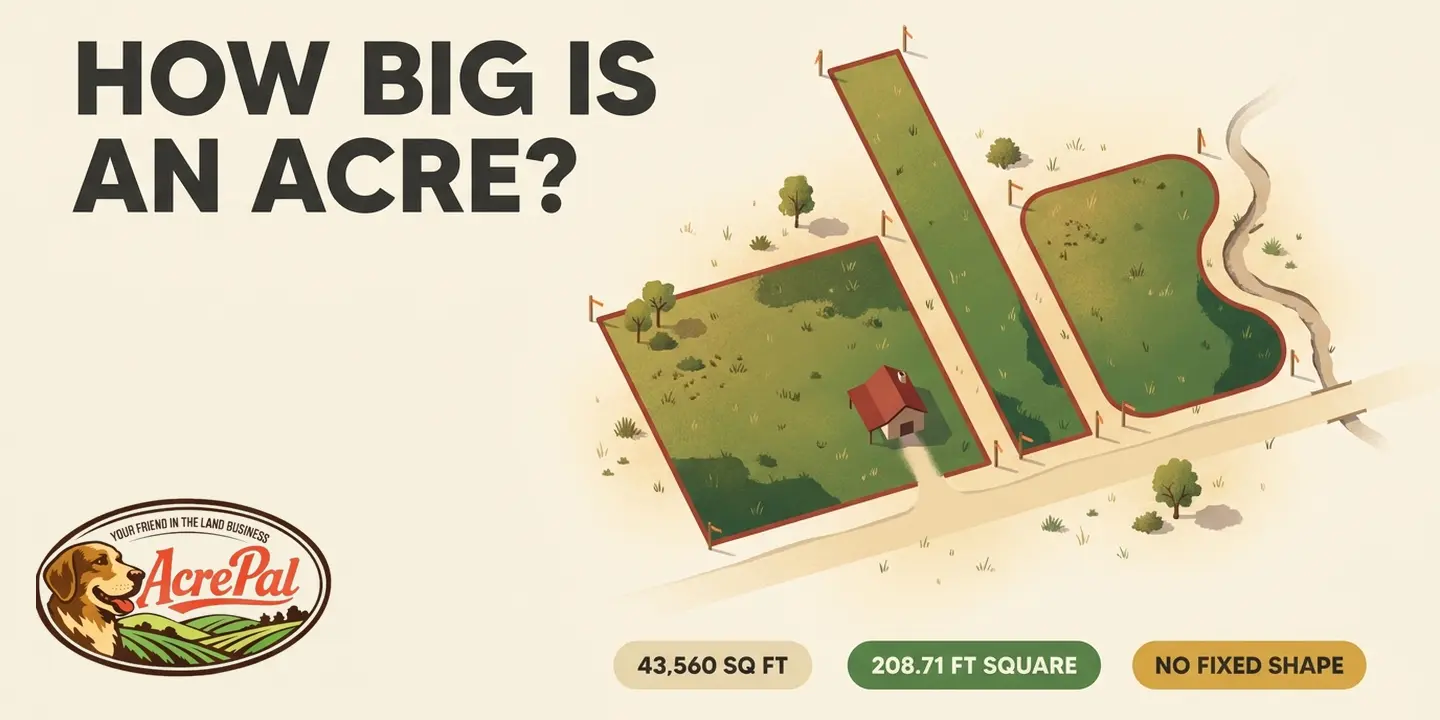
An acre is 43,560 square feet. If that acre happened to be a perfect square, each side would run about 208.7 feet, so how big is an acre has a short answer you can stop reading after.
The federal handbook that governs weights and measures in the United States answers the same question and then adds one more line. An acre "is not necessarily square, or even rectangular." That reads like a technicality. It is not. Two parcels can both hold exactly 43,560 square feet, and one of them can be impossible to build on.
An Acre Is 43,560 Square Feet
- 43,560 square feet, exactly.
- 4,840 square yards. We break that one down in 1 acre in square yards.
- 4,046.8564 square meters, or 0.404686 hectares, which NIST rounds to "0.405 hectare".
- One 640th of a square mile.
- A square acre measures 208.71 feet on a side. That works out to 208 ft 8.52 in, which NIST prints as 208.710 ft and Wikipedia rounds to "208 feet 9 inches". Same number, three levels of precision.
- The diagonal across that square is about 295 feet.

Exactly is not a figure of speech there. NIST Handbook 44, the document that governs weights and measures for legal trade in the United States, lists one acre in its table of area units as "43 560 square feet (exactly)", written with a space where most of us would put a comma. The acre is not measured to 43,560 square feet. It is defined as 43,560 square feet, and it has been for a long time.
The number looks arbitrary because it came out of farming rather than out of a committee. Surveyors worked with a chain of 66 feet and a furlong of 660 feet, and one chain by one furlong is 43,560 square feet. A furlong was a furrow long, the length of a plow run before the team turned. Wikipedia still lists an acre as "66 feet × 660 feet (43,560 square feet)" and as "10 square chains (1 chain = 66 feet = 22 yards = 4 rods = 100 links)".
That is the whole conversion story, and it is the same in every county in the country. If you need to go the other direction and turn a square footage into acreage, 10,000 square feet in acres covers the smaller sizes.
What an Acre Actually Looks Like
Search for a picture of an acre and you will be told it is 75% of a football field, 90% of a football field, slightly smaller than a football field, and 90 yards of one. All four are correct. They are measuring against different fields.
A regulation field including both end zones is 360 feet by 160 feet, which comes to 57,600 square feet, so an acre is 75.62% of it. The playing field alone, end zones excluded, is 300 feet by 160 feet, or 48,000 square feet, and an acre is 90.75% of that. Lay an acre across the full 160-foot width and it runs 90.75 yards of the field's length. The percentages differ because the denominators do.

Nobody on that list is wrong. None of them says which field they mean. One page puts it as "You can think of an acre as about 90% of a football field, 16 tennis courts, or nine basketball courts", another as "An acre is slightly smaller than a football field without the end zones", and those two sentences agree with each other completely once you notice that one counts the end zones and the other does not. The football field became the standard anchor because almost everyone has stood next to one, not because it is a tidy fit.
If you would rather have a walking anchor than a sports one, take the square case. A square acre is 208.71 feet on a side, so walking the boundary all the way around covers a bit over 830 feet. Cut straight across the diagonal instead and you cover about 295 feet. That is the entire parcel, corner to corner, and it is usually smaller than people picture before they stand on one.
An Acre Has No Shape
The best answer sits in a footnote of a federal handbook. NIST Handbook 44, 2018 edition, opens its footnote on the acre with the question people actually ask.
"The question is often asked as to the length of a side of an acre of ground. An acre is a unit of area containing 43 560 square feet. It is not necessarily square, or even rectangular. But, if it is square, then the length of a side is equal to √43560 ft² = 208.710 ft (not exact)."

Everybody writing about acres gets this part right. All six pages we could read say the same thing, and most say it clearly. One answers it in its FAQ with "Yes, an acre can be any shape, as long as the area inside the shape is 43,560 sq ft." Another closes its lesson with "As long as the area is 43,560 square feet, it is an acre!"
Wikipedia states that "As a unit of measure, an acre has no prescribed shape; any area of 43,560 square feet is an acre." Land.com ranks at the top of this search, blocked every route we tried, and has no archived copy, so it is not one of those six.
The agreement stops at the next sentence. One page puts the takeaway like this. "The shape of an acre is not important it is the area of land that makes up the shape that is." Further down, that same page lists "The shape of the land (whether it's easily buildable or not) can also influence its value." Only the first answer gets followed up.
So we measured. Across the six pages we could read, counting every word including navigation and footers, the word setback appears zero times. Not one carries a fencing cost in dollars, and not one names a county or cites a zoning code. The word perimeter turns up three times, and all three mean walking your boundary to work out the acreage.
The shape is free in the sense that nobody charges you for it at closing. It is not free of consequences. Shape decides what a fence around your acre costs, whether your county will let you build on it at all, and how much of the acre is left standing once the setbacks come out.
The Same Acre, Two Very Different Fence Bills
Every parcel in the table below holds exactly 43,560 square feet. The fence around them ranges from 740 feet to more than 1,800.
| Shape, each exactly one acre | Perimeter | vs a square acre |
|---|---|---|
| Circle, radius 117.75 ft | 739.9 ft | -11.4% |
| Square, 208.71 x 208.71 ft | 834.8 ft | 0% |
| 150 x 290.4 ft | 880.8 ft | +5.5% |
| 100 x 435.6 ft | 1,071.2 ft | +28.3% |
| 66 x 660 ft, one chain by one furlong | 1,452.0 ft | +73.9% |
| 50 x 871.2 ft | 1,842.4 ft | +120.7% |

The chain-by-furlong acre needs 1,452 feet of fence. The square acre needs 834.8. That is 617.2 extra feet, 73.9% more fence, for the identical amount of dirt.
There is also a hard floor under that table. No shape on earth encloses one acre in less than 739.9 feet of boundary, and only a perfect circle gets down to it. Every parcel with straight sides and square corners costs more fence than that, always.
Which is why a fence price quoted per acre cannot mean much on a single acre. The home services site homeguide.com says a barbed wire fence "costs $3 to $6 per linear feet installed on average, depending on the property size, wire quality, and number of strands", and the same page also says "Barbed wire costs $2,000 to $2,200 per acre total installed." That page gives the right instruction too. "To calculate how much barbed wire you need for a fence, measure the fence's perimeter and multiply that by the number of strands needed."
Run their own numbers against each other. The shortest possible fence around one acre is 739.9 feet, and at their own low rate of $3 per foot that is $2,220, which already clears the top of their per-acre range. A square acre at the same rate comes to $2,505. No shape of one acre can be fenced for $2,000 at the cheapest rate on the page.
That is not a gotcha, and per-acre pricing is not nonsense. Perimeter grows with the square root of area, so fencing genuinely does get cheaper per acre as the block gets bigger, and that same page notes that "Discount pricing applies for miles of fencing across many acres." The figure is reasonable for a ranch. It is impossible for one acre fenced on its own, which is exactly the situation you are in. Price your fence off the perimeter, never off the acreage.
Your County May Require Your Acre to Be a Certain Width
In two of the counties we sell land in, a parcel can hold a full 43,560 square feet and still fail to be a legal building lot, purely for being too narrow.
Putnam County, Florida publishes a summary of required setbacks and lot sizes through its Planning and Development Services office. Three of its districts, Agriculture, Agriculture Estate and Residential Estate, each carry a minimum lot area of 43,560 square feet and a minimum lot width of 150 feet.
Apache County, Arizona arrives at the same number through a code that has nothing to do with Florida's. Article 4, Section 413 of its zoning ordinance, amended in March 2014, sets RF-1, the Rural Farmstead zone, and RE-1, the Rural Estate zone, at a one-acre minimum lot area and a 150-foot minimum lot width apiece.
Two states, two climates, two unrelated codes, and the same 150 feet. A minimum lot width is a normal feature of zoning, not a quirk of one county that got creative.
An acre is exactly 150 feet wide when it is 290.4 feet deep. Any one-acre parcel deeper than 290.4 feet is narrower than 150 feet and fails, even with all 43,560 square feet present. A square acre passes with 58.7 feet to spare. A 100-foot-wide acre, 435.6 feet deep, is 50 feet short, and the 66-foot-wide chain-by-furlong acre is short by 84 feet.

Two of the pages we read call that last shape the standard. One says "The most common shape for an acre is 1 furlong by 1 chain, or 660 feet by 66 feet." The other says "The most common form for an acre is one furlong by one chain or 660 feet by 66 feet."
Neither sources the claim, and we could not confirm whether it describes parcels on the ground today. That much is certainly the historical definition of the unit. In Putnam and Apache, it is also 84 feet short of the minimum lot width.
One caveat on the Putnam figures. They come from the county's own information sheet, which says as much across the top of the page, "Informational Purposes Only - See the Land Development Code for Specific Requirements". We read that sheet, not Putnam's Land Development Code itself, because the site hosting the code served us a page with no code text on it. Call the zoning office and confirm the numbers for your specific district before you count on them.
What the Setbacks Leave You to Build On
You are picturing a whole acre to build on. You do not get a whole acre.
A setback is how far a structure must sit back from your property line, and your county sets the number. Four counties, all of them with a one-acre minimum lot, set it very differently.
| County and zone | Front | Side | Rear |
|---|---|---|---|
| Mohave County, Arizona, A-R (Section 35) | 15 ft | 5 ft | 15 ft |
| Costilla County, Colorado, Estate Residential (Article 5, Section 5.10) | 20 ft | 5 ft | 25 ft |
| Apache County, Arizona, RF-1 (Section 413) | 20 ft | 20 ft | 30 ft |
| Putnam County, Florida, AE and RE (information sheet) | 40 ft | 20 ft | 20 ft |
Side setbacks alone run from 5 feet to 20 feet there, which on a narrow parcel decides whether a house fits. Subtract them and the rest is the buildable envelope, in square feet and as a share of the acre.
| One-acre parcel | Mohave A-R | Costilla Estate Res | Apache RF-1 | Putnam AE and RE |
|---|---|---|---|---|
| Square, 208.71 x 208.71 | 35,512 (81.5%) | 32,531 (74.7%) | 26,776 (61.5%) | 25,089 (57.6%) |
| 150 wide x 290.4 deep | 36,456 (83.7%) | 34,356 (78.9%) | 26,444 (60.7%) | 25,344 (58.2%) |
| 66 wide x 660 deep | 35,280 (81.0%) | 34,440 (79.1%) | 15,860 (36.4%) | 15,600 (35.8%) |
| 660 wide x 66 deep | 23,400 (53.7%) | 13,650 (31.3%) | 9,920 (22.8%) | 3,720 (8.5%) |

Look at the bottom row. A 660-foot-wide, 66-foot-deep parcel is a full acre and clears Putnam's 150-foot width minimum. Then Putnam's 40-foot front and 20-foot rear setbacks take 60 feet out of a 66-foot depth, leaving 6 feet to build in. Costilla Estate Residential leaves 21 feet, Mohave A-R 36.
The chain-by-furlong acre fails in Putnam both ways, 84 feet too narrow stood on end and six feet deep laid flat.
Coverage caps add a second ceiling, and the shape decides which ceiling binds. Apache RF-1 caps lot coverage at 15%, or 6,534 square feet on a full acre, well under the 26,776 the setbacks leave on a square acre there. Putnam's A, AE and RE districts cap it at 35%, or 15,246 square feet.
So on a normally shaped acre the cap is what stops you, not the setbacks. Distort the shape and the setbacks overtake it, which is how that 660-foot-wide Putnam parcel ends up at 3,720 square feet of envelope with its coverage cap left irrelevant.
None of those numbers is a house. They are envelopes, the outer boundary of where a structure may sit, and the real building area shrinks once a well, septic drainfield and driveway take their share. What a well and septic installation costs covers that.
One note on the Costilla figures. The county's own website returned an error, so the copy we read is the 2015 revision of the Land Use Code on a third-party mirror. It is legible and internally consistent, but not county-hosted, and it may not be the current revision. Confirm it with the county, as with Putnam.
What This Looks Like When It Goes Wrong
A buyer posting in r/land had waited four years for one piece of land, 1.91 acres, listed at $129,900. Then the town inspector looked at it. In their words, "In our town you need 200ft of road frontage to build." The parcel did not have it. "Apparently not building as it sits according to the town inspector, since it only has 20ft or so of road frontage."
This is a town rule rather than a county ordinance, and the poster is a prospective buyer rather than the owner, so nothing has been lost yet. They put the number closer to $70,000 than $129,900 if the lot cannot be built on. The acreage never changed, the frontage was the whole story.
A different owner, posting in r/RealEstate, describes their parcel this way. "We own a very oddly shaped 1 acre of land, long and narrow that has one border that is curved." A new neighbor wanted a power line easement run across that acre rather than the larger parcel next door, and the poster says the neighbors "wanted new line over our land because it was cheaper." That thread is a live dispute and we are not taking a side. The acre came up because it is long and narrow.
A third owner, with 2.5 acres, mentions in passing that "My house was cheaper than the average because of the location and odd shaped flag lot". A flag lot is a narrow strip of frontage running back to the bulk of the land, shaped like a flag on a pole. The acreage matched the neighbors. The price did not.
Three posts are three posts. We went looking for buyers who ran into shape rather than acreage, and this is what we found, which is not a trend. Two of the three are suburban or exurban owners where the shape detail is real but is not the headline. What they show is that frontage and outline carry consequences a listing's acreage will never warn you about.
How to Check an Acre Before You Buy It
Four checks, one afternoon and a couple of phone calls.
- Get the dimensions, not just the acreage. A listing that says one acre gives you the area and nothing about the shape. The plat or the survey carries the frontage and the depth, the two numbers everything above turns on. If you have never read one, what a plat map is covers the basics.
- Ask the county for three numbers for your specific zoning district. Minimum lot width, the setbacks, and the maximum lot coverage. Laid against your dimensions, they tell you what fits and whether it is a legal building lot at all.
- Measure the perimeter before you price a fence. Fence is sold by the foot, and acreage does not tell you the footage. If all you have is a written description of the boundaries, how to calculate acres gets you there.
- Confirm road frontage separately. Frontage minimums are often a separate rule from lot width, in a different part of the code. Frontage is what stopped the buyer above with nearly two acres in hand.
On price, the honest answer is that it swings by state, county and distance from a paved road, and no article can quote a number that means anything on your parcel. What an acre actually costs works through the state-by-state ranges. We sell rural land with owner financing at AcrePal, so read that as a disclosure rather than a recommendation.
Shape does not change the acreage you pay for. It changes what that acreage costs you to use, and that never shows up in a price per acre.
The acreage is the easy part. It is 43,560 square feet in Florida, Arizona, Colorado and everywhere else, and it has not moved in centuries. The shape is different on every parcel, and it is the part worth an afternoon.
FAQ
What are the dimensions of an acre?
An acre has no fixed dimensions. Any shape enclosing 43,560 square feet is an acre, including circles, triangles and long thin rectangles. If the parcel happens to be square, each side runs 208.71 feet, which NIST prints as 208.710 ft and Wikipedia rounds to "208 feet 9 inches". Every other pair of dimensions that multiplies out to 43,560 square feet is just as much an acre.
What is the perimeter of an acre?
There is no single perimeter, because it depends entirely on the shape. A circular acre has the shortest boundary possible at 739.9 feet, and a square acre runs 834.8 feet. A 66 by 660 foot acre runs 1,452 feet, which is 73.9% more fence around exactly the same amount of land. Nothing encloses one acre in less than 739.9 feet.
What is the length and width of an acre?
Any length and width that multiply out to 43,560 square feet. A square acre is 208.71 feet by 208.71 feet. The historical chain-by-furlong acre is 66 feet by 660 feet. An acre that is 150 feet wide runs 290.4 feet deep, and one that is 100 feet wide runs 435.6 feet deep. All of them are a full acre, and they behave very differently under a county's rules.
How many square feet are in an acre?
43,560 square feet, exactly. That is a definition rather than a measurement, which is why NIST's table of area units prints one acre as "43 560 square feet (exactly)". The odd-looking figure comes from one chain by one furlong, or 66 feet by 660 feet. Working the other direction, 10,000 square feet in acres handles the smaller conversions.
Is an acre bigger than a football field?
No, an acre is smaller than a football field whichever way you measure it. Against a full regulation field including both end zones, 360 feet by 160 feet, an acre is 75.62% of the area. Against the playing field alone with the end zones left out, 300 feet by 160 feet, an acre is 90.75%. Both percentages are correct, they just use different fields.
What is a commercial acre?
A commercial acre is 36,000 square feet, about 82.6% of a survey acre. Unlike the acre itself, no standards body defines it. It is a trade convention used in commercial and subdivision development, where land given over to streets, sidewalks and alleys comes off the top before the usable area is counted. If a listing quotes commercial acres, you are getting noticeably less ground than the word acre normally implies.
Can a one-acre lot be too narrow to build on?
Yes, and it fails on paper long before it fails on the ground. Putnam County in Florida and Apache County in Arizona both require 150 feet of minimum lot width in their one-acre residential districts, so a full acre running deeper than 290.4 feet is too narrow to qualify. Ask your county zoning office for the minimum lot width in your district.